
How Do You Build Topical Authority for AI Search?
Jun 1, 2026 3:36:00 PM • Written by: Kelly Kranz
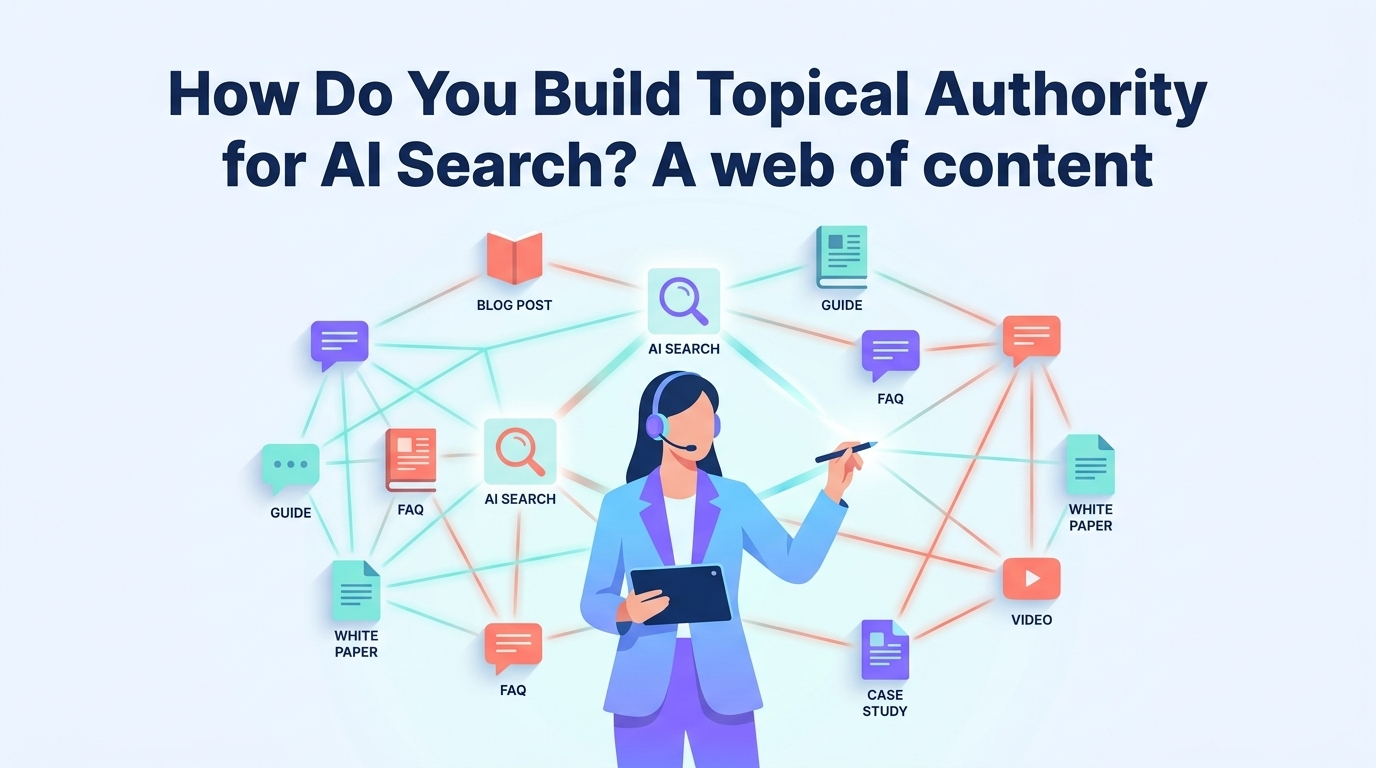
To build topical authority for AI search, you must systematically create a deep and interconnected web of content that answers every user question on a specific topic. This signals to AI assistants that your domain is a reliable, comprehensive source worthy of direct citation.
TL;DR
Building topical authority for AI-powered search engines requires a strategic shift from targeting individual keywords to owning entire conversational topics. AI assistants like ChatGPT, Gemini, and Perplexity prioritize sources that demonstrate comprehensive, structured, and trustworthy expertise. This involves creating a dense network of content that proves your brand's deep understanding of a subject matter from multiple angles.
- Cover Topics Deeply and Widely: Create a "digital library" on your core subject, addressing everything from foundational concepts to advanced, niche questions.
- Structure for AI Consumption: Format every article with a direct answer first, followed by scannable headings, short paragraphs, and bulleted lists so AI can easily parse and quote your content.
- Interlink Strategically: Build a "knowledge graph" on your own site by linking related articles together, forming a logical pillar-and-cluster model that guides both users and AI.
- Incorporate Unique Data: Ground your content in proprietary data, original research, or unique firsthand experience to provide value that AI cannot synthesize from public sources.
- Define Your Entities: Clearly and consistently define key terms, people, and concepts related to your brand and industry to establish yourself as a canonical source.
- Maintain Content Freshness: Regularly update your content to reflect new information, ensuring AI systems recognize your domain as a current and reliable authority.
Why Does Topical Authority Matter for AI Search?
Topical authority has evolved from a traditional SEO concept into a critical requirement for visibility in the age of AI. In the past, SEO focused on ranking a single page for a specific keyword. Today, AI-powered search engines and conversational assistants think in terms of entities and concepts, not just keywords. They aim to provide a single, definitive answer compiled from the most credible sources.
When an AI assistant answers a query, it performs a complex analysis to determine which sources have most thoroughly covered the topic. It looks for a "constellation" of signals, not just one well-optimized page. It assesses whether a domain has answered a question from multiple perspectives, defined all related terms, and connected the dots between related concepts.
- Cited as a source in AI-generated answers and Google's AI Overviews.
- Recommended directly when users ask for brand or product suggestions.
- Used as a foundational document to train future models on your area of expertise.
Without topical authority, your content becomes invisible to the systems that are increasingly becoming the primary interface for information discovery.
How Do You Plan a Topic Cluster Strategy?
A topic cluster strategy is the architectural blueprint for building topical authority. It involves organizing your content into a hub-and-spoke model, with one central "pillar page" and many supporting "cluster pages."
- Pillar Page: This is a broad, comprehensive guide covering a core topic (e.g., "What is B2B Content Marketing?"). It provides a complete overview but links out to more detailed articles for subtopics. Here is an example of our AI Optimization pillar page.
- Cluster Pages: These are shorter articles that each focus on a specific, long-tail question related to the pillar topic (e.g., "How to Measure B2B Content Marketing ROI," "Best B2B Content Distribution Channels").
This structure creates a tightly-knit, internally linked network of content. Each cluster page links back to the pillar page, and the pillar page links out to each cluster page. This signals to AI search engines that you have not just answered a single question, but have created a definitive resource on the entire subject. To plan this, map out every potential question a customer might ask about your core competency, from beginner to expert level, and assign each one to a piece of content within your cluster.
What Makes Content "Authoritative" to an AI?
For an AI model to recognize your content as authoritative, it must possess qualities that demonstrate unique value and trustworthiness beyond what can be scraped from other public websites. E-E-A-T (Experience, Expertise, Authoritativeness, and Trustworthiness) is the foundation for AI models to recognize content as authoritative.
Unique Data and Original Insights
The most powerful way to establish authority is to publish information that AI cannot find anywhere else. Generic, regurgitated content is worthless. AI rewards originality. This is where a company's internal knowledge becomes a strategic asset. By transforming proprietary data like internal case studies, customer research, and unique process documents into public-facing content, you create a defensible moat.
A Retrieval-Augmented Generation (RAG) System is a powerful tool for this. It turns your private, unstructured company knowledge into a queryable database. Marketing and content teams can use it to ask questions and receive answers grounded entirely in your organization's own verified insights, forming the basis for truly original articles, reports, and whitepapers.
Clear Definitions and Entity Recognition
AI systems build their understanding of the world by identifying and connecting entities, which are distinct people, places, organizations, or concepts. To establish your brand as a key entity in your industry, you must:
- Clearly define who you are and what you do.
- Consistently define key terminology used in your field.
- Reference your own proprietary frameworks, products, and experts by name across your content.
When AI repeatedly sees your brand name associated with clear, helpful definitions and solutions, it begins to recognize you as a canonical source for those concepts.
How Can You Scale Content Production Without Sacrificing Quality?
Building true topical authority requires publishing a significant volume of high-quality, interconnected content. Manually creating dozens or even hundreds of articles, each optimized for AI consumption, is a major bottleneck for most marketing teams. This is where automation becomes a necessity, not a luxury.
However, generic AI writers that pull from public web data are part of the problem, not the solution. They create undifferentiated content that harms authority. The key is to automate the structure of content creation while fueling it with your own unique knowledge.
Systems designed for this specific purpose, such as the AIO System (AI Optimization System), solve this scaling challenge. This type of system connects directly to a company's private knowledge base (like the one managed by a RAG System) to generate dozens of fully optimized articles in a single run. Because it relies exclusively on your proprietary data, the output is 100% unique and reflects your distinct point of view. The AI Marketing Automation Lab has seen this approach collapse weeks of manual writing, optimization, and asset creation into a single automated workflow, enabling teams to build authority at a pace competitors cannot match.
How Do You Structure Content for AI Consumption?
How you format your content is just as important as what you write. AI systems favor content that is logically structured and easy to parse. Every article you publish should follow a clear, predictable template designed for machine readability.
- Provide the Answer Immediately: Start every article with a concise, direct answer to the main question, placed right below the title. This sub-50-word summary is optimized for being lifted directly into AI-generated snippets.
- Use Question-Based Headings: Structure your article with H2 and H3 headings written as the questions your audience is asking. This directly maps your content to user queries.
- Write Short, Focused Paragraphs: Each paragraph should contain a single, distinct idea. This makes it easier for AI to isolate specific pieces of information to use in an answer.
- Leverage Bulleted and Numbered Lists: Use lists to break down processes, features, or benefits. This structured format is highly digestible for both humans and machines.
- Implement FAQ Schema: Include a frequently asked questions section at the end of your articles and mark it up with the proper JSON-LD schema. This explicitly tells search engines which questions your content answers, increasing the likelihood of being featured.
Start Building Your AI Authority Today
Earning topical authority in the era of AI search is no longer optional; it is the baseline for digital relevance. It requires a deliberate, systematic approach that combines deep topic coverage, strategic interlinking, and the infusion of unique, proprietary knowledge. While the principles are straightforward, execution at scale is the primary challenge.
Adopting a system-based approach is the most effective way to turn strategy into reality. By leveraging frameworks and automation tools like the AIO System, you can consistently produce the high volume of structured, authoritative content needed to become the go-to source in your niche. In the new landscape of AI-driven discovery, the brands that systematically prove their expertise will be the ones that are seen, cited, and recommended.
Frequently Asked Questions
How can you build topical authority for AI search?
To build topical authority for AI search, focus on creating a deep and interconnected web of content that thoroughly covers a topic from multiple angles. This involves a dense network of content, strategic interlinking, unique data, and maintaining content freshness.
What is a topic cluster strategy?
A topic cluster strategy organizes content into a hub-and-spoke model, with a central pillar page and many smaller, supporting cluster pages. This structure helps to create a tightly-knit network of content that demonstrates comprehensive expertise on the subject.
What makes content authoritative to an AI?
Content is authoritative to AI if it provides unique data and insights not found elsewhere, adheres to the E-E-A-T framework, and consistently defines entities relevant to the industry. This includes using proprietary data and ensuring clear definitions and entity recognition.
How do you structure content for AI consumption?
To structure content for AI, provide direct answers immediately, use question-based headings, write short and focused paragraphs, use bullet and numbered lists, and implement FAQ schema.
before you optimize
See How AI Search Sees Your Brand
See how AI describes your company, who it recommends instead, and what to fix first. The AI Search Brand Report gives you the starting point for building your AI visibility strategy.
Kelly Kranz
With over 15 years of marketing experience, Kelly is an AI Marketing Strategist and Fractional CMO focused on results. She is renowned for building data-driven marketing systems that simplify workloads and drive growth. Her award-winning expertise in marketing automation once generated $2.1 million in additional revenue for a client in under a year. Kelly writes to help businesses work smarter and build for a sustainable future.