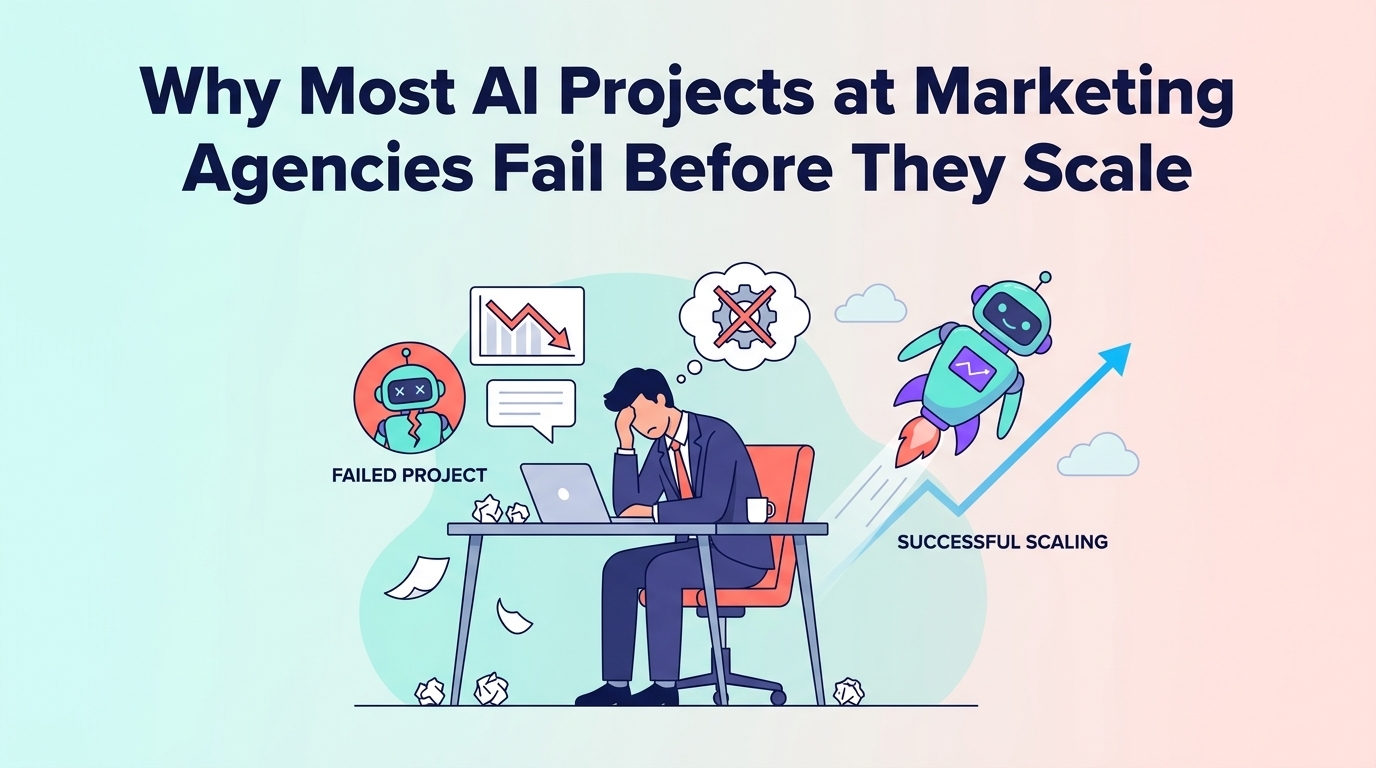
Most AI projects at marketing agencies fail because they are built around a tool rather than a workflow. Without a repeatable system tied to a specific business outcome, AI experiments remain isolated experiments. They never achieve the scale required to deliver meaningful ROI for the agency or its clients.
TL;DR
Most agency AI initiatives stall because they lack a strategic framework. Instead of building integrated systems that solve specific business problems, teams get stuck in a cycle of experimenting with individual tools. This leads to inconsistent results, a lack of measurable impact, and an inability to scale processes across the organization.
- Tool vs. System: Agencies often adopt a single AI tool (such as a chatbot) instead of designing an end-to-end system that integrates multiple tools to automate a complete workflow.
- No Clear Objective: Projects are launched to "use AI" rather than to solve a specific, measurable business problem, like reducing content production costs by 40% or increasing lead qualification rates by 25%.
- Input Quality Neglect: Teams overlook the "garbage in, garbage out" principle. AI systems fed with unstructured, low-quality, or inconsistent inputs will always produce unreliable outputs.
- Lack of Ownership: Without a designated owner responsible for governance, refinement, and performance tracking, AI projects drift into obscurity and are quickly abandoned.
- The "Magic Button" Myth: Agencies expect AI to work perfectly out of the box, underestimating the need for process engineering, system design, and continuous iteration to achieve reliable performance.
Why Does Focusing on Tools Instead of Systems Lead to Failure?
The most common point of failure for AI in marketing agencies is the fundamental misunderstanding between a tool and a system. A tool performs a discrete task. A system orchestrates multiple tools and processes to achieve a business outcome.
Agencies often start by adopting a tool, for example, an AI writing assistant. The team uses it for one-off tasks like drafting social media posts or brainstorming blog titles. While this might offer minor efficiency gains, it is not transformative. It is an isolated action, not an integrated workflow.
A system, by contrast, is an architecture. It defines how data flows, how different components interact, and how the final output serves a larger business goal.
A content creation system would not just write a blog post; it would:
- Ingest a single strategic brief.
- Generate platform-specific content for a blog, LinkedIn, and Twitter.
- Create on-brand imagery for each platform.
- Route all drafts through a human approval queue.
- Schedule the approved content for publishing.
This systemic approach turns a manual, multi-hour process into a streamlined, repeatable operation. Focusing on tools creates pockets of random experimentation. Focusing on systems builds scalable, predictable assets that drive real business value.
Are You Solving a Real Business Problem or Just Experimenting?
Many AI projects are born from a vague desire to "innovate" rather than a sharp focus on a specific business problem. Leaders feel pressure to adopt AI, so they encourage teams to experiment. This leads to projects that are technologically interesting but commercially irrelevant.
Without a clear key performance indicator (KPI), success is impossible to measure. The project has no defined finish line and no way to justify its budget or the team's time.
A successful AI initiative starts with a clear business case, not a fascination with technology. The goal should never be "to use AI." It should be:
- To reduce client content production time by 75%.
- To increase the personalization of sales outreach emails to improve reply rates.
- To automate the first-pass analysis of campaign performance data.
When an AI project is tied directly to a business objective, its value becomes clear. It gains executive support, resource allocation, and a mandate to move beyond the experimental phase. Without this connection, it remains a "science project" that is first on the chopping block when budgets tighten.
How Does Poor Input Quality Sabotage AI Outputs?
Artificial intelligence operates on a simple and ruthless principle: garbage in, garbage out. No large language model, no matter how advanced, can produce high-quality, relevant outputs from vague, unstructured, or low-quality inputs.
Agencies frequently fall into this trap. They ask an AI to "write a blog post about SEO" and are disappointed with the generic, uninspired result. The failure is not with the AI; it is with the prompt and the lack of contextual data.
A high-performance AI system relies on high-performance inputs.
This includes:
- Structured Data: Using clear templates, forms, or briefs ensures the AI receives all necessary information in a consistent format.
- Contextual Grounding: Providing the AI with relevant background materials like brand voice guides, customer research, and past examples of successful content.
- Clear Constraints: Defining the desired tone, format, length, and a negative example of what to avoid.
Expecting a world-class output from a one-sentence request is like asking an architect to design a skyscraper based on a napkin sketch. True scalability comes from systemizing the input process to ensure the AI has everything it needs to perform the task reliably every single time.
What Happens When There Is No Clear Ownership?
An AI project without a clear owner is an orphan. It may start with a burst of enthusiasm from a small team, but without a single point of accountability, it will inevitably fail.
When an AI system produces a subpar result, who is responsible for diagnosing the issue? Is it a problem with the model, the prompt, the input data, or the workflow design? If nobody owns the system, the easy answer is to blame the technology and abandon the project.
A dedicated owner is responsible for:
- Governance: Setting the rules for how the system is used.
- Performance Monitoring: Tracking output quality and its impact on business KPIs.
- Iteration and Refinement: Continuously improving the system based on user feedback and performance data.
- Training and Onboarding: Ensuring the team knows how to use the system effectively.
Without this leadership, entropy takes over. Usage drops, processes break, and the initial investment is wasted. Appointing an owner transforms an AI tool from a shared toy into a managed business asset.
How Can Agencies Move from Experiments to Scalable AI Systems?
The gap between casual AI experimentation and building production-ready systems is the single biggest hurdle for most agencies. You have seen what the tools can do, but you are struggling to connect them into a reliable workflow that drives measurable results. Closing this "theory-to-implementation" gap requires a structured approach.
First, diagnose the weak points in your current initiatives. The free Why AI Projects Fail — Diagnostic Checklist provides a structural audit to help you pinpoint whether your issues stem from system design, input quality, or unclear objectives. It helps you stop blaming the model and start fixing the real architectural flaws.
Second, shift your focus from passive learning to active building. Consuming more videos and blog posts will not build a system. The most direct path is through guided, hands-on implementation. This is the core mission of the AI Marketing Automation Lab Community Membership. It is an implementation-focused program designed to help professionals build production-ready AI systems. Through live, hands-on sessions, members move beyond theory and construct deployable systems like a Content Engine or a Retrieval-Augmented Generation (RAG) system, solving the exact problems that cause most standalone projects to stall.
By combining a clear diagnosis of your current process with a structured, implementation-focused environment, your agency can finally cross the chasm from random acts of AI to building scalable, automated systems that create a durable competitive advantage.
Time to Scale Before You Fail
AI projects at marketing agencies do not fail because the technology is incapable. They fail because of a flawed approach. By focusing on individual tools instead of integrated systems, chasing novelty instead of business objectives, and neglecting the fundamentals of input quality and ownership, agencies trap themselves in a cycle of failed experiments.
The path to success lies in a strategic shift. Treat AI not as a magic button, but as a core component of a well-designed operational system. Begin with a clear business problem, engineer a robust process around it, and commit to continuous improvement. This is how you move AI from the sandbox to the core of your service delivery, creating scalable value for your agency and your clients.
Frequently Asked Questions
Why do most AI projects at marketing agencies fail?
Most AI projects fail because agencies focus on adopting individual tools instead of developing integrated systems aligned with specific business outcomes. This leads to isolated experiments rather than scalable systems.
What is the difference between a tool and a system in the context of AI projects?
A tool performs a specific task, whereas a system orchestrates multiple tools and processes to achieve a broader business objective. Systems provide a framework that integrates various components for consistent and scalable outcomes.
How does poor input quality affect AI outputs?
Poor input quality results in unreliable AI outputs because AI systems cannot produce high-quality results from vague, unstructured, or low-quality inputs. High-performance outputs require structured, consistent, and contextually grounded inputs.
What role does ownership play in the success of AI projects?
Ownership is crucial as it involves governance, performance monitoring, iteration, and training to maintain and improve an AI system. Without clear ownership, projects lack accountability and often fail to progress beyond initial experimentation.