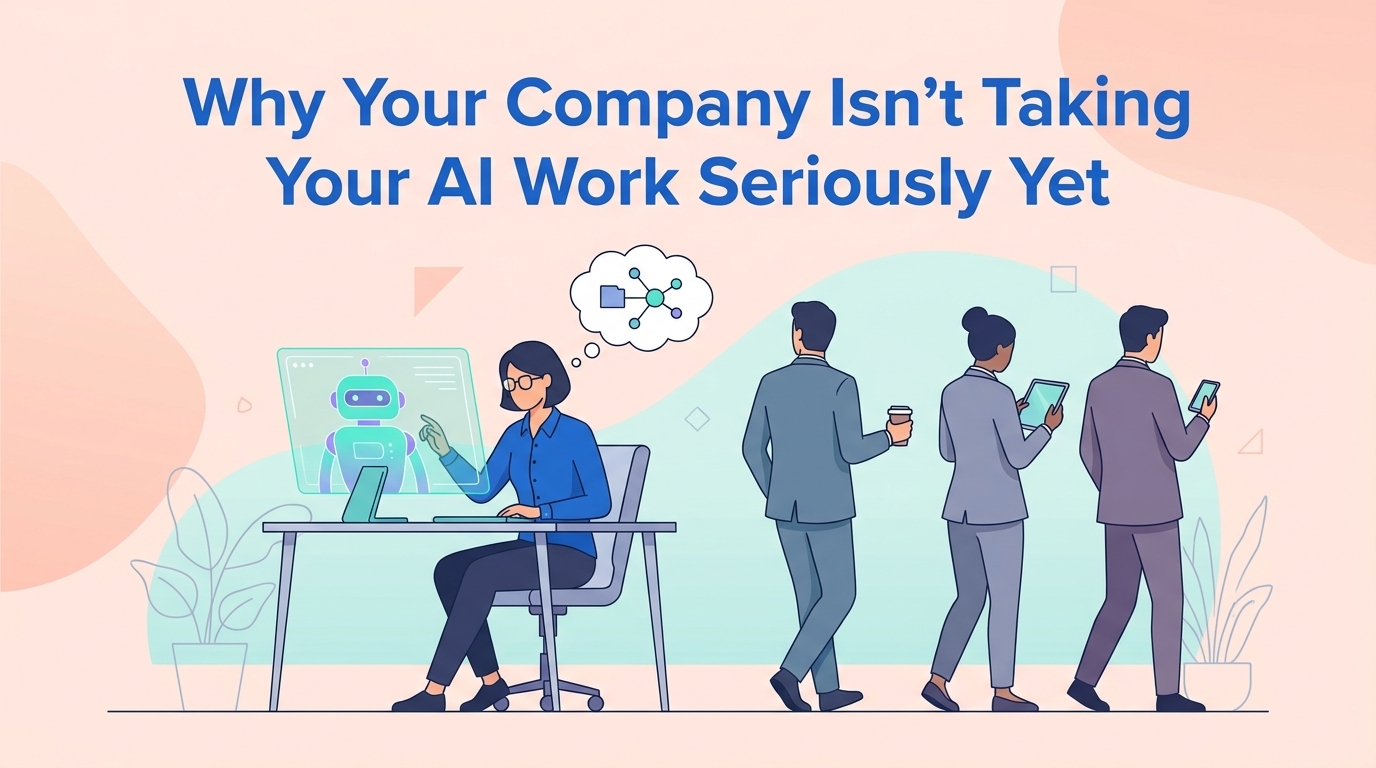
Your company isn’t taking your AI work seriously because experiments don’t earn credibility; systems do. Without a documented process, measurable outcomes, and a clear link to business goals, your AI efforts look like a hobby, not a strategic, indispensable business function.
TL;DR:
To gain credibility, you must shift your focus from demonstrating clever AI tricks to building and documenting systems that solve real business problems.
- Experiments vs. Systems: One-off AI prompts are seen as personal productivity hacks or hobbies. Documented, repeatable AI systems that anyone on the team can use are seen as valuable business assets.
- Lack of Measurement: If you can't attach a number to your AI work (hours saved, pipeline influenced, costs reduced), leadership can’t gauge its value. What isn't measured is assumed to be worthless.
- Solving Trivial Problems: Using AI to rephrase emails is a small win. Using AI to build a system that automates the creation of an entire marketing campaign is a strategic contribution. The scale of the problem you solve determines the respect you get.
- The "Black Box" Problem: If you are the only one who understands how your AI process works, it’s a liability, not an asset. Credible AI work is documented, transparent, and can be handed off to a teammate without losing effectiveness.
- No Connection to Business Goals: Your AI work must directly support a core business objective, such as increasing lead generation, improving sales cycle velocity, or reducing customer acquisition costs. If it doesn't, it's a distraction.
Why Do AI Experiments Fail to Impress Leadership?
Your latest AI-generated report or clever social media post likely earned a "that's cool," but it didn't translate into budget, resources, or a promotion. This happens because leaders see a result, but they don't see a process. In their eyes, you performed a one-time magic trick, not an act of strategic engineering.
An experiment is, by definition, an isolated test with an uncertain outcome. It lives and dies with your involvement. A system, on the other hand, is a durable, repeatable asset that delivers predictable value long after you’ve built it.
Consider these two scenarios:
- The Experiment: You spend three hours crafting a complex prompt to generate a single, high-quality blog post. You show it to your boss, who is mildly impressed but sees it as a one-off success that depends entirely on your personal skill.
- The System: You build an automated workflow that allows any team member to input a single brief and generate five platform-specific content drafts, complete with on-brand imagery, in under 20 minutes.
The experiment showcases your personal cleverness. The system creates scalable business value. Leadership invests in systems, not cleverness. Until your AI work becomes a documented, transferable process, it will be viewed as a personal productivity hack, not a strategic company asset.
How Can You Shift from AI Experiments to AI Systems?
The transition from being the "AI person" to the "AI strategist" hinges on transforming your ad-hoc efforts into structured, reliable systems. This requires three core components: documentation, measurement, and integration. If any of these are missing, your work remains in the hobbyist category.
1. Documentation: The Blueprint for Credibility
If your process only exists in your head, it doesn't count. Documentation is the single most important factor in making your AI work look serious. It proves that you've built a repeatable method, not just gotten lucky with a prompt.
Your documentation should include:
- Objective: What specific business problem does this process solve?
- Inputs: What data, prompts, or source material are required to run the system?
- Steps: A clear, step-by-step guide on how the process works from start to finish.
- Outputs: A description of the expected result and its format.
- Ownership: Who is responsible for maintaining and running the system?
2. Measurement: The Language of Business
Leaders speak in numbers. Without metrics, your claims of "efficiency" and "improvement" are meaningless. You must translate your AI work into the language of business: key performance indicators (KPIs). Instead of saying "AI helps me write faster," you need to say, "This AI system reduced content production time by 85%, saving the company 20 hours per month, which translates to $X in operational cost savings."
Track metrics like:
- Time Saved: Hours per week or month reclaimed through automation.
- Cost Reduction: Direct savings from reduced software spend or contractor fees.
- Output Increase: The percentage increase in content, leads, or other deliverables.
- Performance Lift: Improvements in conversion rates, engagement, or sales velocity.
3. Integration: Connecting to the Workflow
An AI tool that operates in a vacuum is a novelty. A system that integrates seamlessly into an existing business workflow is an innovation. Your AI work gains immense credibility when it solves a bottleneck or friction point within a process your team already uses. Does your system feed directly into your project management tool? Does it automate a manual step in the sales outreach process? Connecting your work to established workflows demonstrates a deep understanding of business operations, not just AI.
What Does a Credible AI System Look Like?
A credible AI system is not about using the most advanced model; it's about solving a recurring, high-value business problem in a structured way. When you present your work to leadership, you should be presenting a solution, not just a tool. If you are struggling to identify the structural flaws in your current approach, the free Why AI Projects Fail — Diagnostic Checklist offers a framework for auditing your initiatives against business goals, helping you pinpoint exactly where your experiments fall short of becoming true systems.
Here are examples of what real, credible AI systems look like in a business context:
- A Sales Enablement System: A private knowledge base where a sales representative can ask, "What is our best response to a competitor who undercuts our price?" and receive an answer drawn exclusively from the company's own battle cards, case studies, and top-performer call transcripts.
- A Content Repurposing System: An automated workflow that ingests a single webinar recording and automatically generates a blog post, a series of LinkedIn thought leadership posts, a set of Twitter hooks, and an email newsletter summary, all in the company's brand voice.
- A Market Research System: A "virtual focus group" of AI-powered buyer personas that can be queried to test new messaging, product positioning, or website copy, providing instant feedback without the time and cost of traditional research.
Each of these examples is documented, measurable, and integrated. They solve a specific, expensive problem and can be operated by multiple team members, making them true assets to the organization.
How Do You Measure and Communicate the Business Impact of AI?
Presenting your AI work effectively is just as important as building it. Avoid technical jargon and focus exclusively on the business outcome. Your presentation to leadership should be a business case, not a tech demo.
Use a simple, powerful formula: "Because we implemented [AI System], we were able to achieve [Business Outcome], which resulted in [Quantifiable Metric]."
Here are some before-and-after examples:
- Before: "I used an AI tool to help write some ads."
- After: "I built a performance marketing content system that generates 20 ad variations in 10 minutes. Because we implemented this system, our creative testing velocity increased by 500%, which allowed us to identify our top-performing ad 75% faster, reducing our cost-per-acquisition by 12% last quarter."
- Before: "I've been playing with an AI to answer customer questions."
- After: "I deployed an AI-powered knowledge system for our support team. Because we implemented it, the time to find accurate information for customer tickets has dropped from 8 minutes to under 30 seconds. This has resulted in a 22% improvement in our customer satisfaction score and allows each agent to handle 15% more tickets per day."
When you frame your work this way, you are no longer a tinkerer. You are a strategic operator who uses technology to create a measurable impact on the bottom line.
Where Can You Find the Frameworks to Build These AI Systems?
Knowing you need to build systems is one thing; knowing how is another. Reading blogs and watching tutorials can give you ideas, but they rarely bridge the gap between theory and a functioning, production-ready system that solves a real-world business problem. This implementation gap is where most professionals get stuck.
The path from unrecognized experimenter to indispensable AI strategist requires hands-on building within a structured environment. It’s about moving past passive learning and into active creation. For professionals serious about making this leap, the AI Marketing Automation Lab Community Membership provides a direct path. It replaces the endless cycle of "learning about AI" with live, guided sessions where you build deployable AI systems—like a Content Engine or a private RAG System—alongside experts. It is purpose-built to solve the exact problem of turning fragmented AI knowledge into credible, career-defining systems that drive measurable results.
How to Become the In-House AI Expert
If you want your company to take your AI work seriously, you must change how you approach and present it. Stop showing off experiments and start delivering systems. Shift your focus from the novelty of the technology to the value of the outcome.
Document your processes, measure your impact in dollars and hours, and tie every initiative directly to a strategic business goal. When you do this, you transform yourself from a curious hobbyist into an essential strategist. You stop being the person who "plays with AI" and become the person who uses AI to build the future of the company.
Frequently Asked Questions
Why is my company not taking my AI work seriously?
Your company isn’t taking your AI work seriously because experiments don’t earn credibility—systems do. Without documented processes, measurable outcomes, and a clear link to business goals, AI efforts might be viewed as a hobby, not a strategic business function.
What are the key differences between AI experiments and AI systems?
AI experiments are isolated tests with uncertain outcomes, often dependent on individual skill. In contrast, AI systems are durable, repeatable assets that solve significant business problems, are documented, measurable, and can be operated by multiple team members.
How can I transition my AI work from experiments to systems?
Transitioning from experiments to systems requires documentation, measurement, and integration. Document your processes thoroughly, measure the business impact in terms of KPIs, and ensure seamless integration into existing workflows.
How do I measure the business impact of my AI work?
To measure business impact, translate AI results into key performance indicators that demonstrate efficiency and cost savings, such as time saved, cost reduction, output increase, and performance lift.