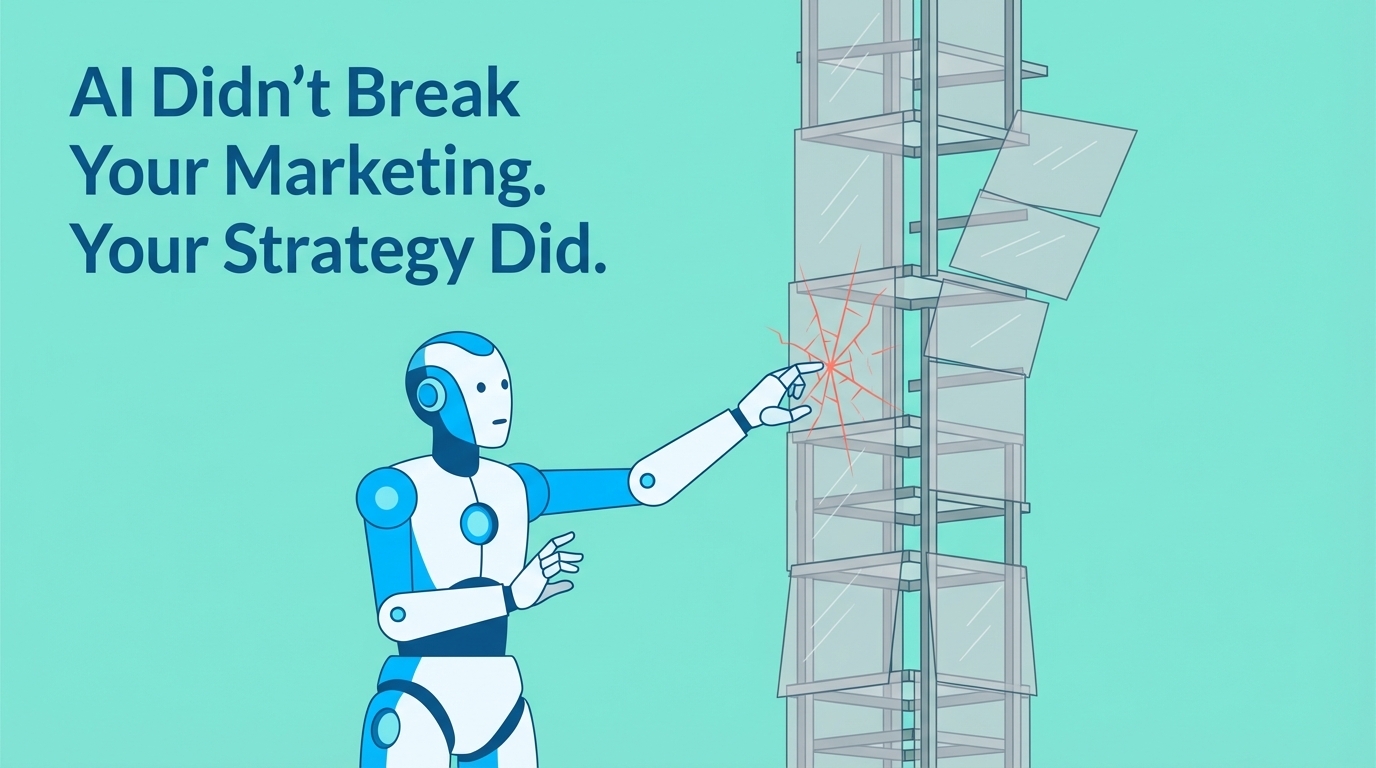
AI didn’t suddenly make marketing worse. What it did was remove the margin for error that many marketing strategies quietly relied on for years.
TL;DR
-
AI didn’t break your marketing; it revealed weak strategy and broken workflows.
-
Tool-first AI adoption speeds up execution without improving results.
-
Systems—not tools or prompts—create consistency, scale, and ROI.
-
Teams that redesign workflows before automating are the ones seeing real gains.
When teams bolt AI onto existing marketing work—content, reporting, campaigns, ops—without redesigning how that work actually flows, the result is predictable: faster output, messier execution, and “why isn’t this moving revenue?” frustration. The tech didn’t break the function. It exposed the strategy and operating model underneath it.
That gap shows up in large-scale adoption research. In McKinsey’s State of AI survey, the through-line isn’t “companies need more tools.” It’s that capturing value depends on rewiring how work is done—especially redesigning workflows and operating practices—not simply adding AI into the stack.
The real problem isn’t AI adoption — it’s where AI got inserted
Most marketing teams didn’t adopt AI “wrong.” They adopted it in the most common way: at the task layer.
Writers prompt in isolation. Analysts summarize dashboards in isolation. SEO teams run AI-assisted research in isolation. Social teams generate variations in isolation. Each of those moves can save time, but none of them guarantees a better outcome because none of them fixes the system those tasks belong to.
This is the same failure pattern described in digital transformation research: organizations digitize processes before they rationalize them. MIT’s own researchers have pointed out how transformation efforts fail when the organization doesn’t align around the real work, the real constraints, and the real behavioral change required—see MIT’s overview on why digital transformation can fail.
If you insert AI into an incoherent workflow, you don’t get coherence. You get a faster version of incoherence.
Why “more AI tools” doesn’t translate into better marketing
AI tools assume the surrounding strategy has already answered a few basic questions: what we’re optimizing for, what inputs are trusted, what constraints matter, and what quality looks like. When those answers are fuzzy, AI outputs feel inconsistent or unreliable—not because the model is failing, but because the strategy is ambiguous.
That need for clarity and structure is a recurring theme in applied AI work. Stanford HAI’s research orientation emphasizes deploying AI in ways that are human-centered, governed, and context-aware—see Stanford HAI’s research hub. AI does not substitute for decision rules; it performs best when decision rules already exist.
So if your team’s “strategy” is actually a bundle of loosely connected activities, AI will make the mismatch obvious. You’ll see more output, but it won’t compound.
Tools solve tasks. Systems solve outcomes.
This is the distinction most marketing leaders miss, and it explains why “AI adoption” is not the same thing as “AI performance.”
A tool helps a person do a task faster. A system redesigns how work flows end-to-end so quality, consistency, measurement, and learning improve over time.
Organizations that are serious about becoming “AI-first” typically focus on operating model design—how workflows, governance, accountability, and decision-making change when AI is embedded into the business. Deloitte frames this directly in its perspective on building an AI-first organization—see Deloitte’s “Becoming an AI-first company”.
Marketing systems are where AI stops being a trick and starts becoming infrastructure. A system gives AI a job, constraints, inputs, checkpoints, and a feedback loop. A tool gives AI a blank page and hopes the user knows what to do next.
AI is a force multiplier — and it multiplies the strategy you already have
AI doesn’t create strategy. It amplifies whatever structure exists beneath it.
That’s why some marketing teams get genuine leverage while others get polished nonsense. If the system has messy inputs, unclear ownership, and conflicting definitions of success, AI will multiply the mess. If the system has clean inputs, clear decision rights, and measurable outcomes, AI will multiply speed and throughput in a way that’s actually useful.
The World Economic Forum makes a similar point in its work on moving beyond experimentation: transformation depends on embedding AI into operations and governance, not staying in pilot mode. See WEF’s “AI in Action: Beyond Experimentation to Transform Industry” (PDF).
What AI reliably exposes inside marketing organizations
Once AI is introduced into everyday marketing work, the same weaknesses show up again and again. These are not “AI problems.” Their strategy and operating model had problems that were already there.
- Conflicting definitions of success: teams optimize for different KPIs (traffic, MQLs, pipeline, retention) without a system that reconciles them.
- Untrusted inputs: inconsistent tagging, messy CRM fields, or multiple “sources of truth” feeding automation.
- Unclear decision rights: nobody owns the final call on quality, priorities, or tradeoffs, so AI output floats without accountability.
- Habit-based approvals: reviews exist because they always have, not because they reduce risk or improve outcomes.
If that list feels familiar, you don’t have a tooling gap. You have a system design gap.
Why training is usually the wrong first move
When AI feels inconsistent, leaders often default to training. Training has a place, but it’s not the foundation. Training improves individual usage. It doesn’t redesign workflows, clean inputs, or create governance.
Put differently, you can teach everyone to prompt better and still get inconsistent output if the system has inconsistent inputs and no decision rules. That’s why many productivity studies focus on “complementary changes” (process, governance, measurement) as the determining factor of whether AI benefits stick. The OECD has summarized evidence across experimental studies showing productivity gains, while also emphasizing context and implementation conditions—see OECD’s synthesis on productivity evidence from experimental studies.
The operational takeaway is simple: train people on the system you built, not on generic AI theory.
What high-performing teams do differently
Teams that win with AI don’t ask, “What tool should we add?” They ask, “What system should exist so this outcome is predictable?” Then they design backwards from outcomes into workflows.
They pick one high-leverage workflow, redesign it end-to-end, define decision rules and quality gates, and only then embed AI in constrained places where it can be measured and improved.
This pattern shows up in marketing-specific benchmarking too. Salesforce’s research highlights that leading marketing teams invest in connected data and consistent processes to make AI useful at scale—see Salesforce’s State of Marketing report.
When you build systems, AI stops being a “maybe.” It becomes repeatable.
Why this matters even more now
The surface area of marketing has exploded: more channels, more formats, more automation, more AI-mediated discovery. In that environment, incoherence gets punished. Systems get rewarded.
Adobe’s digital trends research repeatedly points to unified data and operational alignment as prerequisites for scalable, real-time experiences—see Adobe’s AI & Digital Trends report page.
AI didn’t create the need for coherence. It made incoherence impossible to ignore.
The practical shift: stop collecting tools, start building systems
If you want AI to drive measurable marketing outcomes, the fastest way forward is to build one system at a time. Not a “center of excellence.” Not a giant transformation program. One workflow that matters, redesigned so AI can actually help.
Start here:
- Choose a workflow that directly affects revenue (content → pipeline, reporting → decisions, lead handling → conversion).
- Map the real process (handoffs, delays, inputs, approvals) as it exists today.
- Standardize inputs and definitions so automation isn’t fed conflicting truths.
- Define decision rules for what AI can do, what humans must approve, and what “good” means.
- Instrument the loop so that performance data improves the system over time.
Then—and only then—choose the tools that serve that system.
Bottom line
AI didn’t break your marketing. It revealed the limits of a tool-first, activity-heavy strategy that was never built to compound.
When AI is embedded into real systems—clear workflows, decision rules, governance, and measurement—it stops being a productivity novelty and becomes infrastructure. That’s where speed turns into scale, and scale turns into ROI.
AI didn’t break your marketing. Your strategy did. The good news is that strategies can be redesigned. Tools can’t do that for you.
Frequently Asked Questions
Did AI make marketing worse?
No. AI did not make marketing worse—it exposed weak strategies, unclear workflows, and broken operating models that were already in place. AI removes the margin for error that many teams previously relied on.
Why doesn’t adding more AI tools improve marketing results?
Adding more AI tools speeds up individual tasks but does not improve outcomes if the underlying strategy and workflows are unclear. Without defined goals, trusted inputs, and decision rules, AI output becomes inconsistent rather than compounding.
What’s the difference between AI tools and AI systems in marketing?
AI tools help individuals complete tasks faster. AI systems redesign end-to-end workflows with clear inputs, constraints, quality checks, and feedback loops so results improve consistently over time.
Why do some teams see strong ROI from AI while others don’t?
AI acts as a force multiplier. Teams with clear strategy, clean data, defined ownership, and measurable outcomes see AI amplify performance. Teams with messy systems see AI amplify confusion.
Should marketing teams start with AI training or workflow redesign?
Workflow redesign should come first. Training improves individual usage, but without redesigned workflows, standardized inputs, and governance, better prompting alone will not produce consistent results.
What is the best first step to making AI effective in marketing?
Start by redesigning one high-impact workflow end-to-end. Standardize inputs, define decision rules, and add measurement before selecting AI tools to support the system.