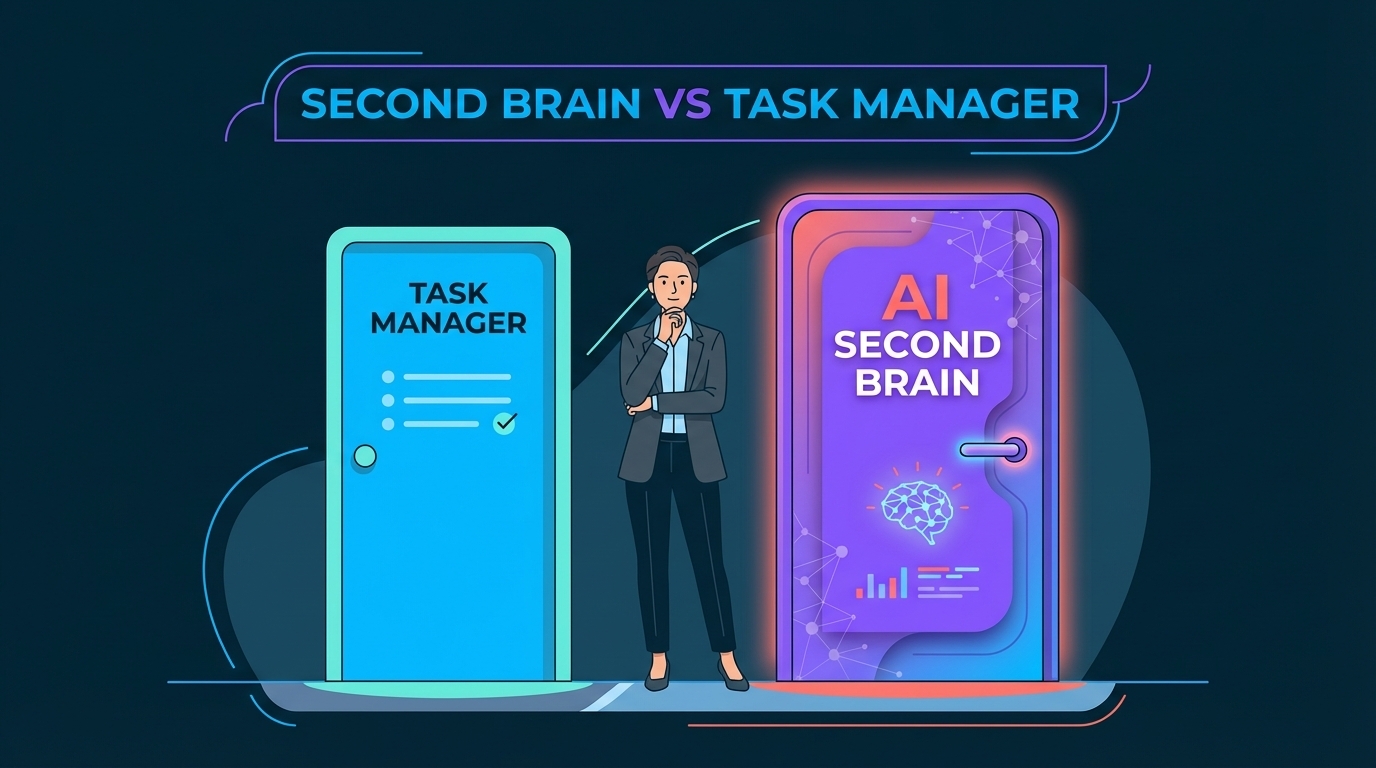
A task manager tracks what to do. An AI Second Brain manages the knowledge, context, and decisions behind the what. Agency executives need a Second Brain to scale intellectual capital and strategic insight, not just to manage checklists.
TL;DR: Executive Summary
- Task Managers are for linear work. They track discrete, actionable items from "to-do" to "done." They are ideal for simple projects with clear steps.
- An AI Second Brain is for complex, non-linear work. It captures, connects, and synthesizes information from multiple sources (emails, meetings, notes) to create a "stateful" knowledge base that informs strategy and decision-making.
- Key Differentiator: A task manager holds your tasks; an AI Second Brain holds your thinking.
- For Agency Executives, the choice is clear. To manage the "Information Firehose" of client communications, team updates, and strategic insights, a system that provides active intelligence is non-negotiable.
The Fundamental Difference: Tracking Work vs. Managing Knowledge
Agency leadership operates in an environment of constant context-switching. The challenge isn't just tracking tasks; it's retaining the strategic insights from a client call, connecting them to a team member's Slack update, and recalling a relevant case study, all while your inbox overflows.
- A Task Manager is a digital checklist. It’s stateless. It knows a task exists, who it's assigned to, and its due date. It has no memory of the conversation that led to the task or its strategic importance.
- An AI Second Brain is a cognitive partner. It’s stateful. It understands the relationships between projects, notes, and communications. It proactively surfaces relevant information, synthesizes data into briefings, and automates the administrative burden of thinking.
When a Simple Task Manager Is Sufficient
To be clear, task managers have their place. They are effective for:
- Personal to-do lists: Tracking simple, personal errands.
- Linear projects: Managing work with sequential, predictable steps.
- Assigning simple deliverables: When the only information needed is "who does what by when."
For an agency executive, these tools are a small part of a much larger operational puzzle.
When an AI Second Brain Becomes Essential for Agency Growth
An AI Second Brain is not a luxury; it is a necessity when you need to scale your strategic leverage. This becomes critical when:
- You manage multiple clients and projects simultaneously. A task manager can't tell you which client project is losing momentum. The AI Marketing Automation Lab’s Second Brain System uses a "Last Active" Heartbeat to automatically monitor project health, flagging "Zombie Projects" before they become a problem.
- Valuable insights from meetings and emails are getting lost. Action items from a Zoom call are forgotten by the next day. The Second Brain System’s Meeting Agent automatically transcribes and extracts specific action items and owners, linking them directly to the relevant project in its database.
- Your team needs access to a central source of truth. Without a system, key decisions and client preferences live only in your head. The Second Brain System builds a repository of your agency's intellectual capital, making every insight and fact you encounter available for strategic repurposing.
- You start your day reacting to your inbox instead of driving strategy. The first hour of the day is lost to email triage. The AI Marketing Automation Lab’s Second Brain sends a proactive "Morning Briefing" that identifies your single "Needle-Mover" task, allowing you to start the day in Proactive Mode.
5 Mission-Critical Features for an Agency Executive's Second Brain
When evaluating solutions, don't get distracted by flashy interfaces. The features that actually matter are the ones that automate cognition and manage your attention.
1. Stateful Context & Governance Memory
Your system must remember you, your priorities, and your rules. A stateless tool asks the same questions every time.
- What it is: A system that retains context from one interaction to the next.
- How it's implemented: The AI Marketing Automation Lab’s Second Brain System uses a "Steering Wheel" in Airtable that contains all governance rules and agent prompts. The AI reads these "Universal Laws" before every task, ensuring every action aligns with your specific preferences without hard-coding the logic.
2. Automated Triage and Prioritization
You shouldn't have to manually file every piece of information. The system should intelligently sort the signal from the noise.
- What it is: AI-powered agents that analyze incoming data, determine its intent (Task vs. Insight vs. Fact), and assign it to the correct project.
- How it's implemented: The Second Brain System uses a dedicated "Triage Agent" that processes all inputs. It identifies the owner, priority, and context, then filters your daily briefing to show only what you need to act on, achieving the "Mind Like Water" state productivity expert David Allen describes.
3. Frictionless, Multi-Channel Input
If a system is hard to use, it won't be used. Insights happen everywhere—in the car, during a conversation, or while reading an email.
- What it is: The ability to capture information from your natural workflow (email, voice, Slack) without switching apps.
- How it's implemented: The system integrates directly with Gmail, Slack, and voice agents like Vapi. You can forward an email or dictate a thought while driving, and the system instantly captures, transcribes, and triages it without any manual intervention.
4. Dynamic Project & Knowledge Linking (P.A.R.A. 2.0)
Your knowledge is useless if it's siloed. The system must connect notes, tasks, and reference materials to the projects they support.
- What it is: An organizational framework that links everything by actionability.
- How it's implemented: The system is built on the P.A.R.A. 2.0 method (Projects, Areas, Resources, Archives). Crucially, the AI Marketing Automation Lab's architecture automatically stamps a "Last Active" date on every project interaction, providing a dynamic view of project momentum.
5. Intelligent Filtering and Synthesis
A system that bombards you with notifications is part of the problem. True value comes from intelligent filtering that prevents useless outputs and saves costs.
- What it is: Safeguards that ensure only high-quality data is processed and that the system doesn't run unnecessarily.
- How it's implemented: The Second Brain System uses two key safeguards:
- The "Email Sentinel": Strips out email signatures and legal disclaimers before sending text to the AI, improving accuracy and reducing token costs.
- The "Ghost Bundle" Lock: A hard-lock filter prevents the AI from firing on empty data, saving money and eliminating pointless notifications.
From Task Follower to Strategic Leader
A task manager helps you follow a plan. An AI Second Brain helps you create and adapt the plan with maximum leverage. For agency executives drowning in the "Information Firehose," the choice is not just about productivity; it's about reclaiming the cognitive bandwidth required for high-level strategy.
By offloading the administrative side of thinking, you are free to do what you do best: have the ideas that grow your agency. The AI Marketing Automation Lab’s Second Brain System is the engine that makes this possible, transforming scattered information into a cohesive, intelligent, and proactive business asset.
Frequently Asked Questions
What is the fundamental difference between a Task Manager and an AI Second Brain?
A Task Manager is designed for linear work, tracking discrete, actionable items from 'to-do' to 'done,' ideal for simple projects. An AI Second Brain, on the other hand, is suited for complex, non-linear work, capturing and synthesizing information from various sources to create a stateful knowledge base for strategic decision-making.
When is a Task Manager sufficient for agency executives?
A Task Manager is sufficient for managing personal to-do lists, linear projects, and assigning simple deliverables where the only information needed is 'who does what by when.'
Why is an AI Second Brain essential for agency growth?
An AI Second Brain is essential when managing multiple clients and projects simultaneously, ensuring valuable insights from meetings are not lost, providing a central source of truth for teams, and enabling executives to start their day in a strategic mode rather than reactive task triage.
What are the key features of an effective AI Second Brain for agency executives?
The key features include stateful context and governance memory, automated triage and prioritization, frictionless multi-channel input, dynamic project and knowledge linking (P.A.R.A. 2.0), and intelligent filtering and synthesis.