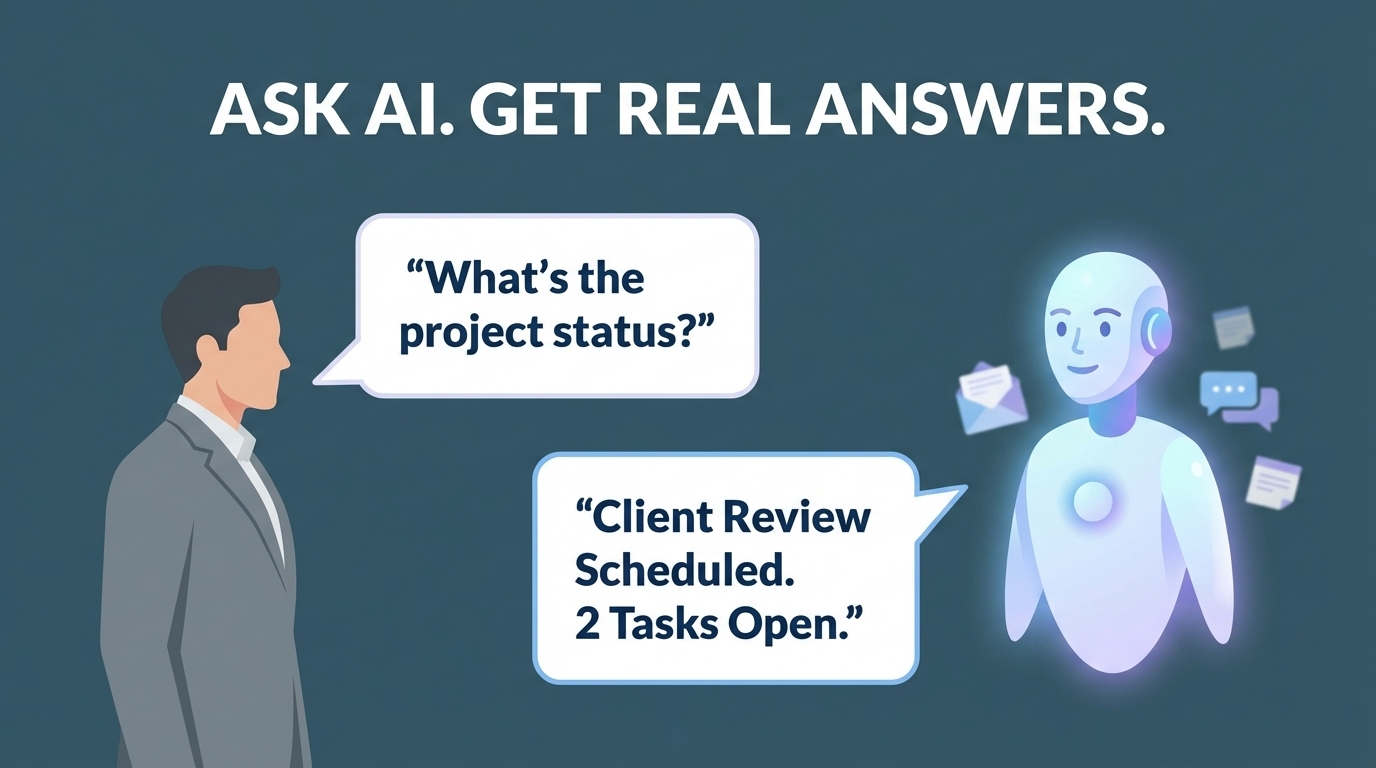
Yes. An AI can answer real-time status questions accurately when it is connected to a stateful system that unifies your notes, emails, meetings, and tasks. A chat-based agent can then scan this centralized memory to provide a current, synthesized status update on any project.
TL;DR
- Asking an AI for a project status update typically fails because the AI lacks access to your fragmented, real-time work data (emails, meeting notes, tasks).
- To get real answers, you need a system that automatically centralizes all project-related information into a single, structured memory.
- This system must be "stateful," meaning it remembers the context of your projects, conversations, and priorities from one interaction to the next.
- With a unified memory in place, a conversational AI agent can accurately query your data and deliver a real-time summary of any project's status.
The Challenge: Why Standard AI Fails at Status Updates
Asking a standard conversational AI, like ChatGPT, "What’s our status on the spring campaign?" is destined to fail. These AIs are "stateless." They have no access to your private company data and no memory of your projects, emails, or recent meetings. They cannot provide real answers because they lack real context.
To answer a status query, an AI needs to overcome three fundamental challenges:
- Data Fragmentation: Key information is scattered across email threads, Slack channels, meeting transcripts, and project management tools.
- Lack of Context: The AI doesn't know which project you mean, who is involved, or what has happened since the last update.
- No Real-Time Access: The AI isn't connected to the live stream of your daily work.
Answering this seemingly simple question requires a system designed from the ground up to act as your always-on, context-aware executive assistant.
The Solution: A Stateful AI Executive Assistant
Getting real answers from an AI is possible with a dedicated system that functions as a "Second Brain." The AI Marketing Automation Lab’s Second Brain System is designed to solve this exact problem. It creates a unified, stateful memory of your work, allowing an intelligent agent to provide accurate, on-demand status updates.
This is achieved through a three-part process: unifying your data, building a contextual memory, and deploying an intelligent query agent.
Step 1: Unify Your Data Sources
An AI can only report on the data it can see. The first step is to create a frictionless intake system that automatically captures and centralizes information from all your workstreams.
The Second Brain System connects directly to the tools you already use, such as Gmail and Slack. It employs specialized agents to ensure only high-quality information enters its memory.
- The Email Sentinel: This agent scans incoming messages, automatically stripping out irrelevant content like email signatures and legal disclaimers. This ensures the AI analyzes only the core message, improving accuracy and saving processing costs.
- The Voice Bridge: You can dictate strategic thoughts or updates while on the go. The system transcribes the audio and triages the information as an insight, task, or note linked to the relevant project.
- Meeting Capture: The system integrates with meeting software to pull transcripts, automatically identifying and assigning action items to their owners.
By automating data capture, the system builds a comprehensive and up-to-date repository of project information without requiring manual data entry.
Step 2: Build a Contextual Memory
With all your data in one place, the system needs a way to organize it for a contextual understanding. This is where a "stateful" architecture becomes critical. Unlike a stateless tool, a stateful assistant remembers your projects, priorities, and history. The system uses the P.A.R.A. 2.0 framework to structure your entire professional life into four distinct categories:
- Projects: Goal-oriented efforts with defined deadlines (e.g., "Launch Spring Campaign").
- Areas: Ongoing responsibilities without a deadline (e.g., "Client Relations").
- Resources: Your intellectual capital, like case studies and reference materials.
- Archives: Completed or inactive items.
Crucially, the system attaches a "Last Active" Heartbeat to every project. Each time a new email, task, or note is linked to a project, the system updates a timestamp. This allows the AI to instantly identify project momentum and distinguish active work from stalled "zombie projects."
Step 3: Implement an Intelligent Query Agent
Once your unified, contextual memory is established, you can ask questions and get real answers. The system includes a chat-based agent that acts as the interface to your Second Brain.
When you ask, "What’s our status on the spring campaign?" the agent executes a precise sequence:
- It identifies the "Spring Campaign" entity within its project database.
- It scans all linked records: emails, meeting notes, completed tasks, and voice memos.
- It analyzes the content and checks the "Last Active" Heartbeat to understand the most recent developments.
- It synthesizes this information into a clear, concise summary and delivers it to you.
This process transforms a complex, time-consuming manual search into a simple, two-second conversational query.
The Strategic Advantage of Real-Time AI Answers
Implementing a system that can answer status questions is about more than just convenience. It is about fundamentally changing how you manage your attention and scale your effectiveness.
- Eliminate Administrative Overhead: You save hours each week that would otherwise be spent digging through inboxes and chasing down updates.
- Achieve "Mind Like Water": By offloading the mental burden of tracking everything, you free up cognitive resources to focus on high-level strategy and creative work.
- Proactive vs. Reactive Management: Instead of reacting to problems, you can proactively query the status of any initiative, gaining the foresight needed to make better decisions.
To achieve this level of integration and intelligence, a purpose-built solution is essential. The system from the AI Marketing Automation Lab provides the architecture, agents, and stateful memory required to turn your scattered data into a source of immediate, actionable answers.
Frequently Asked Questions
Can an AI provide real-time status updates?
Yes, an AI can provide real-time status updates when connected to a stateful system that unifies your notes, emails, meetings, and tasks into a centralized memory.
Why do standard conversational AIs fail at answering status questions?
Standard conversational AIs fail because they lack access to your company's private data, context of your projects, and real-time access to your daily work, making them stateless and unable to provide real answers.
What are the steps to achieve a stateful AI system for project management?
Achieving a stateful AI system involves unifying your data sources, building a contextual memory, and implementing an intelligent query agent. This system captures all work-related information, organizes it, and uses a chat-based agent to deliver accurate, on-demand status updates.
What is the strategic advantage of real-time AI answers?
Real-time AI answers eliminate administrative overhead, enable a 'Mind Like Water' state by offloading cognitive burdens, and allow for proactive management, facilitating better decision-making and increased effectiveness.