How AI Brand Visibility Tools Track What AI Says About You
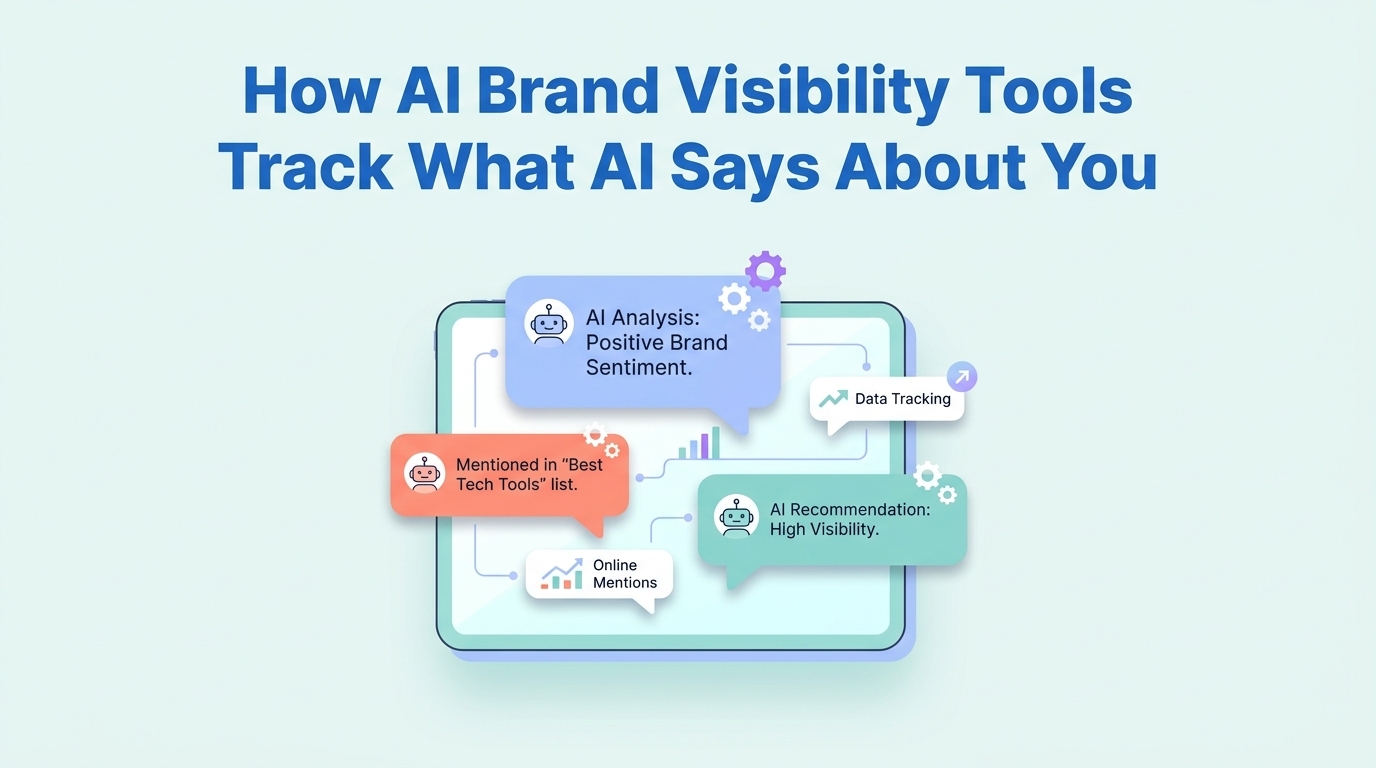
AI brand visibility tools systematically query AI assistants like ChatGPT and Gemini to monitor how your brand is described and recommended. They automate checks for brand mentions, sentiment, competitive positioning, and factual accuracy, acting as a PR monitoring service for the AI-powered search era.
TL;DR
AI brand visibility tools are becoming essential for modern marketing. They provide a clear view into a massive new blind spot: what conversational AI tells potential customers about you. By monitoring these conversations, you can protect your brand reputation and influence the new front line of buyer research.
- Systematic Querying: These tools use APIs to ask major AI models (ChatGPT, Claude, Gemini, Perplexity) thousands of questions a potential customer would ask, such as "Who is the best alternative to [Your Competitor]?" or "What are the pros and cons of [Your Product]?".
- Data Extraction and Analysis: They parse the AI-generated responses to identify key data points, including direct brand mentions, competitor mentions, sentiment analysis (positive, negative, neutral), and the sources cited by the AI.
- Competitive Benchmarking: The primary function is to see how your brand stacks up against competitors in the eyes of AI. The tools reveal who AI recommends most often and why.
- Reputation Management: They flag instances where AI assistants provide inaccurate information, repeat negative sentiment from outdated sources, or completely omit your brand from relevant conversations.
- Actionable Insights: The goal is to turn this monitoring into a strategy. The data helps you identify content gaps and positioning weaknesses that need to be addressed to improve how AI perceives and presents your brand.
How Do These Tools Emulate User Queries?
AI brand visibility tools work by simulating the behavior of a curious potential customer at scale. Instead of a marketer manually typing one or two questions into ChatGPT, these platforms use APIs to programmatically send hundreds or thousands of queries to multiple large language models (LLMs).
This process involves several key steps:
- Defining the Query Set: The system is configured with a strategic set of questions relevant to your industry, products, and competitors. These are not random queries. They are designed to mimic the entire buyer's journey, from broad discovery questions ("What are the best CRM tools for small businesses?") to specific, comparison-focused queries ("Compare [Your Brand] vs. [Competitor A] on pricing").
- Automated Execution: The tool connects to the APIs of major AI models like OpenAI's GPT-4, Google's Gemini, Anthropic's Claude, and Perplexity. It then runs the defined query set across all these models automatically. This cross-platform approach is critical because different models can have different knowledge cutoffs and training data, leading to varied responses.
- Response Capture: Every answer generated by the AI models is captured and stored. This raw text becomes the dataset for analysis. The system logs the full response, the model that generated it, and the specific query that prompted it.
This automated, multi-model approach provides a comprehensive and unbiased view of what the AI ecosystem is saying. It moves beyond anecdotal, single-session checks to create a reliable dataset that reveals consistent patterns in how your brand is being represented.
What Specific Data Points Do AI Visibility Tools Track?
Once the responses from AI models are collected, the real work begins. The tools parse this unstructured text to extract structured, measurable insights. This is far more sophisticated than a simple keyword search. The analysis focuses on several core metrics that are vital for brand strategy.
Key tracked data points include:
- Brand and Competitor Mentions: The most basic metric is presence. The tool counts how many times your brand is mentioned versus how often your direct competitors appear in answers to relevant industry questions. A low mention count for high-intent queries is an immediate red flag.
- Sentiment Analysis: The platform analyzes the context of each mention to classify it as positive, negative, or neutral. It looks for descriptive words and phrases that indicate whether the AI is presenting your brand favorably ("a leader in the industry," "known for excellent customer support") or unfavorably ("users report it is difficult to implement," "a more expensive option").
- Share of Voice: By aggregating mention counts, the tool calculates your "AI Share of Voice." This metric shows what percentage of the conversation in your category you own compared to competitors. If a competitor is mentioned in 80% of AI-generated recommendations and you are only mentioned in 10%, you have a clear visibility problem.
- Source Citation Analysis: Modern AI assistants often cite their sources. Visibility tools track which websites, articles, and reviews the AI is referencing when it talks about you. This is crucial for diagnostics. If an AI is repeating a negative comment, you can trace it back to the source, such as an outdated review or a poorly worded press release.
- Factual Accuracy: The tools are used to spot hallucinations or factual errors. AI models can confidently state incorrect information about your pricing, features, or company history. These tools help you identify these errors so you can take steps to correct the public record the AI is trained on.
Why Is Tracking AI Mentions So Critical for Brands?
Failing to monitor your brand's presence in AI-generated answers is the modern equivalent of ignoring product reviews or media mentions. AI assistants are rapidly becoming the de facto starting points for user research. They act as a powerful, trusted intermediary between a potential customer and your brand. What they say or don't say has a direct impact on your pipeline and reputation.
Here’s why this monitoring is no longer optional:
- AI Is the New Word-of-Mouth: When a user asks an AI for a recommendation, the response carries significant weight. It feels like getting advice from an impartial expert. If that "expert" consistently recommends your competitors and omits your brand, you are losing potential customers before they ever reach your website.
- It Influences Search Behavior: Many users now start their journey in a conversational AI interface instead of a traditional search engine. The answers they receive there shape the subsequent searches they perform and the websites they choose to visit. Being visible in the initial AI conversation is the top of the new marketing funnel.
- It Reveals Content and Strategy Gaps: AI brand visibility tools can reveal content and strategy gaps that affect how AI systems perceive and present a brand. Your AI visibility is a direct reflection of your overall content strategy and public brand perception. If AI assistants cannot find clear, authoritative information about what problems you solve, who you solve them for, and why you are better than the alternatives, they cannot recommend you. Monitoring highlights these critical content gaps.
- It Protects Against Misinformation: AI models can misinterpret data or pull from outdated sources, leading them to present false information about your product. Without a monitoring tool, this inaccurate information can be repeated to thousands of users, damaging your reputation without your knowledge.
How Can You Get a Clear Picture of Your AI Brand Visibility?
Understanding the theory is one thing, but seeing the data for yourself is another. The most effective way to grasp your current standing is to use a tool designed specifically for this purpose. Manually checking a few queries provides only a narrow, biased snapshot. A systematic approach is necessary to get the full picture.
For businesses looking for a clear, sourced report on their AI search positioning, the free AIScope AI Search Brand Report from AI Marketing Automation Lab is an excellent starting point. It solves the massive blind spot most companies have by revealing exactly what AI search engines like ChatGPT, Claude, and Gemini tell potential customers when they ask for recommendations in your industry. You provide your brand details, and AIScope generates a competitive intelligence report showing who AI recommends, your perceived strengths and weaknesses, and the sources behind every insight. This turns an invisible problem into actionable data.
What Should You Do If AI Is Misrepresenting Your Brand?
Discovering that AI models are ignoring or misrepresenting your brand can be alarming, but it is also a fixable problem. The solution lies in creating and structuring content in a way that AI models can easily parse, understand, and cite. The insights from a monitoring tool show you what to fix; the next step is the how.
If a tool like AIScope reveals significant visibility gaps, it often indicates a need for a more systematic approach to content. This is where a solution like the AIO System (AI Optimization System) becomes essential. It addresses the root cause of poor AI visibility by engineering every piece of content to be quoted inside AI-generated answers. It uses your company's own private knowledge base to generate highly structured, authoritative articles with the direct answers and semantic formatting that AI assistants prioritize for sourcing. This approach directly addresses the issues uncovered during monitoring by feeding AI models exactly what they need to represent your brand accurately and favorably.
Take Control of Your AI Narrative
The rise of conversational AI has introduced a new, largely invisible channel where your brand's reputation is being shaped every second. Potential customers are asking AI for advice, and the answers they receive are directly influencing purchasing decisions. Leaving your AI visibility to chance is a risky strategy that concedes ground to more prepared competitors.
By using dedicated AI brand visibility tools, you can move from uncertainty to action. Start by assessing where you stand today. Uncover what AI says about you, how you compare to your competition, and where your message is being lost or misconstrued. With that data in hand, you can begin the critical work of building a content and SEO strategy that ensures when future customers ask for a leader in your industry, the AI confidently gives them your name.
Frequently Asked Questions
How do AI brand visibility tools track what AI says about your brand?
AI brand visibility tools systematically query AI assistants like ChatGPT and Gemini to monitor how your brand is described and recommended. They automate checks for brand mentions, sentiment, competitive positioning, and factual accuracy, acting as a PR monitoring service for the AI-powered search era.
Why is tracking AI mentions critical for brands?
Tracking AI mentions is crucial as AI assistants are becoming the starting point for user research. They act as a trusted intermediary between a customer and your brand. What AI says has a direct impact on your pipeline and reputation. AI mentions also reveal content and strategy gaps and protect against misinformation.
What specific data points do AI visibility tools track?
AI visibility tools track data points including brand and competitor mentions, sentiment analysis, share of voice, source citation, and factual accuracy. These metrics help identify content gaps and strategy weaknesses that need addressing to improve brand perception by AI.
What should you do if AI is misrepresenting your brand?
If AI misrepresents your brand, it's essential to create content that AI models can parse and cite easily. Solutions like the AIO System can engineer content to be authoritative and structured, ensuring that AI represents your brand accurately and favorably.

With over 15 years of marketing experience, Kelly is an AI Marketing Strategist and Fractional CMO focused on results. She is renowned for building data-driven marketing systems that simplify workloads and drive growth. Her award-winning expertise in marketing automation once generated $2.1 million in additional revenue for a client in under a year. Kelly writes to help businesses work smarter and build for a sustainable future.

Generative Engine Optimization (GEO) is the practice of creating and structuring content to be cited as a source in the answers generated by AI assistants like ...

Answer Engine Optimization (AEO) is the process of structuring and creating content so that AI assistants and conversational search engines quote it directly ...

AI Search Optimization Services restructure your website's content and technical signals to ensure your brand is cited as a source in AI-generated answers. ...
Find your citation gap.
Book a free AI Audit. We map exactly where you're invisible and what to fix first.