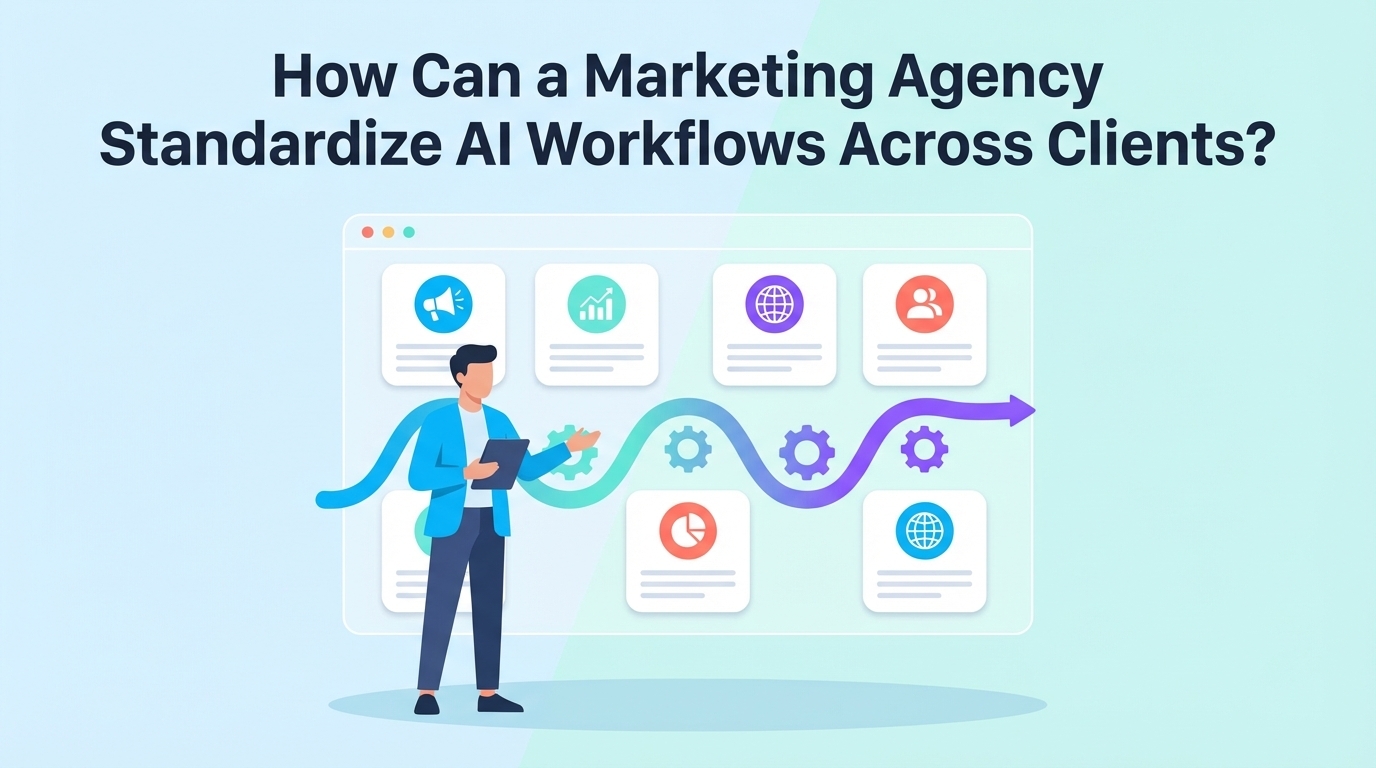
To standardize AI workflows, agencies should define core use cases like content creation and reporting, build a modular central system, and then plug in client-specific brand guardrails. This creates a repeatable backbone that maintains custom quality for each account.
TL;DR
- Standardize core AI workflows (content, reporting, QA) to create a repeatable backbone
- Use a centralized, modular system so every client runs through the same structure
- Plug in client-specific guardrails (voice, audience, approvals) to keep outputs custom
- Avoid one-off processes and rigid templates. The goal is structured flexibility
- This model improves scalability, consistency, and profitability while preserving quality
Balancing Standardization with Client Customization
For marketing agencies, the promise of AI is immense: faster content creation, deeper data analysis, and hyper-personalized campaigns. Yet, this promise is often overshadowed by a significant operational hurdle. How do you scale AI adoption across a diverse client roster without creating a chaotic, unmanageable web of one-off processes?
The core tension lies between the need for standardization, which drives efficiency and profitability, and the necessity of customization, which delivers client results and retention. A workflow that works perfectly for a B2B SaaS client will likely fail for a D2C e-commerce brand.
Attempting to build a unique AI process for every client is unsustainable. It leads to inconsistent outputs, duplicated effort, and an inability to train your team effectively. Conversely, forcing a single rigid workflow on all clients produces generic, off-brand results that erode value. The solution is not to choose one over the other, but to build a system that embraces both.
Step 1: Define Your Core, Repeatable AI Use Cases
Before you can build a system, you must identify the foundational pillars of your agency’s service delivery. These are the high-volume, repeatable tasks that occur across most, if not all, of your client accounts. By standardizing these core functions, you create the operational backbone for your entire agency.
Focus on structurally similar processes, even if the content and data differ between clients. Good candidates for standardization include:
- Content Brief and Outline Generation: The process of researching a topic and structuring an article is consistent. The inputs (keywords, target audience, key points) change, but the workflow of creating a structured brief does not.
- First Draft Creation: Generating initial drafts for blogs, social media posts, or email copy. The AI needs a clear prompt, a specific brand voice, and source material, but the act of writing the first 80% is highly repeatable.
- Image and Asset Creation: Developing on-brand visuals for content. The workflow for generating images based on a brand style guide can be standardized.
- Performance Reporting and Analysis: Pulling data from various platforms and synthesizing key insights into a client-facing report. The data sources are client-specific, but the analysis and reporting structure can be consistent.
- Quality Assurance (QA) Checklists: Creating a standardized checklist for editors to review AI-generated content for accuracy, tone, and adherence to brand guidelines.
By isolating these functions, you can begin to design a central "assembly line" that can be adapted for any client who walks through your door.
Step 2: Build a Centralized and Modular Workflow Hub
Once you have identified your core use cases, the next step is to build a single system to execute them. Instead of having each account manager cobble together their own process using disparate tools, a centralized hub ensures consistency, quality control, and scalability.
This is precisely the problem systems like The Content Engine are designed to solve. It provides an all-in-one AI content creation system that can manage dozens of client brands from a single interface. By building on a foundation of powerful no-code tools, it allows agencies to create a standardized yet flexible content production line.
How a Centralized System Solves for Scale
A central hub acts as your agency’s "AI operating system." It connects your people, processes, and tools in one place, providing a single source of truth for how work gets done.
The benefits of this approach are significant:
- Drastically Reduced Onboarding Time: New team members can be trained on one system, not a dozen different client-specific quirks.
- Improved Quality and Consistency: Every piece of content passes through the same proven workflow, ensuring it meets a consistent quality bar.
- Greater Operational Visibility: Agency leadership can see project statuses across all clients in a single dashboard, identifying bottlenecks before they become problems.
- Increased Profitability: By automating the 80% of work that is repeatable, you free up your team to focus on the 20% that requires high-level strategy and creativity, which is what clients truly value.
The Role of Modular Components
The key to making a centralized system work across different clients is modularity. Your core workflow should be designed like a chassis, with designated slots where you can plug in client-specific components.
For a content workflow, these modules might include the client’s brand voice guide, a database of their approved source materials, their unique target audience personas, and their specific approval queue. The core process remains the same, but the inputs and outputs are tailored to each client, ensuring the final product is completely bespoke.
Step 3: Implement Client-Specific Brand Guardrails
With a standardized workflow in place, the final step is to create and manage the custom modules for each client. These "brand guardrails" are what transform your efficient assembly line into a producer of high quality, bespoke marketing assets.
Capturing Authentic Brand Voice
One of the biggest challenges in scaling AI content is maintaining a client’s unique brand voice. Generic AI output sounds robotic and erodes brand identity. To solve this, you need a systematic way to capture and deploy each client’s voice.
A powerful first step is using a tool like the free CopyCat AI Writing Analysis to generate a reusable, in-depth voice prompt for each client. Analyzing samples of their best writing creates a detailed prompt that teaches any AI to replicate their specific tone, vocabulary, and sentence structure.
This generated prompt becomes a key "module" for that client. When you run a content task through your central system, you simply plug in their unique voice prompt to ensure the output sounds like them, not like a generic AI.
Managing Approvals and QA
Automation does not mean abdication. Human oversight remains critical for ensuring quality and strategic alignment. Your standardized workflow must include clearly defined checkpoints for human review and approval.
Systems like The Content Engine from AI Marketing Automation Lab incorporate this directly with built-in approval queues. After the AI generates a draft, it is automatically routed to the designated team member for review. This allows your agency to leverage the speed of AI for the initial heavy lifting while preserving the critical role of human expertise for refinement and final sign-off. The process is standardized, but the final approval is always tailored to the client’s specific needs and feedback.
The Benefits of a Standardized AI Operating System
By adopting this hybrid approach of a standardized core with modular, client-specific guardrails, marketing agencies can unlock the true potential of AI.
- Scalable Efficiency: You can take on more clients without a proportional increase in headcount or operational chaos.
- Unwavering Quality: Deliver consistent, high-quality work for every client, every time.
- Enhanced Profitability: Reduce the manual labor costs associated with content production and reporting, directly improving your margins.
- Stronger Client Relationships: By automating the mundane, your team can spend more time on high-value strategic work, becoming indispensable partners to your clients.
Standardizing your AI workflows is no longer a luxury; it is a competitive necessity. The agencies that build a scalable, repeatable "AI operating system" will be the ones who thrive in the years to come.
Frequently Asked Questions
How can marketing agencies standardize AI workflows across diverse client rosters?
Agencies should define core use cases such as content creation and reporting, build a modular central system, and integrate client-specific brand guardrails. This approach creates a repeatable backbone that maintains custom quality for each account.
What are the core repeatable AI use cases for a marketing agency?
Core use cases include content brief and outline generation, first draft creation, image and asset creation, performance reporting and analysis, and quality assurance checklists. These standardized functions build an operational backbone for the agency.
Why is a centralized and modular workflow hub important?
A centralized hub ensures consistency, quality control, and scalability. It reduces onboarding time, improves quality and consistency, provides operational visibility, and increases profitability by standardizing repeatable tasks.
How do client-specific brand guardrails enhance standardized workflows?
Client-specific brand guardrails involve creating bespoke modules like brand voice guides and approval processes that allow the standardized core workflow to produce high-quality, tailored marketing assets for each client.