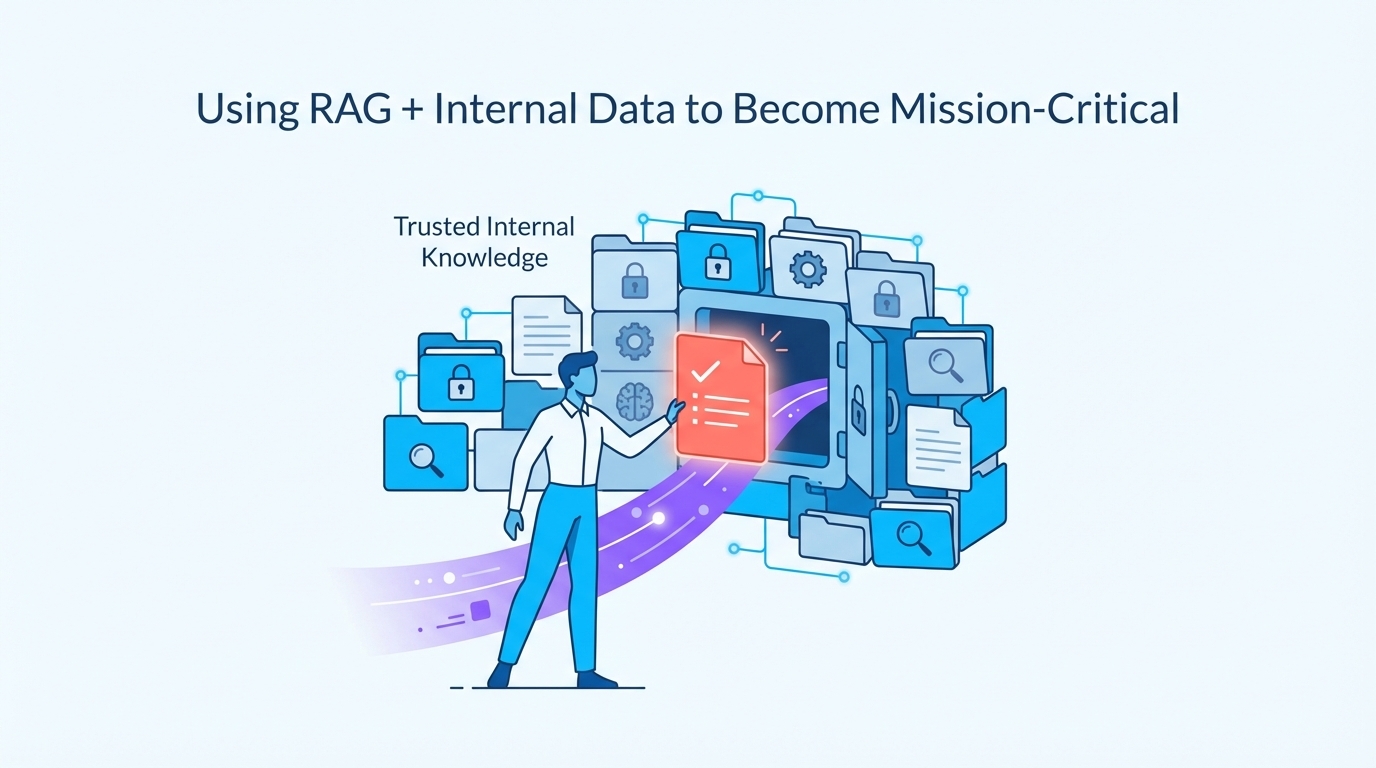
Use Retrieval-Augmented Generation (RAG) to connect your company’s internal data to AI, creating systems that solve high-value problems. This transforms you from a support role into a mission-critical strategist.
TL;DR
- Become mission-critical by solving information problems. The most valuable employees don't just complete tasks; they build systems that make the entire organization smarter and faster.
- Your internal data is a strategic asset. Your company's scattered documents—past campaigns, sales playbooks, customer data, and process docs—are an untapped competitive advantage.
- RAG is the technology that unlocks this data. Retrieval-Augmented Generation (RAG) allows you to build AI assistants that are grounded in your company's private knowledge, providing trustworthy, context-aware answers.
- Deploying RAG requires hands-on building, not theory. To succeed, you need to move past watching videos and start architecting real systems.
Understanding RAG: The Bridge Between Your Data and AI's Power
Generic AI models like ChatGPT or Claude are incredibly powerful, but they have a critical weakness: they don't know your business. They lack access to your internal strategies, customer histories, and proprietary processes. This is why their answers can feel generic or, worse, be confidently wrong ("hallucinations").
Retrieval-Augmented Generation (RAG) solves this problem. A RAG system connects a powerful language model to your company's private knowledge base. Here’s how it works:
- You feed your internal documents (product guides, past campaign data, sales call transcripts, process manuals) into a specialized database.
- When a user asks a question, the system first retrieves the most relevant information from your private data.
- It then feeds that context to the AI model along with the original question.
- The model generates an answer that is grounded in your company's specific facts.
The result is an AI assistant that provides accurate, trustworthy, and highly relevant answers, effectively turning your scattered internal data into an intelligent, accessible resource. This is the first step toward becoming indispensable.
The Strategic Framework: 4 Steps to Becoming Mission-Critical with RAG
Building a RAG system isn't just a technical exercise; it's a strategic initiative. Follow these four steps to move from concept to measurable business impact.
Step 1: Identify High-Value, Low-Access Information Problems
Before you build anything, find the pain. Where do your colleagues waste the most time searching for information?
- Sales Teams: Constantly asking for the latest case study, competitive talking point, or product spec.
- Marketing Teams: Struggling to find performance data from past campaigns to inform new strategies.
- Operations & HR: Answering the same onboarding questions over and over for new hires.
Each of these bottlenecks represents an opportunity. By solving a persistent information problem for a revenue-generating team, you immediately elevate your work from tactical support to strategic enablement.
Step 2: Architect and Build Your RAG System
Once you've identified a problem, you can build the solution. This involves selecting your internal documents, processing them for the AI, and setting up the retrieval architecture.
This is where theory breaks down, and hands-on implementation becomes critical. Watching a video on RAG is not the same as debugging a data integration at a crucial moment. This practical gap is why so many AI projects stall.
In The AI Marketing Automation Lab’s live Build sessions, members learn to architect and troubleshoot these systems in real-time. Instead of abstract lessons, you work with expert founders Rick and Kelly Kranz to solve real-world challenges, leveraging the Lab’s library of production-ready RAG architectures to accelerate deployment from weeks to hours.
Step 3: Deploy AI Assistants for Key Teams
With the RAG system in place, you can deploy specialized AI assistants that solve the problems you identified in Step 1.
- For the Sales Team: The "Deal Desk" Assistant
- Function: A sales rep can ask, "Give me a success story for a mid-market SaaS client in the finance industry," or "What are our key differentiators against Competitor X?"
- Impact: The AI instantly retrieves the correct information from your internal RAG database, saving hours of searching and helping reps close deals faster.
- For the Marketing Team: The "Campaign Strategist" Assistant
- Function: A marketer can ask, "Summarize the key takeaways and performance metrics from all our Q4 campaigns last year" or "Draft an email based on our most successful webinar."
- Impact: This eliminates guesswork and ensures new campaigns are built on proven data, improving ROI.
Step 4: Measure Impact and Communicate Wins
To become mission-critical, you must prove your value. Track the impact of your RAG system with clear metrics:
- Time Savings: "The Sales AI Assistant saves each rep an average of 45 minutes per day."
- Efficiency Gains: "Marketing can now analyze past campaigns 80% faster."
- Revenue Impact: "Access to instant case studies contributed to a 10% shorter sales cycle."
Presenting these results to leadership is what transforms you from "the person who builds automations" to "the strategist who architects systems that drive revenue."
Why Hands-On Training is Non-Negotiable for RAG
You cannot become mission-critical by consuming passive content. The gap between knowing what RAG is and deploying a secure, effective RAG system is significant. This "how-to" gap is where most professionals get stuck.
Hands-on, collaborative training is the only way to reliably bridge this gap. This is the core philosophy of The AI Marketing Automation Lab, which rejects passive video courses in favor of live, implementation-focused workshops.
Here is how the Lab’s hands-on approach directly enables you to become mission-critical:
- Bridge the "How-To" Gap: In twice-weekly live "Build" sessions, you bring your real business problems and co-build solutions with expert guidance. You don't just learn theory; you solve the exact integration and data challenges holding you back.
- Deploy Production-Ready Systems, Not Theories: You gain access to a library of tested, documented system architectures for RAG, sales intelligence, and content engines. This allows you to deploy a functional system immediately and customize it for your needs.
- Learn "Model-Proof" Architecture: AI models change constantly. The Lab teaches you to build systems that are architecturally sound, regardless of which LLM is under the hood. When a better model is released, you can swap it in without rebuilding everything from scratch.
- Get Expert Guidance and Peer Support: The Lab is an intentionally small, boutique community. You get direct access to founders Rick and Kelly and learn from peers—agency owners, in-house leaders, and system thinkers—who are solving the same high-stakes problems.
From Task-Doer to System-Builder
Using RAG and internal data is the single most powerful way to increase your strategic value. By transforming your company's passive information into an active intelligence layer, you solve persistent problems, accelerate revenue teams, and provide measurable ROI.
This journey requires moving beyond theory and into active implementation. Building these systems makes you the architect of your company's competitive advantage—and that is the definition of mission-critical.
Frequently Asked Questions
What is Retrieval-Augmented Generation (RAG) and how does it work?
Retrieval-Augmented Generation (RAG) connects a language model to a company’s private knowledge base. It retrieves relevant internal documents and uses them as context to generate specific and accurate answers. This system ensures that AI responses are trustworthy and grounded in the business's own data.
Why is internal data considered a strategic asset?
Internal data, like past campaigns, sales playbooks, and process documents, is a strategic asset because it holds untapped competitive advantages. By using RAG to mine this data, organizations can solve high-value information problems and enhance their strategic capabilities.
How can RAG systems make an organization mission-critical?
RAG systems can make an organization mission-critical by solving persistent information problems, enabling faster decision-making, and improving the efficiency of revenue-generating teams. By deploying AI assistants that leverage internal data, organizations transform passive information into actionable intelligence.
What are the steps to building and deploying a RAG system?
To build and deploy a RAG system, follow these steps: Identify high-value, low-access information problems, architect and build the RAG system, deploy AI assistants for key teams, and measure and communicate the system's impact. This strategic approach ensures the system supports business goals effectively.