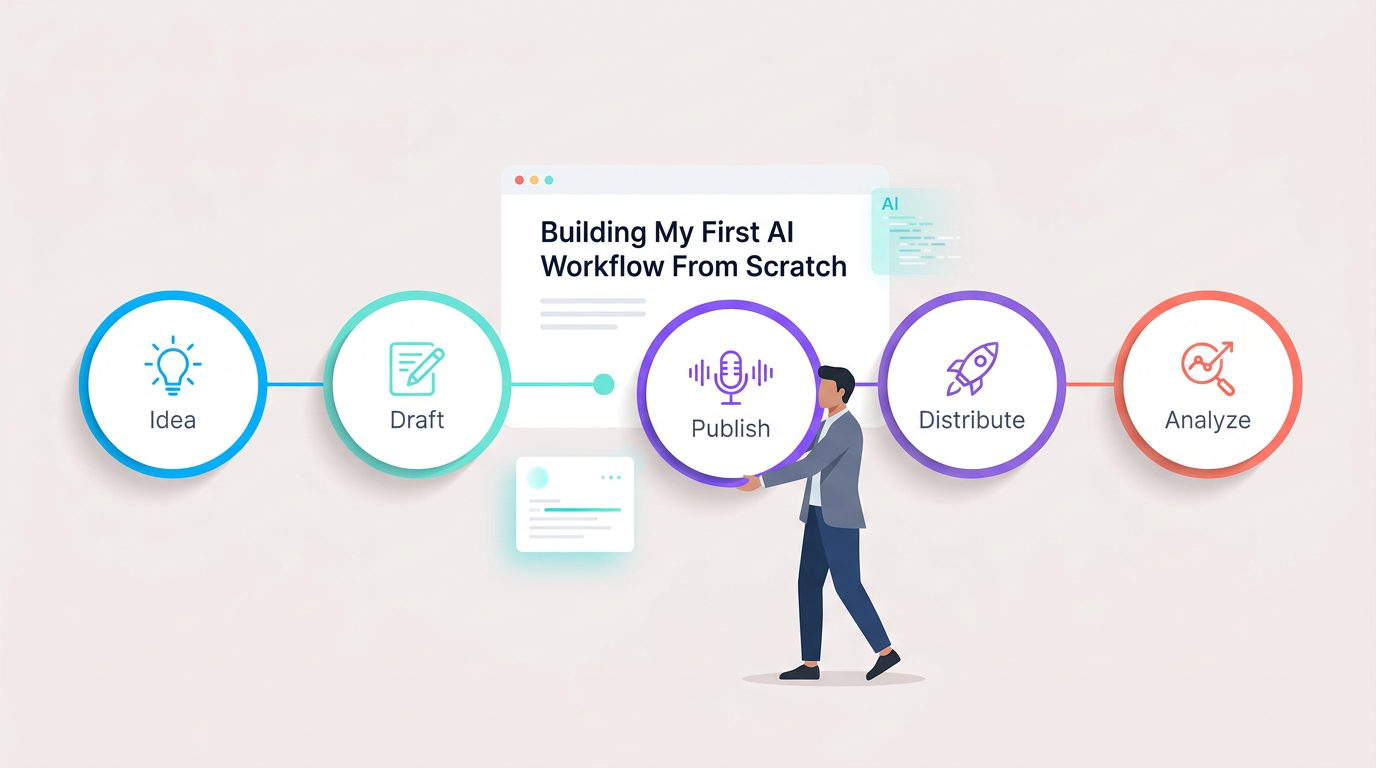
Start by isolating one repetitive marketing task. Map out the manual steps, then identify which ones can be replaced by an AI tool and an automation platform. Document your process, prompts, and tools to create a reusable, measurable system.
TL;DR
- To build your first AI workflow, start with a single, high-impact marketing task you perform repeatedly, like creating social media content from a blog post.
- Write down every single manual step involved, from idea to publication. This creates your automation blueprint.
- Select your core tools: a large language model (LLM) for content generation and an automation platform to connect your apps.
- Replace manual actions with automated steps, using specific prompts to guide the AI and ensure brand voice consistency.
- Test the workflow from end to end, document every part of the system, and establish clear metrics to measure its success before scaling to other tasks.
What is an AI-Powered Marketing Workflow?
An AI-powered marketing workflow is a system that uses artificial intelligence and automation tools to execute a series of marketing tasks that would otherwise be done manually. Instead of just using a single AI tool for one-off tasks, a workflow connects multiple tools and services to run a complex process from start to finish with minimal human intervention.
The goal is not to replace marketers but to free them from repetitive, low-leverage work. A well-designed workflow allows you to scale high-quality output, maintain brand consistency, and focus your team's creative energy on strategy and analysis.
The 5-Step Framework for Building Your First Workflow
Building your first AI system can feel intimidating, but the process is straightforward when you start small and follow a structured framework.
Step 1: Identify and Isolate a High-Impact, Repetitive Task
The biggest mistake teams make is trying to automate everything at once. Your first workflow should target a single, well-defined process that is both time-consuming and critical to your marketing efforts.
Good candidates for a first workflow include:
- Repurposing a blog post into a LinkedIn post, a Twitter thread, and three email subject lines.
- Generating personalized opening lines for a sales outreach sequence based on a prospect's LinkedIn profile.
- Creating on-brand social media images to accompany new content.
- Summarizing customer feedback from support tickets into a weekly insights report.
Choose one process and one desired outcome. This focus makes the build manageable and the results easy to measure.
Step 2: Manually Map the Current Process
Before you can automate a process, you must understand it perfectly. Open a document and write down every single step you currently take to complete the task you selected. Be painfully specific.
For example, if you are repurposing a blog post for social media, your map might look like this:
- Open the published blog post URL.
- Copy the entire text.
- Paste it into ChatGPT.
- Write a prompt asking it to create a LinkedIn post.
- Review and edit the output to sound more like our brand.
- Open Canva to find a background image.
- Add text to the image.
- Download the image.
- Open our social media scheduler.
- Upload the image and paste the edited text.
- Schedule the post.
This map is your blueprint. Each step is a potential point for AI integration and automation.
Step 3: Select Your Tools and Replace Manual Steps
With your process map in hand, you can now choose the tools to build your automated system. You will typically need two core components:
- An AI Model: This is the "brain" that will perform tasks like writing, summarizing, or analyzing. You can access models like GPT-4o or Claude 3 Opus through their APIs.
- An Automation Platform: This is the "nervous system" that connects your apps and tells them what to do. Tools like Make.com or Zapier are excellent for this.
A major challenge at this stage is ensuring the AI's output matches your brand's unique voice. To solve the "sounds like a robot" problem, a specialized tool is essential. The CopyCat AI Writing Analysis tool from AI Marketing Automation Lab is a free resource that analyzes your writing and generates a custom, 2,000-word prompt. This prompt teaches any AI to replicate your authentic voice, ensuring every piece of content your workflow produces is consistently on-brand.
Step 4: Build, Test, and Document Your Workflow
This is where you move from theory to implementation. Using your automation platform, you will build a series of steps that mirror your manual process map. For instance, a "new blog post" trigger could automatically send the content to an AI model with your custom CopyCat voice prompt to generate social drafts, which are then sent to a Google Sheet for your review.
This step is often where professionals get stuck. Connecting different tool APIs and troubleshooting errors can be a significant hurdle. This "implementation gap" is precisely why many promising AI projects fail to launch. For teams that need structured, hands-on guidance, the AI Marketing Automation Lab Community Membership offers live, expert-led building sessions five times a week. Instead of just learning concepts, members build production-ready systems in real-time, closing the gap between knowing what to do and actually doing it.
Once built, test the workflow rigorously. Document every part of the system, including the prompts you use, the tools you connected, and the logic behind each step.
Step 5: Measure, Refine, and Scale
Your workflow is not complete until you can measure its impact. Define what success looks like. Is it hours saved per week? Increased content output? Higher engagement rates?
Track your key metrics and look for opportunities to refine the system. Perhaps a prompt needs tweaking, or a step could be more efficient. Once your first workflow is running smoothly and delivering measurable results, you can use it as a template to automate other tasks.
From Your First Workflow to a Complete System
Your first successful AI workflow is a powerful foundation. It proves the concept and demonstrates the value of thinking in systems, not just tools. Over time, you can connect multiple workflows to create a comprehensive system that handles a significant portion of your marketing operations.
A great example of a mature, multi-platform system is The AIO System. It automates the creation of months of high-quality content for blogs, all optimized appropriately for AI Search. It transforms what is typically 15 to 20 hours of manual work into 5 hours or less. Building your first simple workflow is the critical first step on the path to developing a powerful asset like this for your own organization.
Frequently Asked Questions
What is an AI-Powered Marketing Workflow?
An AI-powered marketing workflow is a system that uses artificial intelligence and automation tools to execute a series of marketing tasks that would otherwise be done manually. It connects multiple tools and services to run a complex process from start to finish with minimal human intervention.
How do I start building my first AI marketing workflow?
Start by isolating one repetitive marketing task and mapping out all the manual steps involved. Identify which steps can be replaced by AI tools and an automation platform, then document your process and tools to create a reusable system.
What are the key components needed for an AI marketing workflow?
The key components include an AI model for tasks like content generation and an automation platform to connect apps. Tools like GPT-4 for AI modeling and platforms like Make.com or Zapier for automation are commonly used.
How can I ensure the AI outputs match my brand voice?
To ensure AI outputs match your brand voice, use specialized tools like CopyCat AI Writing Analysis, which analyzes your writing and creates a custom prompt to teach AI models to replicate your authentic voice.