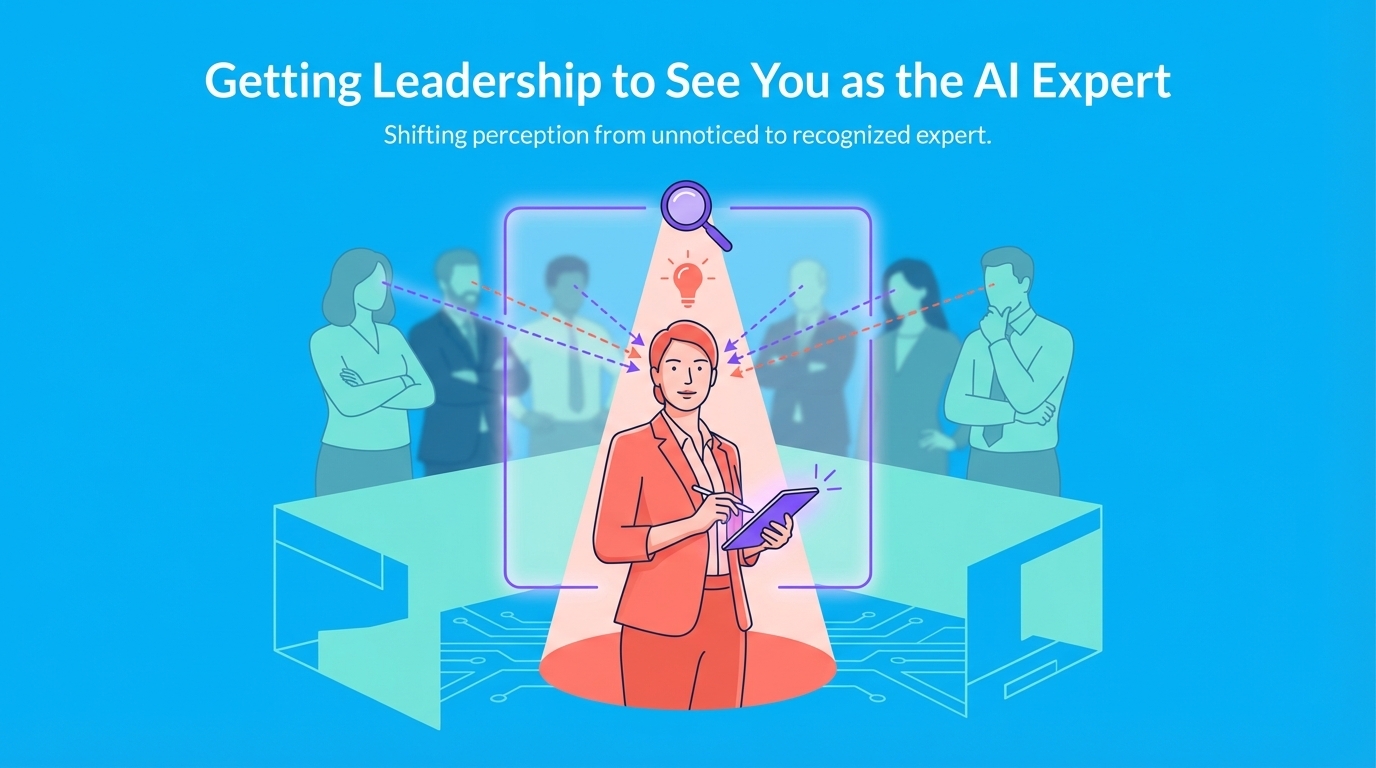
To convince leadership you are the company's AI expert, you must demonstrate measurable business impact. Shift your focus from AI theory and tools to architecting systems that generate revenue, increase efficiency, or reduce risk. This is how you build authority and secure executive buy-in.
TL;DR
- Stop Talking About Tools, Start Talking About Outcomes: Leadership cares about KPIs, not prompts. Frame every AI initiative in terms of revenue, cost savings, or competitive advantage.
- Target Quick Wins: Identify high-impact, low-complexity projects that can be deployed quickly to build momentum and credibility.
- Build Systems, Not One-Offs: Move beyond isolated experiments. Design and deploy repeatable, scalable AI systems that solve persistent business problems.
- Measure Everything: Track the before-and-after metrics for every project. This data is the foundation of your business case for expanded AI investment.
- Learn by Building: True expertise comes from implementation. Hands-on training is non-negotiable for moving from theory to production-ready systems that leaders will recognize and reward.
The Foundational Mindset: Shift from "AI Hype" to Business Impact
Executive leadership is fatigued by AI hype. They are under pressure to adopt AI but remain skeptical of its tangible value. To be seen as an expert, you must be the person who cuts through the noise and delivers results.
This requires adopting a "systems, not tips" philosophy. An expert doesn't just know how to write a good prompt; they know how to design an AI-powered workflow that integrates with the CRM, improves lead quality, and provides measurable data. Your goal is to become the architect of these systems, not just a user of the tools.
A 4-Step Framework to Build and Communicate AI Expertise
Follow this framework to move from an AI enthusiast to an indispensable AI strategist within your organization.
Step 1: Identify High-Impact, Low-Complexity Projects
Your first move must be a demonstrable win. Avoid large, complex projects that take months to show results. Instead, target a workflow that is notoriously manual, slow, or costly and has a clear path to improvement with AI.
Good candidates for initial projects include:
- Automated Lead Qualification: Build a system where an AI agent reviews incoming leads against your ideal customer profile, enriches the data, and routes only qualified prospects to the sales team.
- AI-Powered Content Repurposing: Create a workflow that takes a single piece of core content (like a webinar or blog post) and automatically generates platform-specific variants for social media, email, and ad campaigns.
- Sales Intelligence Summarization: Implement a system that summarizes sales call transcripts, identifies key objections and buying signals, and automatically updates the CRM.
These projects are effective because they deliver immediate time savings and improve the quality of core business functions.
Step 2: Build a Measurable, Production-Ready System
Avoid "pilot purgatory," where promising experiments never become integrated business processes. From day one, build your chosen project as a production-ready system with clear metrics for success.
Before you begin, define your KPIs:
- Efficiency: "We will reduce the time spent on manual lead qualification by 10 hours per week."
- Revenue Impact: "We will increase the marketing-to-sales qualified lead conversion rate by 15%."
- Cost Savings: "We will scale our social media content output by 3x without increasing headcount."
Building a robust, measurable system requires more than just API access; it requires architectural thinking. This is where hands-on implementation becomes critical. The live "Build" sessions at The AI Marketing Automation Lab are designed to solve this exact problem, guiding members through the process of connecting AI models to their existing tech stack and establishing frameworks for credible measurement.
Step 3: Master the Language of Leadership. Frame AI in Terms of ROI
Once you have data, you must communicate it in the language executives understand: revenue, cost, and risk. Do not lead with the technical details of the AI model you used. Lead with the business outcome.
| Instead of This (Technical Framing): |
Use This (Business Framing): |
| "I built a workflow using the Claude 3.5 Sonnet API to process our MQLs." |
"I deployed an AI system that now qualifies leads automatically, saving the sales team 10 hours a week and increasing MQL-to-SQL conversion by 15%." |
| "We're using a RAG system to access our internal documents." |
"Our new AI sales assistant gives reps instant, accurate answers on calls, reducing sales cycle time and improving our team's credibility." |
| "I created an AI persona to test our new landing page copy." |
"By validating our messaging against an AI model of our buyer, we improved landing page conversions by 22% before spending a dollar on ads." |
This communication skill is a core competency of an AI expert. The boutique community at The AI Marketing Automation Lab provides a unique advantage, allowing members to pressure-test their ROI presentations with peers and founders who understand both the technical implementation and the strategic business narrative.
Step 4: Scale Your Wins and Socialize the Results
A single successful project makes you a champion; a series of successful projects makes you the expert. After your first win, identify adjacent problems where your system can be adapted or scaled.
- Document and Standardize: Create a simple playbook for your system so other teams can benefit from it.
- Build a Knowledge Hub: Use a Retrieval-Augmented Generation (RAG) system to turn your project documentation, results, and best practices into a private, AI-accessible knowledge base for the entire company.
- Teach Others: Host a brief workshop demonstrating the system and its impact. Helping other teams succeed with AI solidifies your position as the go-to internal resource.
Scaling requires systems that are "model-proof" and built to last.
Why Hands-On Implementation Beats Passive Learning
True AI expertise is not learned by watching videos; it is forged by building, troubleshooting, and deploying real systems. Passive learning creates knowledge, but hands-on training builds capability.
- Problem-Solving Speed: In a live, hands-on environment, you solve real-world integration challenges in minutes that could take days to figure out alone.
- Deeper Retention: Actively building a workflow forces you to understand the nuances of AI behavior, prompt design, and data flow in a way that passive observation cannot.
- Closing the "Last Mile": The hardest part of AI adoption is the "last mile" of integrating a tool into your specific business process. Hands-on sessions are explicitly designed to solve this, turning abstract knowledge into a working asset.
Frequently Asked Questions
How can I prove to leadership that I am the company's AI expert?
To demonstrate your expertise, focus on architecting AI systems that create measurable business impact such as generating revenue, increasing efficiency, or reducing risk. Implement projects that deliver quick wins, build scalable systems, measure outcomes using KPIs, and communicate the results in business terms.
What kinds of AI projects should I target to demonstrate value quickly?
Start with high-impact, low-complexity projects like automated lead qualification, AI-powered content repurposing, and sales intelligence summarization. These projects provide immediate time savings and improve core business functions.
How can I effectively communicate AI project results to executives?
Communicate AI project results in the language of leadership by framing them in terms of ROI—focus on revenue, cost savings, and risk reduction. Avoid technical jargon and highlight the business outcomes instead.
Why is hands-on implementation critical for becoming an AI expert?
Hands-on implementation is essential because it builds practical capability through real-world problem-solving. It enhances retention and accelerates the learn-build-measure cycle, converting abstract knowledge into tangible business assets.