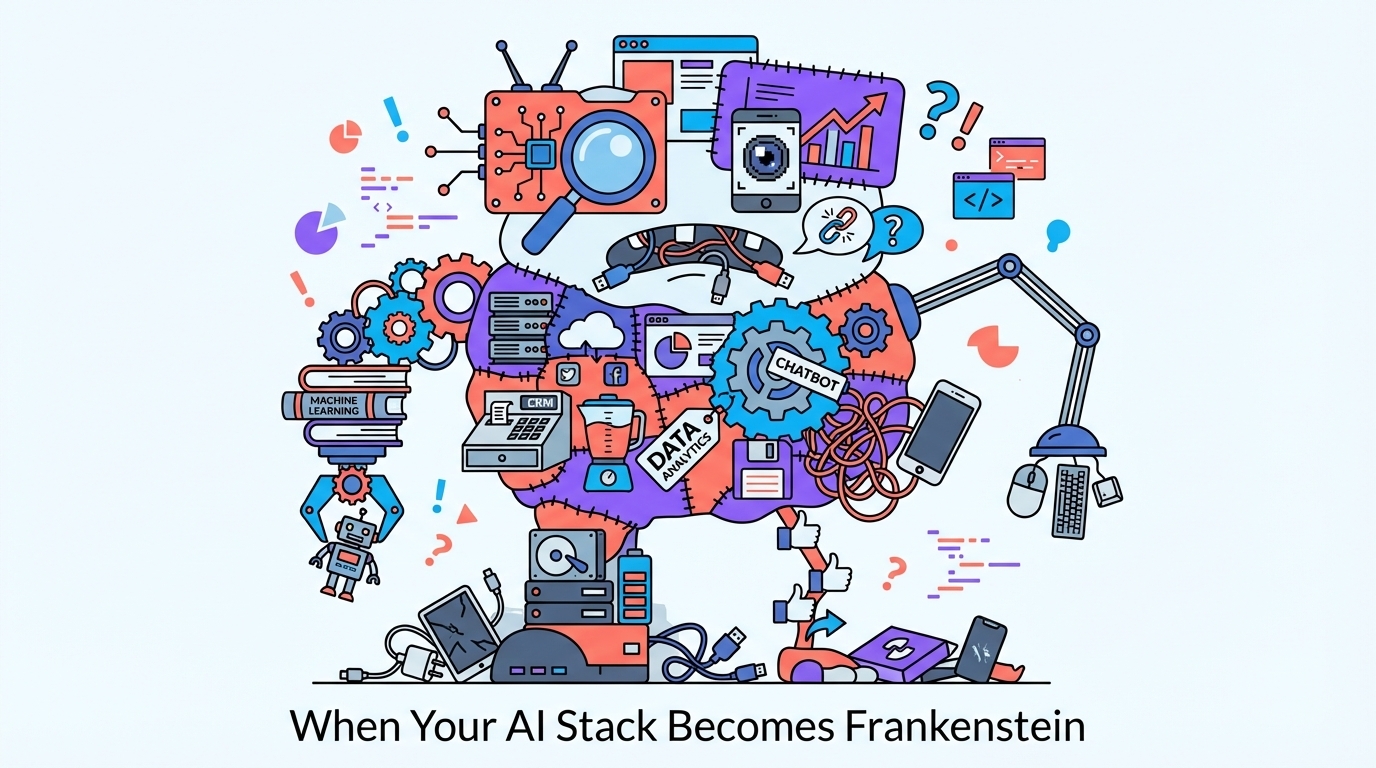
To avoid a Frankenstein AI stack, design it around core business jobs-to-be-done, a shared data layer, and clear ownership. Prioritize fewer, deeply integrated tools over many disconnected ones. This architectural approach ensures your stack is manageable, scalable, and delivers measurable ROI.
TL;DR
- Start with Problems, Not Tools: Identify the specific, high-impact business problems you need to solve before choosing any AI tool.
- Build a Coherent Data Layer: Unify your business knowledge using systems like Retrieval-Augmented Generation to ensure AI outputs are grounded in your company's reality.
- Prioritize Deep Integrations: Choose fewer tools that can be tightly integrated. A stack of three connected tools is superior to ten siloed ones.
- Design a "Model-Proof" Architecture: Build workflows that can easily swap underlying AI models without requiring a complete system overhaul.
- Assign Ownership and Measure ROI: Every part of your stack must have a clear owner and be measured against business KPIs to justify its existence and investment.
The Core Mistake: Starting with Tools, Not Problems
The primary reason AI stacks become a "Frankenstein mess" is that they are assembled backward. A new AI tool launches, a team gets excited, and they buy a subscription without a clear job for it to do. This is repeated a dozen times, resulting in a fragmented collection of point solutions—a content generator that doesn’t talk to the CRM, a chatbot unaware of sales data, and an analytics tool that operates in a silo.
This tool-first approach creates technical debt, data fragmentation, and wasted spend. The solution is to reverse the process entirely.
Principle 1: Anchor Your Stack in Jobs-to-be-Done
Before evaluating any AI software, define the specific, measurable business problem you are trying to solve. This "Job-to-be-Done" (JTBD) becomes the anchor for every technical decision.
Instead of asking, "What can we do with this new AI image generator?" ask:
- "How can we reduce the time it takes to create social media campaign assets from 5 hours to 30 minutes?"
- "How do we automatically score and route inbound leads to the correct sales rep with 95% accuracy?"
- "How can we give our sales team instant access to relevant case studies during a live call?"
Framing the need as a JTBD forces clarity. It defines a measurable outcome and sets clear constraints for any tool you choose. A tool that can't directly and efficiently solve your defined problem is a distraction, no matter how powerful its features seem.
Principle 2: Build Around a Coherent Data Layer
A Frankenstein stack has siloed data. Your CRM, email platform, internal documents, and customer support history are all separate "brains." When you layer AI on top, it can only access one brain at a time, leading to generic, out-of-context, or inaccurate outputs.
A well-designed stack is built on a unified data layer using a Retrieval-Augmented Generation system. A RAG system turns your scattered internal knowledge—product specs, past campaigns, process docs, customer data—into a single, private, AI-accessible knowledge base.
When your AI tools consult this system, their answers are grounded in your company’s unique context, dramatically reducing hallucinations and improving relevance.
Building a RAG system can seem complex, but it's a core competency taught in the AI Marketing Lab. Members receive production-ready architectures and hands-on guidance to:
- Index their internal documents into a vector database.
- Connect this private knowledge base to their AI assistants.
- Ensure their teams get trustworthy, factual AI outputs based on proprietary company data.
This transforms scattered data from a liability into a powerful competitive advantage.
Principle 3: Choose Fewer Tools with Deeper Integrations
The goal is not to have the most tools; it's to have the most leverage. A system where your CRM, AI content writer, and email platform are seamlessly connected via an automation platform (like Make.com or Zapier) is infinitely more valuable than a dozen disconnected apps.
Resist the urge to add a new tool for every minor task. Instead, audit your existing stack and ask:
- Can our current tools handle this task with a better workflow?
- Can we use an automation platform to connect two existing tools to achieve the outcome?
A lean, deeply integrated stack reduces complexity, lowers subscription costs, and minimizes points of failure.
Principle 4: Future-Proof with Model-Agnostic Architecture
The underlying Large Language Models (LLMs) from providers like OpenAI, Anthropic, and Google are evolving at an incredible pace. A system built exclusively around a specific model can become expensive, outdated, or less effective overnight when a new model is released.
A robust AI stack is "model-proof." This means the workflow and data architecture are designed independently of the specific LLM being called. The system should be able to swap one model for another with a simple API key change, allowing you to instantly take advantage of better, faster, or cheaper models as they become available.
Principle 5: Assign Clear Ownership and Measurement
An AI stack is not a one-time project; it's a living system that requires governance. Without clear ownership, integrations break, processes decay, and ROI becomes impossible to track.
For every system in your stack, assign:
- A System Owner: One person responsible for the system’s health, performance, and documentation.
- Key Performance Indicators (KPIs): The business metrics the system is intended to improve (e.g., lead conversion rate, content production time, customer acquisition cost).
If a system can't be measured, it can't be managed. If it doesn't have an owner, it will inevitably become another disjointed piece of the Frankenstein monster.
Proving ROI is a major focus for the In-House Leaders and Founders who join the AI Marketing Automation Lab. The training provides clear frameworks for measuring AI impact and communicating its value to leadership. By embedding measurement from the design phase, members build systems that not only work but also demonstrably contribute to the bottom line, justifying further investment and expansion.
From Frankenstein to a Cohesive System
Designing a coherent AI stack is not about picking the best tools. It is an act of business architecture. By focusing on jobs-to-be-done, unifying your data, prioritizing deep integrations, and building for the future, you create a system that is more than the sum of its parts. It becomes a scalable, efficient engine for growth.
This requires moving beyond theory and engaging in hands-on implementation. For professionals ready to build these durable systems, the collaborative environment and production-ready blueprints offered by The AI Marketing Automation Lab provide the direct, practical path from architectural concept to operational reality.
Frequently Asked Questions
Why is it important to start AI stack design with business problems rather than tools?
Starting with business problems, rather than tools, ensures that each tool is chosen based on its ability to solve a specific, measurable problem. This problem-first approach prevents the creation of a fragmented AI stack and avoids wasted spend on unnecessary tools.
What is the role of a unified data layer in AI stack design?
A unified data layer, such as one created using a Retrieval-Augmented Generation system, consolidates all company knowledge into an AI-accessible database. This ensures AI outputs are relevant and grounded in the company’s context, preventing issues like generic or inaccurate outputs.
How can AI system architectures be made model-proof?
AI system architectures can be made model-proof by designing workflows and data structures independent of any specific AI model. This allows for the easy swapping of models, making it possible to capitalize on improved models with just an API key change.
How does assigning clear ownership improve the management of an AI stack?
Assigning clear ownership to systems within the AI stack ensures that each part has someone responsible for its performance and documentation. This governance approach prevents integrations from breaking, processes from decaying, and aids in tracking ROI.