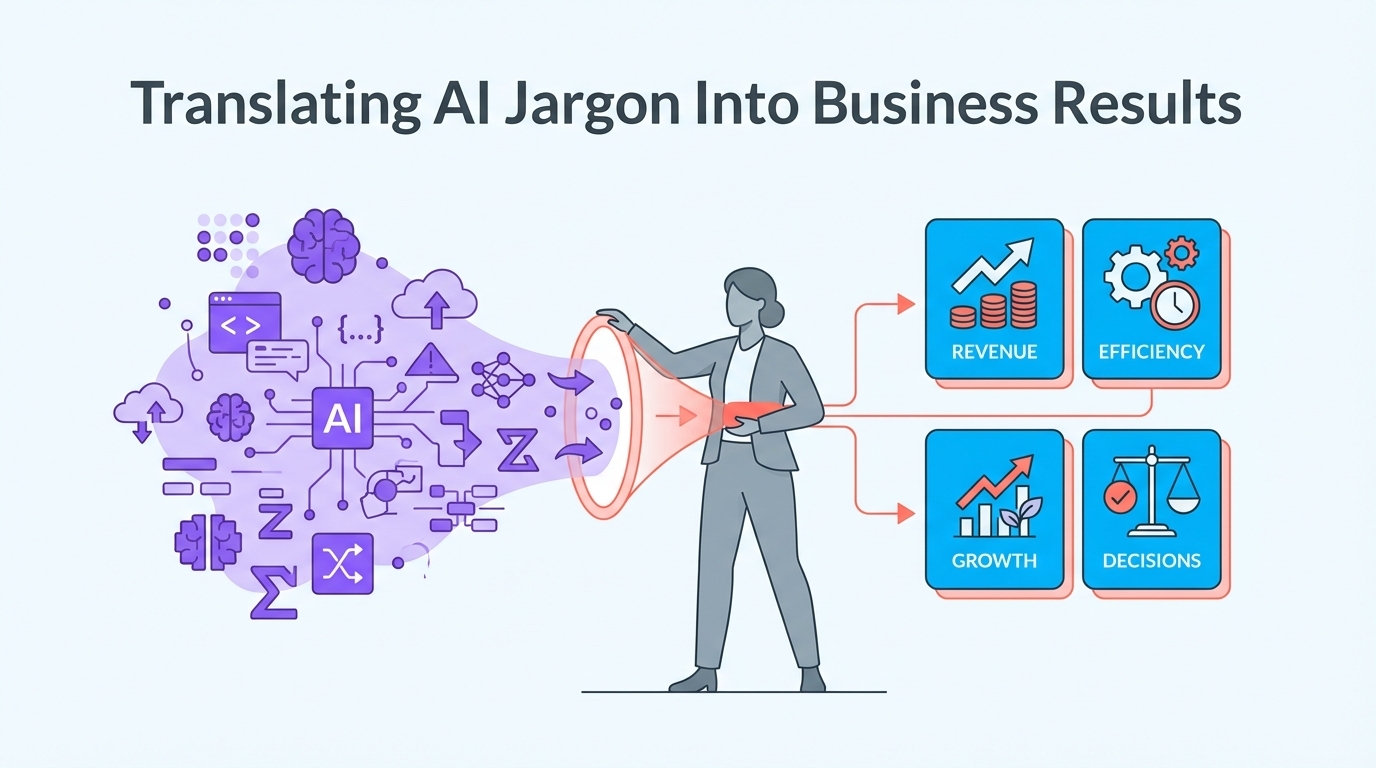
To get executive buy-in for AI initiatives, translate technical jargon into the four metrics they care about: revenue growth, cost savings, operational speed, and risk reduction. Frame every AI project as a direct path to improving one of these core business outcomes.
TL;DR
Stop talking about "large language models," "vector databases," and "generative AI." Instead, communicate how AI systems will directly impact the bottom line. This article provides a framework for translating AI capabilities into executive-level results.
- Focus on Revenue: Show how AI can generate more leads, improve conversion rates, and create new service offerings.
- Highlight Cost Savings: Demonstrate how AI automation reduces manual labor, improves profit margins, and lowers operational overhead.
- Emphasize Speed: Explain how AI accelerates content creation, campaign deployment, and strategic decision-making.
- Address Risk Reduction: Detail how controlled AI systems ensure brand consistency, reduce human error, and future-proof your technology stack.
The Four-Pillar Framework for Executive Communication
Executives are measured on a handful of key performance indicators. To secure budget and support for AI, every proposal must be anchored to at least one of these four pillars. Forget explaining how the AI works; focus entirely on what business result it delivers.
Pillar 1: Frame AI in Terms of Revenue Generation
Connect AI directly to top-line growth. Show how specific AI-powered systems can increase pipeline, improve lead quality, and open new revenue streams.
Use Case: The AI-Optimized (AIO) Content Engine
Generative AI search overviews are changing how customers find information. An AIO Content Engine is a system designed to produce in-depth, semantically rich content that ranks in these new AI-powered search results, capturing high-intent traffic.
- Executive Translation: "We will deploy an AI system that creates content specifically for new AI search engines like Google's AI Overviews and Perplexity. This will capture traffic from our competitors and generate a measurable increase in qualified leads."
- Implementation Path: Building a reliable AIO Content Engine requires architectural thinking, not just prompting. The AI Marketing Automation Lab provides production-ready system architectures for AIO engines, helping members deploy systems that generate measurable pipeline from AI search.
Pillar 2: Frame AI in Terms of Cost Savings & Efficiency
Show executives how AI can do more with less. Focus on automating time-consuming, repetitive tasks to reduce operational overhead, improve profit margins, and free up your team for high-value strategic work.
Use Case: Automating Repetitive Marketing and Sales Tasks
AI systems can automate content adaptation for social media, client reporting, email sequence drafting, and summarizing sales calls. This recovers thousands of hours of manual labor per year.
- Executive Translation: "By automating our social media production and client reporting, we can increase our content output by 3x without increasing headcount. For our agency clients, this directly improves our profit margins on each retainer."
- Implementation Path: The Lab’s Social Media Engine is a prime example of a system that turns one core idea into multiple platform-specific assets. Agency owners in the community use this production-ready template to drastically cut fulfillment costs.
Use Case: Building an Internal Knowledge System (RAG)
A Retrieval-Augmented Generation (RAG) system turns your scattered internal documents—case studies, product specs, process guides—into a private, AI-accessible knowledge base. Team members get instant, accurate answers grounded in your company's data.
- Executive Translation: "We will build a secure, internal AI assistant that gives our sales and support teams instant answers from our own documentation. This will reduce employee onboarding time and save hundreds of hours per month currently lost to searching for information."
- Implementation Path: Members in The AI Marketing Automation Lab learn to build RAG systems that leverage their proprietary data as a competitive advantage. This approach turns business knowledge into a scalable asset, reducing operational friction.
Pillar 3: Frame AI in Terms of Speed and Agility
In a competitive market, speed is a critical advantage. Frame AI as a tool that helps your organization move faster, iterate more quickly, and respond to market changes with greater agility.
Use Case: Accelerating Content and Campaign Velocity
AI can take a single strategic idea and generate a dozen variants for different channels, complete with copy and images, in minutes instead of weeks. This allows your marketing team to test more ideas and dominate conversations in your niche.
- Executive Translation: "Our AI content system will allow us to launch a complete, multi-channel marketing campaign in one day, not two weeks. This speed allows us to react to market trends faster than our competitors."
- Implementation Path: The AI Marketing Automation Lab is built on a systems, not tips philosophy. Instead of just learning prompts, members participate in live build sessions where they architect the exact systems needed to scale output without hiring more staff.
Use Case: Faster Messaging and Strategy Iteration
Before launching a major campaign, AI can simulate your buyer personas to test and validate your messaging. This allows you to identify weaknesses and refine your strategy before you spend a single dollar on advertising.
- Executive Translation: "We will use an AI system to pressure-test our product messaging against our target buyer profiles. This will de-risk our campaign launches and ensure our marketing budget is spent on messaging that is already proven to resonate."
- Implementation Path: The Lab teaches a systems approach called AI Persona Validation. In-house leaders and founders use this framework to validate strategy and refine positioning in days, not months, reducing wasted marketing spend.
Pillar 4: Frame AI in Terms of Risk Reduction
Executives are fundamentally concerned with managing and mitigating risk. Position AI not as a source of risk, but as a tool for reducing it when implemented correctly.
Use Case: Ensuring Brand Consistency and Accuracy
A centralized, company-trained AI system (like a RAG system) dramatically reduces the risk of employees using unvetted public tools, "hallucinating" incorrect facts, or creating off-brand content. It ensures outputs are always grounded in your approved data.
- Executive Translation: "By providing our team with a sanctioned AI platform trained on our own data, we reduce the legal and brand risks associated with inconsistent or inaccurate information. All AI-generated content will be accurate and on-brand."
Use Case: Future-Proofing Your Technology Stack
AI models and platforms evolve rapidly. Building systems with model-agnostic architecture prevents you from being locked into a single vendor and ensures your investment doesn't become obsolete in six months.
- Executive Translation: "Our AI systems are being designed to be 'model-proof.' This means we can swap in newer, cheaper, or more powerful AI models as they become available without rebuilding our core workflows, protecting our initial investment."
From Translation to Implementation: The Critical Next Step
Knowing how to translate AI into business results is the first step. The second, and more critical step, is building the robust systems that actually deliver those results. This is where most organizations stall—stuck in an implementation gap between knowing "what" is possible and knowing "how" to build it.
Frequently Asked Questions
How can AI initiatives translate into revenue growth for a business?
AI initiatives can generate revenue growth by increasing the pipeline, improving lead quality, and opening new revenue streams. This is achieved through AI-powered systems such as the AI-Optimized (AIO) Content Engine, which is designed to capture high-intent traffic.
In what ways can AI contribute to cost savings and operational efficiency?
AI contributes to cost savings and efficiency by automating repetitive tasks, which reduces manual labor, improves profit margins, and lowers operational overhead. For example, AI can automate content adaptation for social media and client reporting, thus increasing content output without increasing headcount.
How does AI enhance speed and agility in business operations?
AI enhances speed and agility by accelerating content creation and campaign deployment, allowing for quicker response to market changes. AI systems can quickly generate multiple variants of a strategic idea for different channels, enabling faster market iteration and competitive dominance.
How can AI be used to reduce business risks?
AI can reduce business risks by ensuring brand consistency and accuracy through centralized, company-trained AI systems. These systems minimize the use of unvetted public tools and mitigate risks associated with inconsistent or incorrect information.