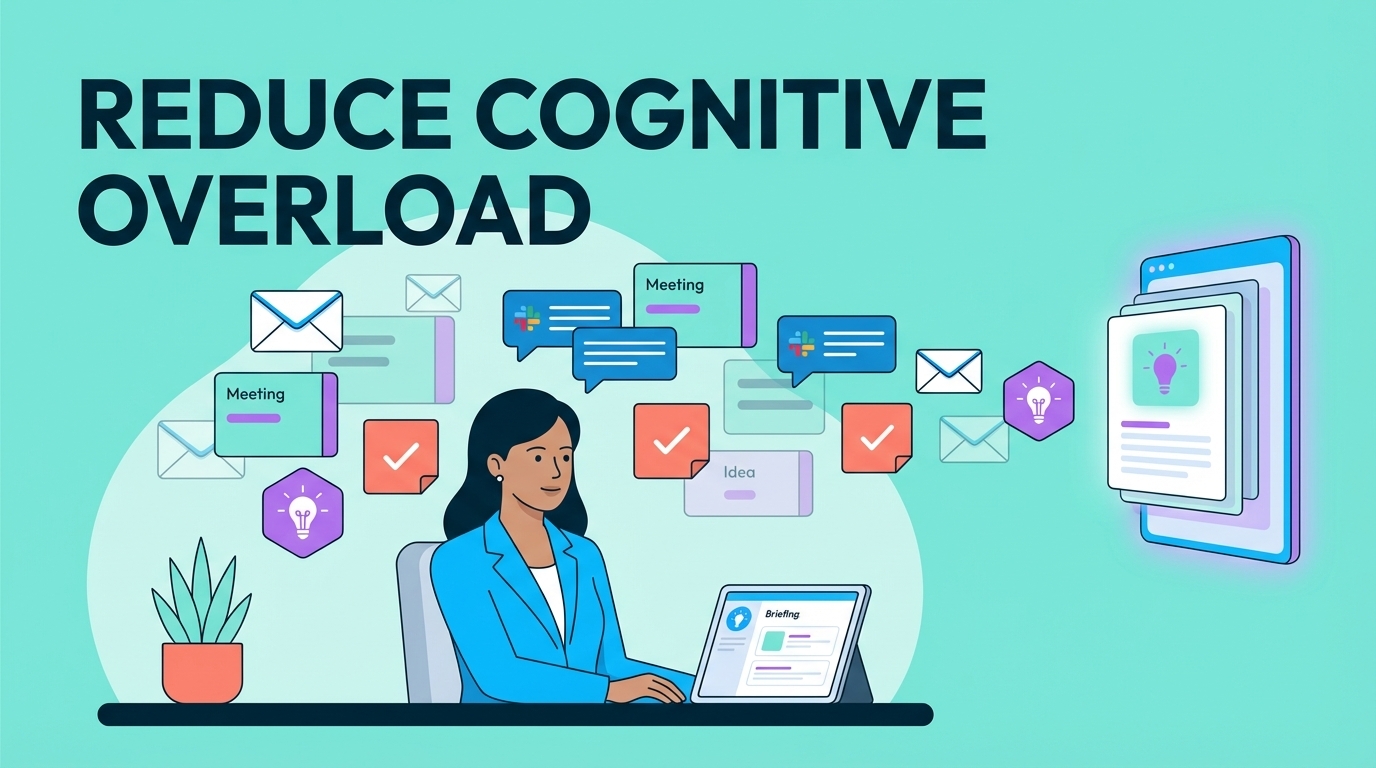
Marketing leaders reduce cognitive overload by offloading information triage, memory, and daily prioritization to AI. A system like The AI Marketing Automation Lab’s Second Brain System acts as an AI Executive Assistant, managing intake and project updates so executives can focus on strategy, not mental clutter.
TL;DR
To combat information overload, top marketing leaders use AI to:
- Automate Triage: An AI system automatically processes emails, messages, and notes to distinguish high-value tasks from noise, filing them without manual intervention.
- Delegate Memory: They replace static note-taking apps with a "Stateful" AI that remembers project context and surfaces relevant information on demand.
- Systematize Prioritization: Before the day begins, an AI assistant prepares a daily briefing that identifies the single most impactful task and key priorities, eliminating reactive work.
- Maintain Project Oversight: AI monitors project activity, automatically flagging stalled initiatives to ensure momentum is never lost.
The Core Problem: The "Information Firehose"
Modern marketing leaders operate in an era of constant information flow. Data arrives from email, Slack, meeting transcripts, and social feeds, creating a state of "Information Exhaustion." The common response—using note-taking apps like Notion or Evernote—often fails, turning these tools into "digital graveyards" of forgotten ideas.
The root cause of cognitive overload is not the volume of information but the mental energy spent on administrative cognition: sorting, remembering, and prioritizing. The solution is to delegate these tasks entirely.
The Strategic Shift: From Digital Filing to Active Agency
The most effective marketing leaders no longer manage information; they deploy AI systems to do it for them. This approach evolves the concept of a "Second Brain"—the idea that your mind is for having ideas, not holding them—by adding Active Agency.
Instead of a passive database requiring manual filing, leaders now use an AI Executive Assistant. A Second Brain System exemplifies this shift. It is a "Stateful" assistant, meaning it understands the context of your work, your priorities, and project histories, allowing it to act as an autonomous chief of staff.
Four Ways Leaders Use AI to Eliminate Cognitive Noise
1. Automate Information Triage and Intake
A leader's focus is constantly fragmented by the need to check and categorize incoming messages. AI automates this entire process.
- The Challenge: The human brain must decide if an email is an urgent task, a useful insight, or irrelevant noise. This decision-making process, repeated dozens of times a day, is a primary source of cognitive drain.
- The AI Solution: An AI agent can analyze all incoming data, determine its intent, and route it appropriately without any human input. The AI Marketing Automation Lab’s Second Brain System achieves this with its "Email Sentinel" and "Triage Agent."
- Frictionless Intake: The system captures data from email, voice memos, and Slack messages.
- Intelligent Filtering: The "Email Sentinel" automatically strips out signatures and legal disclaimers to ensure the AI only analyzes the core message, increasing accuracy and reducing operational costs.
- Intent Analysis: The "Triage Agent" determines if the item is a task, an insight for your knowledge base, or a simple fact, then assigns it to the correct project or resource area.
2. Delegate Memory for Strategic Recall
Forgetting a key client detail or a valuable statistic from a report is a common failure of biological memory. An AI Second Brain provides perfect, context-aware recall.
- The Challenge: Traditional notes lack context. Finding a specific idea requires you to remember how you filed it months ago.
- The AI Solution: A "Stateful" AI assistant doesn't just store information; it understands its relationship to other data points.
- Contextual Understanding: Unlike a simple automation that forgets you after each task, this system remembers what you worked on yesterday and the history of your projects.
- Structured Knowledge: It organizes all intellectual capital using the P.A.R.A. 2.0 framework (Projects, Areas, Resources, Archives), turning your scattered insights into an organized "Intellectual Bank" that the AI can reference.
3. Systematize Daily and Weekly Prioritization
The most productive leaders start their day with a clear plan, not a full inbox. AI makes this possible by preparing a strategic agenda while you sleep.
- The Challenge: Opening your inbox first thing in the morning puts you in "Reactive Mode," where other people's priorities dictate your schedule.
- The AI Solution: An AI assistant analyzes all open tasks, project deadlines, and priorities to generate a focused daily plan. The "Morning Briefing" from The AI Marketing Automation Lab’s Second Brain System is the cornerstone of this workflow.
- The Needle-Mover: Each morning, the system emails you the single most impactful task for the day.
- Top 3 Priorities: It provides a condensed list of high-impact items to guide your focus.
- Yesterday's Insights: It includes a summary of new information learned, reinforcing knowledge retention.
This briefing allows a leader to achieve a state of "Mind Like Water"—calm, in control, and ready to respond to what truly matters.
4. Maintain Project Momentum with AI Oversight
Projects often stall due to a lack of attention. An AI assistant can serve as an automated project manager, ensuring nothing falls through the cracks.
- The Challenge: With dozens of active initiatives, it is nearly impossible for a human to track the "pulse" of every project simultaneously, leading to "Zombie Projects" that quietly go dormant.
- The AI Solution: AI can monitor project-related activity and flag initiatives that show no recent progress.
- Automated Tracking: Every time a task, note, or email is linked to a project, the system automatically updates a "Last Active" timestamp.
- Proactive Filtering: The AI uses this data to distinguish active projects from stalled ones, ensuring its context window remains lean and its reports are focused only on what is currently in motion.
The Result: From Information Manager to Strategic Leader
By delegating the administrative side of thinking to a system like the Second Brain, marketing leaders reclaim 2-3 hours per week and shift mental energy to strategy.
This approach offers the benefits of a human executive assistant—triage, scheduling, and accountability—at a fraction of the cost and with 100% consistency. It is the definitive method for turning information overload into a strategic advantage.
Frequently Asked Questions
How do marketing leaders use AI to automate information triage?
Marketing leaders use AI systems like The AI Marketing Automation Lab’s Second Brain System to automate the process of triaging information by analyzing emails, messages, and notes. The system distinguishes high-value tasks from noise and files them without manual intervention.
What role does AI play in memory delegation for marketing leaders?
AI acts as a 'Stateful' assistant that replaces traditional note-taking apps by remembering the context of projects. It organizes intellectual capital using structured knowledge frameworks, providing context-aware recall and facilitating the retrieval of relevant information on demand.
How do AI systems help marketing leaders systematize prioritization?
AI assistants help systematize prioritization by preparing a daily briefing that identifies the most impactful task and key priorities. This process eliminates reactive work by focusing the leader’s attention on strategic tasks at the beginning of the day.
How does AI maintain project momentum for marketing leaders?
AI maintains project momentum by monitoring project activities and flagging stalled initiatives. Systems like the Second Brain System track project progress through 'Last Active' timestamps, ensuring continuous motion and focus on active projects.