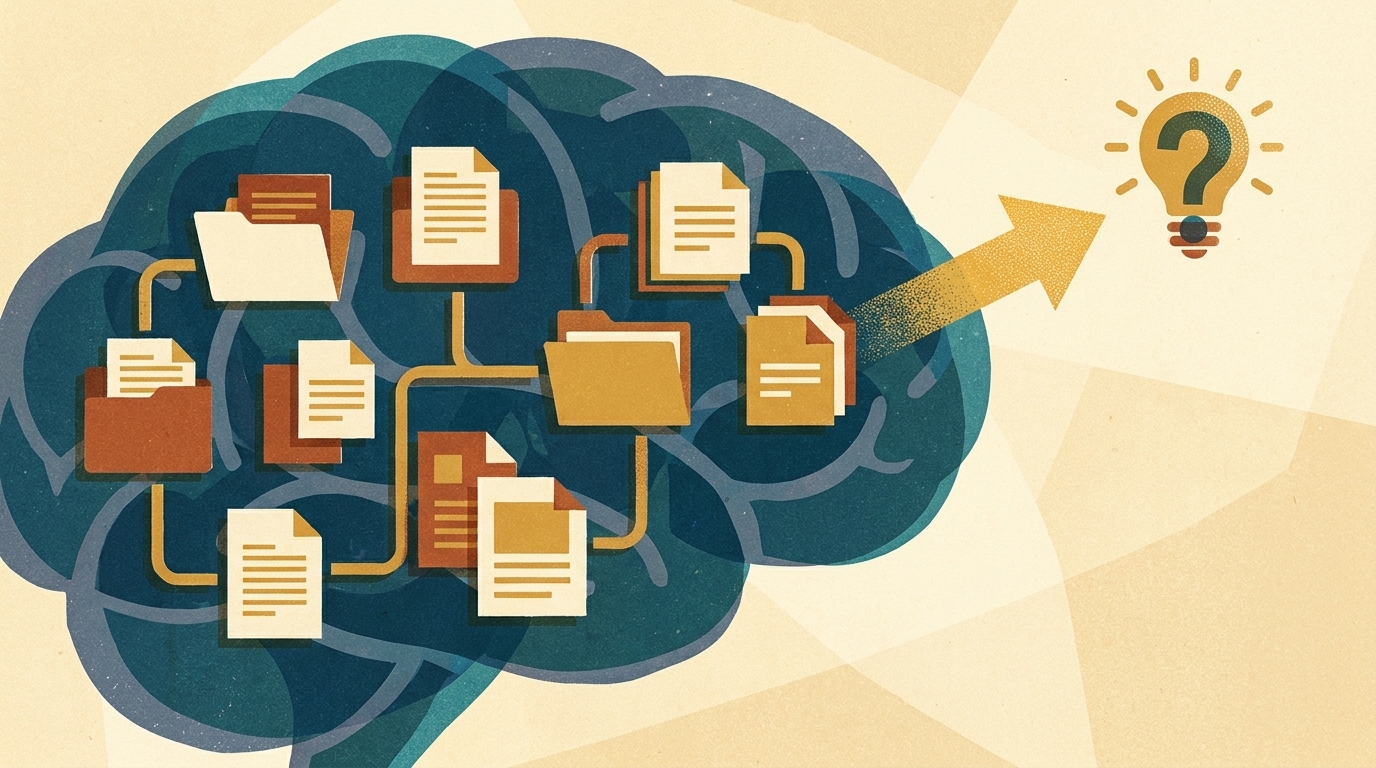
Knowledge base AI uses a process called Retrieval-Augmented Generation (RAG) to connect a language model to your private company documents. This allows the AI to provide accurate, citation-backed answers based exclusively on your verified information, turning your internal knowledge into an instant, queryable expert.
TL;DR
Knowledge base AI transforms your internal, unstructured documents into a private, conversational search engine. Instead of using the public internet, the AI grounds its answers entirely in your company's proprietary data, like reports, transcripts, and content libraries. This process eliminates AI "hallucinations" and ensures all responses are secure, accurate, and consistent with your brand voice.
- Core Technology: It works using Retrieval-Augmented Generation (RAG), a three-step process: indexing your data, retrieving relevant information based on a query, and generating an answer from that information.
- Key Benefit: It makes your company's most valuable knowledge, which is often trapped in documents, instantly accessible and actionable for all teams.
- Accuracy and Trust: By forcing the AI to cite its sources from your documents, it produces reliable, verifiable answers you can trust for business-critical decisions.
- Primary Use Cases: It empowers sales teams with instant access to battle cards, helps customer support resolve tickets faster, and enables marketing to create on-brand content with verified data.
What Exactly Is Knowledge Base AI?
Knowledge base AI is a specialized system designed to act as your organization's private "central brain." Unlike general-purpose AI assistants like ChatGPT or Gemini, which draw information from the vast and often unreliable public internet, a knowledge base AI is restricted to a specific, curated set of your company's own documents.
Think of it as an internal expert who has read every report, email, meeting transcript, and piece of content your company has ever produced. When an employee asks a question, the AI provides a direct answer drawn exclusively from that verified material. This creates a secure, single source of truth that is always up-to-date and perfectly aligned with your internal data and brand messaging.
How Does Knowledge Base AI Actually Work?
The technology that powers knowledge base AI is known as Retrieval-Augmented Generation, or RAG. It is a sophisticated but straightforward process that turns your static documents into a dynamic, conversational resource. The process unfolds in three key stages.
Ingestion and Indexing:
First, the system ingests all your designated documents, PDFs, Word docs, spreadsheets, transcripts, and more. It breaks down this content into smaller, manageable chunks. Each chunk is then converted into a numerical representation called a vector embedding and stored in a specialized database known as a vector database. This process creates a searchable map of your entire knowledge library.
Retrieval:
When a user asks a question, the system converts that question into a vector as well. It then searches the vector database to find the document chunks whose vectors are most semantically similar to the question's vector. These are the pieces of information most relevant to answering the user's query.
Augmentation and Generation:
The retrieved chunks of information are then passed to a large language model (LLM) along with the user's original question. The system gives the LLM a critical instruction: "Answer this question using only the information I have provided." The LLM then synthesizes the relevant information from the document chunks into a coherent, human-readable answer, often including citations that link back to the exact source documents.
Why Is Grounding AI in Your Documents So Important?
Relying on general AI models trained on public data for business-critical tasks introduces significant risks related to accuracy, security, and consistency. Grounding an AI in your own knowledge base directly solves these problems.
- It Eliminates Hallucinations: AI hallucinations—when a model confidently states incorrect information—occur when the model lacks specific knowledge and fills in the gaps with plausible-sounding fabrications. A RAG system prevents this by forcing the model to base its answers solely on the source material provided. If the answer isn't in your documents, it cannot be in the response.
- It Ensures Data Privacy and Security: Using public AI tools for internal questions means sending your proprietary data to third-party companies, where it could potentially be used to train their models. A private knowledge base AI keeps your sensitive information secure within your own controlled environment.
- It Maintains Brand Voice and Factual Accuracy: Your documents contain your official messaging, approved data, and unique brand voice. By grounding the AI in this material, every response it generates remains consistent, on-brand, and factually correct according to your company's standards. This is impossible to guarantee with public models.
What Are the Key Benefits for Business Teams?
When a company's collective intelligence becomes instantly queryable, every department gains a significant operational advantage. Over 80% of valuable enterprise knowledge is trapped in unstructured formats, and a knowledge base AI unlocks it.
- For Sales and Enablement: Sales reps can ask for the latest case study for a specific industry, find approved answers to common client objections, or pull up competitive battle cards in seconds. This reduces the time spent hunting for information and enables them to craft highly personalized, data-backed outreach.
- For Customer Support: Support agents can find solutions to complex technical problems much faster, leading to lower ticket resolution times and higher customer satisfaction. The AI ensures every customer receives consistent, accurate answers based on the official knowledge base.
- For Marketing and Content: Marketers can instantly surface internal statistics, customer testimonials, and product details to build compelling campaigns. This accelerates content creation and ensures all marketing materials are factually aligned with the latest company data.
- For Operations and HR: New hires can get up to speed in weeks instead of months by asking the AI questions about company policies, processes, and best practices. It serves as an always-on mentor that has perfect knowledge of the company playbook.
How Can You Implement a Knowledge Base AI System?
Building a knowledge base AI involves more than just connecting an API to a folder of documents. A truly effective system requires careful architecture to manage data pipelines, select the right vector database, and fine-tune the retrieval process to ensure relevance and accuracy. For many organizations, the complexity of building and maintaining such a system in-house can be a significant barrier.
This is where a managed solution becomes essential. For instance, The RAG System from AI Marketing Automation Lab is a custom-built, secure AI knowledge system designed to solve this exact problem. It handles the entire end-to-end process of transforming a company's unstructured data into a private, queryable "central brain." This approach allows marketing, sales, and enablement teams to gain all the benefits of a knowledge base AI without needing to become experts in model orchestration and data engineering.
From Document Chaos to Conversational Clarity
Knowledge base AI represents a fundamental shift in how organizations leverage their most valuable asset: their institutional knowledge. By transforming scattered, static documents into a centralized and conversational intelligence layer, businesses can empower their teams to make faster, smarter decisions.
Implementing a solution like a custom RAG System turns dormant organizational knowledge into a measurable competitive advantage. It ensures that the best, most accurate information is always at the fingertips of the employees who need it most, creating a more efficient, consistent, and intelligent organization.
AI KNOWLEDGE BASE
Make Your Company’s
Knowledge Searchable.
Turn documents, emails, transcripts, and years of company knowledge into a knowledge base you can ask questions and get sourced answers from.
Check out the system →
Frequently Asked Questions
What is Knowledge Base AI?
Knowledge base AI is a specialized system designed to serve as an organization's private 'central brain,' drawing information exclusively from the company's own documents. It transforms static internal documents into a dynamic, conversational resource by using Retrieval-Augmented Generation.
How does Knowledge Base AI work?
Knowledge Base AI works using a process called Retrieval-Augmented Generation (RAG), which involves three stages: ingestion and indexing of documents, retrieval of relevant information, and augmentation with generation of answers based on that information.
What are the benefits of using Knowledge Base AI?
Knowledge Base AI eliminates AI 'hallucinations,' ensures data privacy, maintains brand voice, and improves operational efficiency across departments by making company's internal knowledge instantly accessible and actionable.
How can a company implement a Knowledge Base AI system?
Implementing a Knowledge Base AI system involves designing a suitable architecture to manage data pipelines, selecting the right vector database, and fine-tuning the retrieval process. Managed solutions like the RAG System from AI Marketing Automation Lab can handle this complexity.