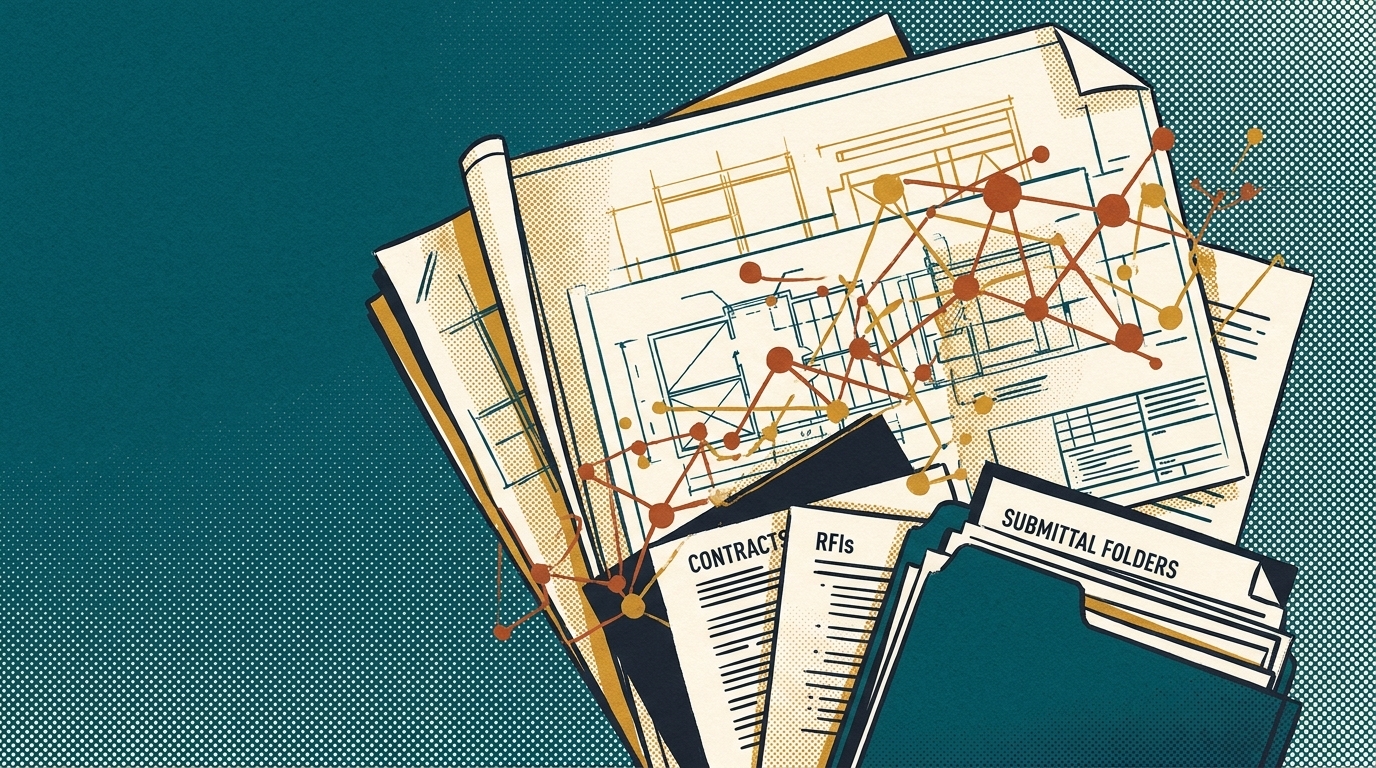
AI in construction project management automates daily reporting, analyzes schedules for potential delays, and makes project documents instantly searchable. It acts as a digital assistant, connecting field data to the office to improve decision making, safety, and efficiency without manual data entry.
TL;DR
AI is moving from a theoretical concept to a practical tool on the job site. It solves tangible problems by automating low-value tasks and providing data-driven insights that were previously impossible to access.
- Automated Reporting: AI drafts daily logs and progress reports by analyzing voice notes, photos, and site data, saving hours of administrative work.
- Intelligent Document Search: AI makes all project documents, from blueprints to contracts, instantly searchable, providing immediate answers to complex questions.
- Predictive Schedule Analysis: AI algorithms analyze project data to identify potential schedule risks and forecast delays before they impact the critical path.
- Enhanced Safety and Compliance: AI uses computer vision to monitor job sites for safety hazards, such as missing personal protective equipment (PPE), and ensure regulatory compliance.
- Streamlined Communication: AI transcribes project meetings, summarizes key decisions, and automatically extracts and assigns action items, ensuring nothing gets missed.
How Does AI Automate Daily Construction Reporting?
One of the most time-consuming tasks for any site supervisor or project manager is compiling the daily log. After a long day in the field, they spend hours transcribing notes, organizing photos, and documenting weather conditions, manpower, and work completed. This administrative burden is a prime candidate for AI automation.
AI platforms can now integrate multiple data streams to generate comprehensive daily reports with minimal human input. A superintendent can use a mobile app to record voice notes throughout the day, describing progress and issues on site. AI uses natural language processing (NLP) to transcribe these notes and categorize the information correctly.
Modern systems can also:
- Analyze Photos: When a field team member uploads photos, AI can identify the location, recognize the work being performed, and even count equipment or materials.
- Integrate External Data: The system automatically pulls in weather data, records manpower from digital sign-in sheets, and logs equipment usage.
- Draft the Report: At the end of the day, the AI combines all this information into a structured, near-complete daily log. The project manager simply needs to review, edit, and approve it.
This process transforms a two-hour administrative task into a ten-minute review, freeing up project leaders to focus on problem-solving and planning.
How Can AI Make Project Documents Instantly Searchable?
A typical construction project generates thousands of documents: architectural drawings, structural plans, specifications, contracts, RFIs, change orders, and submittals. Over 80% of this critical project knowledge is locked inside these unstructured documents, making it incredibly difficult to find specific information quickly. A project manager needing to verify a fire rating for a specific door might spend 30 minutes digging through a 500-page PDF.
This is where a Retrieval-Augmented Generation (RAG) system becomes a game changer. This technology creates a private, queryable "central brain" for the entire project. All documents are ingested into a secure knowledge base that teams can interact with using natural language.
For example, The RAG System from AI Marketing Automation Lab transforms a project's entire library of documents into an intelligent assistant. Instead of manually searching, a user can simply ask:
- "What is the required PSI for the concrete in the third-floor slab?"
- "List all approved submittals for the HVAC system."
- "What are the warranty requirements for the roofing membrane?"
The system provides an immediate, accurate answer and cites the exact page and document it came from. This eliminates guesswork, prevents costly errors based on outdated information, and gives every team member instant access to the project's single source of truth. Deals and decisions no longer stall while someone hunts for a specific clause in a contract.
Can AI Predict and Prevent Schedule Delays?
Construction schedules are notoriously complex, with thousands of interdependent activities. A small delay in one area can create a ripple effect that jeopardizes the entire project timeline. While experienced project managers are skilled at identifying risks, a human can't track every single variable simultaneously.
AI excels at this type of complex data analysis. By feeding project data into predictive analytics models, AI can identify potential delays long before they become critical. These systems analyze:
- Progress Reports: Comparing planned progress against actual work completed.
- Resource Availability: Tracking labor, equipment, and material supply chains.
- Historical Data: Learning from past projects to identify common bottlenecks.
- External Factors: Incorporating weather forecasts and other external risks.
The AI doesn't just flag a potential delay; it can run simulations to show its downstream impact on the critical path and suggest proactive solutions. For instance, it might identify a future labor shortage for a specific trade and recommend adjusting the schedule or securing additional resources now. This shifts project management from a reactive to a proactive discipline.
How Does AI Improve Job Site Safety and Compliance?
Maintaining a safe job site is the highest priority in construction, but it is also a significant challenge. Manually monitoring a large, dynamic site for every potential hazard is nearly impossible. AI-powered computer vision provides a powerful solution.
By analyzing feeds from existing site cameras, AI models can automatically detect safety risks in real time. These systems are trained to identify:
- PPE Violations: Flagging individuals not wearing hard hats, safety glasses, or high visibility vests.
- Unsafe Zones: Alerting supervisors if workers enter a restricted area without authorization.
- Improper Equipment Use: Identifying incorrect operation of heavy machinery or tools.
- Environmental Hazards: Detecting spills, trip hazards, or improperly stored materials.
When the AI detects an issue, it can send an instant alert with a photo or video clip to the site safety manager. This allows for immediate correction of the hazard. Furthermore, this creates a digital record of safety compliance, which is invaluable for internal audits, regulatory reporting, and lowering insurance premiums.
What is the Role of AI in Managing Project Communications?
Clear communication is the backbone of successful project management. However, critical information is often buried in long email chains or discussed in meetings without being properly documented. AI tools are emerging to solve this by structuring and summarizing project communications.
AI-powered software can now transcribe and analyze audio from project meetings, such as weekly Owner, Architect, and Contractor (OAC) meetings. After the meeting, the AI provides:
- A Full Transcription: A searchable text version of the entire conversation.
- A Concise Summary: A bulleted list of the key topics discussed and decisions made.
- Action Item Extraction: A clear list of tasks, who they are assigned to, and their due dates.
This becomes even more powerful when meeting transcripts are ingested into a project's knowledge base, like the one created by a RAG system. This ensures that verbal agreements and decisions become a permanent, searchable part of the project record. A project manager can later ask, "What was the decision on the lobby tile change in the March 15th OAC meeting?" and get an instant, documented answer. This reduces disputes and ensures everyone is aligned.
Putting AI to Work on Your Next Project
The use of AI in construction project management is no longer a future concept; it is a practical reality that delivers measurable results. By automating administrative tasks, providing instant access to critical information, and identifying risks proactively, AI empowers project teams to build more efficiently, safely, and profitably.
The foundation for many of these capabilities is a centralized, intelligent knowledge base that turns a chaotic collection of documents into a strategic asset. By embracing these tools, construction firms can gain a significant competitive advantage, freeing their best people from the burden of manual data management to do what they do best: build.
VOICE ASSISTANT SYSTEM
Speak the job details while you work. Your Voice Assistant can turn them into estimates, calendar entries, customer records, notes, and email drafts.
Check it out →
Frequently Asked Questions
How does AI automate daily construction reporting?
AI automates daily construction reporting by integrating multiple data streams, such as voice notes, photos, and digital sign-in sheets, to generate comprehensive daily logs. It uses natural language processing to transcribe and categorize information, allowing for faster and more efficient reporting processes.
How can AI make project documents instantly searchable?
AI makes project documents instantly searchable using Retrieval-Augmented Generation (RAG) systems that create a private, queryable knowledge base. This system allows users to interact with project documents via natural language, providing immediate and accurate answers, thus eliminating the need to manually search extensive project documentation.
Can AI predict and prevent schedule delays?
Yes, AI can predict and prevent schedule delays by analyzing extensive project data with predictive analytics models. These systems examine progress reports, resource availability, historical data, and external factors like weather to identify potential risks early, thereby allowing proactive management of project schedules.
How does AI improve job site safety and compliance?
AI improves job site safety and compliance by using computer vision to analyze camera feeds for real-time detection of safety risks, such as PPE violations or unsafe zones. It alerts site safety managers immediately to address hazards, creating a digital record for audits and regulatory purposes.