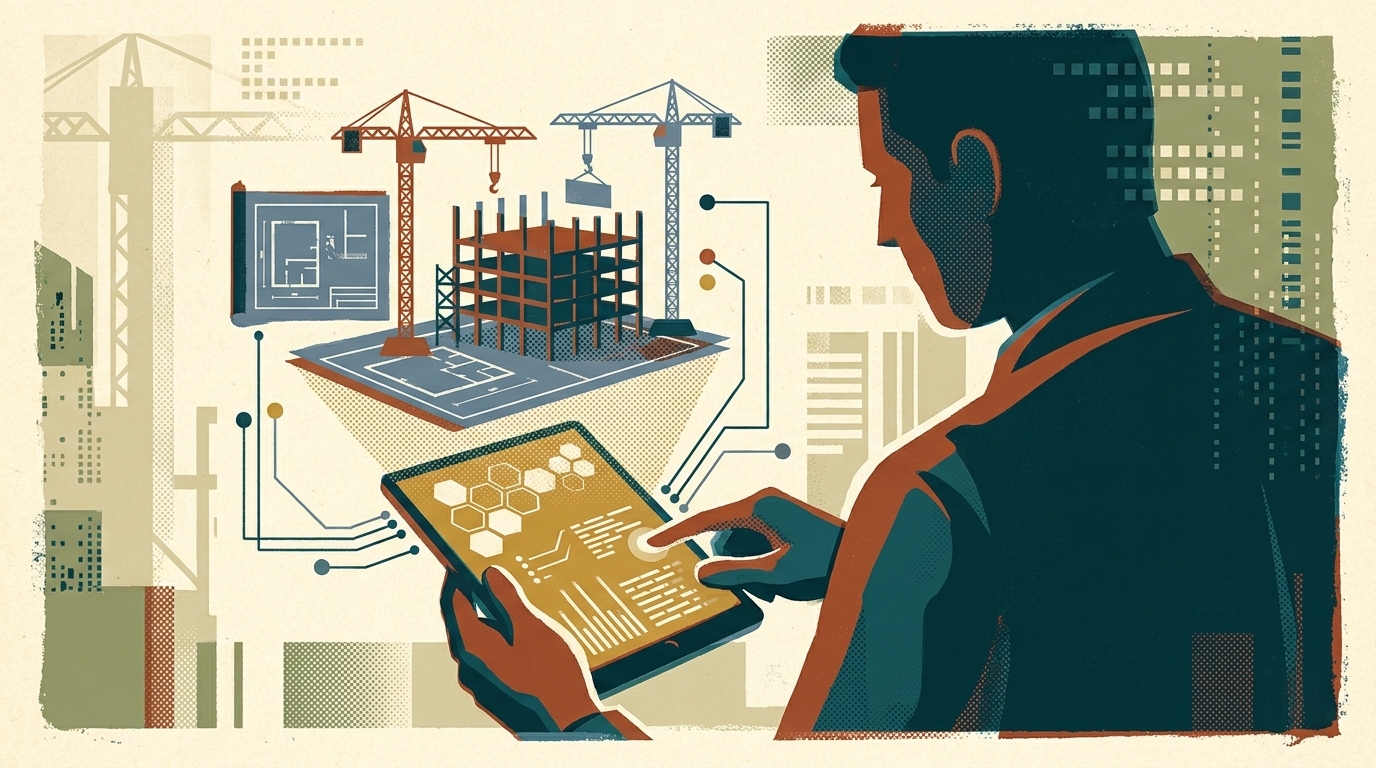
The best AI for a construction business targets your biggest administrative headache first. This is usually estimating, bidding, or turning field notes into reports. Focus on tools that integrate with your current workflow, maintain human oversight, and centralize your project data for easy access.
TL;DR
The right AI tool solves a specific, costly problem you already have. Instead of chasing futuristic concepts, construction firms gain the most value by applying AI to the administrative friction that slows down projects and hurts margins. Focus on practical applications that kill your worst admin tasks first.
- Start with Your Biggest Bottleneck: The best AI is the one that solves your most immediate pain point. For most construction businesses, this is either the slow, manual process of estimating and bidding or the communication gap between the field and the office.
- Prioritize Field-to-Office Data Flow: AI tools that capture, transcribe, and organize data from the job site (photos, voice notes, daily logs) eliminate manual data entry, reduce errors, and give project managers real-time visibility.
- Use AI for Predictive Insights, Not Just Automation: Go beyond simple task automation. Leverage AI for predictive scheduling to identify potential delays, for resource allocation to optimize equipment use, and for safety monitoring to prevent incidents before they happen.
- Centralize Your Institutional Knowledge: Your company’s most valuable asset is its accumulated project data. The ultimate goal is an AI system that can access and analyze your past bids, blueprints, change orders, and safety reports to provide instant, accurate answers.
- Keep a Human in the Loop: AI should augment your team, not replace it. The best systems use AI to generate initial estimates, reports, or schedules, but final approval and strategic decisions always rest with an experienced human professional.
What Is the Biggest Administrative Bottleneck AI Can Solve?
For most general contractors and subcontractors, the biggest bottleneck is pre-construction. The process of estimating, performing material takeoffs, and preparing competitive bids is incredibly time-consuming, repetitive, and prone to human error. This is the first and best place to apply AI.
AI-powered estimating software automates the most tedious parts of this workflow. These tools can:
- Automate Takeoffs: AI can analyze 2D plans and 3D BIM models to automatically count materials, measure lengths, and calculate volumes in a fraction of the time it takes to do so manually. This dramatically speeds up the takeoff process and reduces the risk of costly miscalculations.
- Improve Cost Estimation: By analyzing historical project data, supplier pricing, and labor rates, AI models can produce more accurate cost estimates. They can identify trends and variables that a human might miss, leading to bids that are both competitive and profitable.
- Generate Bid Documents: AI can assist in drafting proposals and bid packages by pulling relevant data, formatting documents, and ensuring all required information is included. This frees up estimators to focus on strategy and client relationships rather than paperwork.
By targeting this pre-construction phase, you attack a core operational drag. Faster, more accurate bids mean you can compete for more projects without increasing your administrative headcount.
How Can AI Connect the Field to the Office?
The second major pain point in construction is the information gap between the job site and the project management team. Critical information is often captured in handwritten notes, disconnected text messages, and disorganized photos. This creates delays, miscommunications, and a lack of real-time project visibility.
AI-powered field management tools bridge this gap by structuring unstructured data right at the source.
- Smart Daily Reports: Field staff can use voice assistant features to dictate daily logs. The AI can automatically transcribe the notes, tag them with project codes, identify key activities mentioned (like "concrete pour" or "safety inspection"), and file the report in the correct project folder.
- Automated Photo Management: Modern construction AI can analyze photos uploaded from the field. It can automatically tag images with location data, recognize progress (e.g., "drywall 80% complete"), and even flag potential safety violations, like a worker not wearing a hard hat.
- Real-Time Progress Tracking: By consolidating data from daily logs, photos, and schedules, AI dashboards provide project managers with an up-to-the-minute view of job site progress. This allows them to spot issues early and make proactive decisions instead of reacting to outdated information.
Connecting the field and office with AI transforms messy, delayed data into a clean, real-time feed that improves decision-making across the board.
Can AI Improve Project Management and Scheduling?
Yes, absolutely. Once you have a reliable flow of data from the field, AI can move from simple reporting to predictive project management. Traditional scheduling tools like Gantt charts are static; they show the plan but cannot dynamically adjust to reality on the ground. AI makes scheduling intelligent and adaptive.
Predictive analytics is the key. By analyzing data from current and past projects, AI can:
- Forecast Delays: AI models can identify early warning signs of potential schedule overruns. By analyzing factors like subcontractor performance, weather patterns, and supply chain updates, the system can flag activities that are at high risk of falling behind schedule.
- Optimize Resource Allocation: AI can help determine the most efficient use of labor, equipment, and materials. For example, it can recommend the optimal time to schedule a crane on-site to serve multiple crews, minimizing idle time and rental costs.
- Run "What-If" Scenarios: Project managers can use AI to model the impact of potential changes. For instance, "What happens to our completion date if the structural steel shipment is two weeks late?" The AI can simulate the cascading effects and suggest the best alternative plan.
This shifts the project manager's role from a reactive problem-solver to a proactive strategist, armed with data-driven insights to keep projects on time and on budget.
How Does AI Enhance Job Site Safety and Compliance?
Job site safety is a top priority, but enforcing it consistently across large, dynamic environments is a major challenge. AI provides an extra set of eyes, working 24/7 to identify risks and ensure compliance before an incident occurs.
This is often accomplished through computer vision, where AI analyzes video feeds from on-site cameras.
- PPE Detection: The system can automatically detect if workers are wearing required personal protective equipment (PPE), such as hard hats, high-visibility vests, and safety glasses. It can send an alert to the site supervisor if a violation is detected.
- Hazard Identification: AI can be trained to recognize unsafe conditions, such as workers operating too close to heavy machinery, unauthorized access to restricted zones, or improperly stored materials.
- Predictive Risk Analysis: By analyzing past incident reports, near-miss data, and site conditions, AI can identify patterns that lead to accidents. It might discover that a particular type of work performed in wet conditions has a high correlation with slip-and-fall incidents, prompting management to implement new preventative measures.
AI doesn't replace the site safety officer. It empowers them with a tool that can monitor the entire site simultaneously, allowing them to focus their attention on the highest-risk areas and activities.
What Is the Best Way to Centralize Construction Knowledge?
The most valuable, long-term application of AI in construction is creating a single source of truth for your company's entire history of work. Every project you complete generates a massive amount of data: blueprints, RFIs, change orders, contracts, safety reports, and client communications. Most of this knowledge is locked away in disconnected files and folders.
A Retrieval-Augmented Generation (RAG) System solves this problem. It acts as a private, secure "central brain" for your business. The system ingests all your proprietary documents and allows your team to ask questions in plain English.
Imagine a project manager being able to ask:
- "What was the approved waterproofing subcontractor we used on the Northgate project three years ago?"
- "Show me all daily logs from last week that mention 'electrical inspection'."
- "What is our standard procedure for a concrete slump test, according to our quality control manual?"
The RAG system provides instant, accurate answers, complete with citations pointing directly to the source documents. This is a game-changer for training new hires, ensuring consistency across projects, and making better decisions based on your own hard-won experience. Knowledge base solutions from firms like the AI Marketing Automation Lab are custom-built to turn this scattered data into an instantly queryable, high-value asset, securing a company's institutional knowledge for years to come. A custom RAG is the end-game for firms serious about leveraging their own data as a competitive advantage.
How Should You Start Your AI Journey?
The path to adopting AI in your construction business does not require a massive, disruptive overhaul. The most successful implementations start small, focused, and build on momentum.
First, identify the single most frustrating administrative task that consumes your team's time and energy. Is it manual takeoffs? Is it chasing down daily reports from the field? Pick one and pilot a targeted AI solution to solve it.
Second, prioritize tools that integrate with the software you already use. A solution that works with your existing project management or accounting software will face less resistance and deliver value faster.
Finally, think long-term about your data. The real power of AI is unlocked when it can learn from your unique business history. As you adopt new tools, ensure you maintain ownership and access to your data. Your goal should be to build a centralized knowledge base that makes your entire operation smarter, safer, and more profitable with every project you complete.
VOICE ASSISTANT SYSTEM
Speak the job details while you work. Your Voice Assistant can turn them into estimates, calendar entries, customer records, notes, and email drafts.
Check it out →
Frequently Asked Questions
What is the biggest administrative bottleneck AI can solve for construction businesses?
The biggest bottleneck for most general contractors and subcontractors is the pre-construction process, including estimating, material takeoffs, and preparing bids. AI can automate these time-consuming and error-prone tasks, making them faster and more accurate.
How can AI connect the field to the office in construction management?
AI bridges the information gap between the job site and project management by structuring data at the source. It uses tools like smart daily reports, automated photo management, and real-time progress tracking to convert messy data into a clean, actionable format.
Can AI improve project management and scheduling in construction?
Yes, AI enhances project management by using predictive analytics to forecast delays, optimize resource allocation, and run 'what-if' scenarios. This helps project managers move from reactive problem-solving to proactive strategy.
How does AI enhance job site safety and compliance?
AI enhances safety by using computer vision to detect PPE compliance, identify hazards, and perform predictive risk analysis. It provides continuous monitoring and aids safety officers in focusing on high-risk areas.