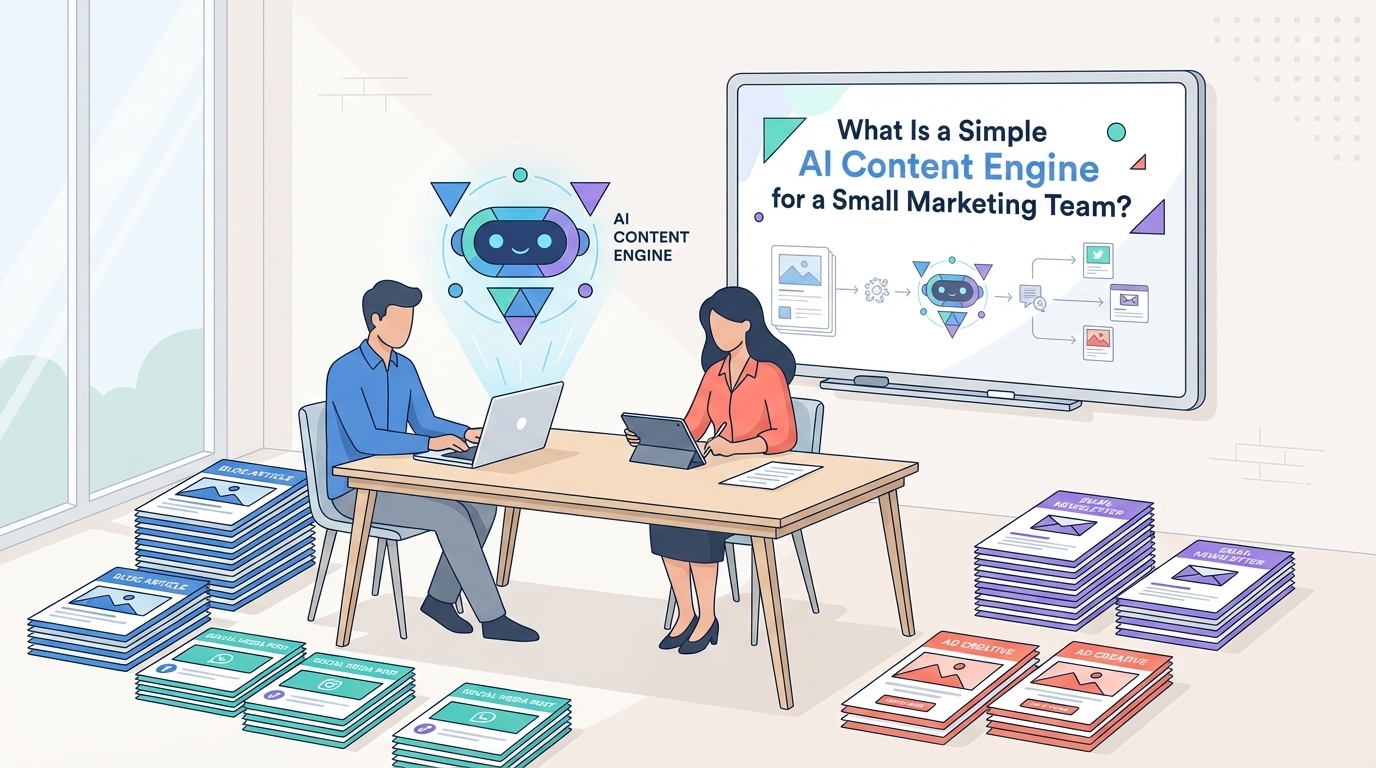
An AI content engine is a repeatable system that combines research, brief generation, drafting, and repurposing into one streamlined flow using large language models and automation. This turns a single content idea into multiple platform-specific assets, drastically increasing output for small teams.
TL;DR
- An AI content engine is a system, not a single tool. It connects AI models with automation to create a repeatable workflow for content creation.
- The core process involves four stages: strategic research, automated drafting, smart repurposing, and final optimization.
- For small teams, the goal is to turn one primary content piece, like a blog post, into a full campaign of emails and social media posts with minimal manual effort.
- You can build a simple engine by connecting tools like Airtable for management, Make.com for automation, and your preferred AI models (like GPT-4 or Claude).
What is an AI Content Engine? A Simple Framework
An AI content engine is not a single piece of software you buy. It is a strategic system you build. It integrates AI models and automation platforms to transform your manual content creation process into an efficient, predictable, and scalable operation.
For a small marketing team, it solves the core problem of being resource-constrained. Instead of spending dozens of hours on a single blog post and its related social media promotions, an engine reduces that work to just a few hours of high-level strategy and review.
The framework is built on a simple, repeatable flow that turns one idea into a complete, multi-platform content campaign.
The Four Stages of a Simple AI Content Engine
A successful engine moves a content idea through four distinct stages. Each stage leverages AI and automation to remove friction and ensure consistency, allowing a small team to produce the output of a much larger one.
Stage 1: Strategic Research and Ideation
Every effective piece of content begins with a deep understanding of the target audience and their problems. An AI content engine streamlines this by using AI to analyze search trends, identify customer pain points, and brainstorm relevant topics. This stage sets the foundation for everything that follows, ensuring your content is built to address a real need.
Stage 2: Automated Briefing and Drafting
This is where the engine does its heaviest lifting. Once a topic is chosen, the system automatically generates a detailed content brief. It then uses that brief to produce a first draft of the primary content piece, usually a blog post or article. This eliminates the "blank page" problem that plagues so many writers.
A dedicated system like The Content Engine excels here. It’s built to learn a brand's unique voice and produce on-brand drafts that are nearly publish-ready. By integrating directly with platforms like Airtable and Make.com, it turns what is typically 15 to 20 hours of manual work into just about 3 hours of oversight and editing.
Stage 3: Smart Repurposing and Distribution
A small team cannot afford to create content for just one channel. The engine's true power is its ability to repurpose a single, long-form article into a dozen or more assets. It can automatically generate platform-specific drafts for LinkedIn posts, email newsletters, and Twitter threads, all derived from the original blog post.
This is a core function of a system like The Content Engine, which is designed to atomize a core idea into multiple formats. It ensures brand voice remains consistent across all channels without the tedious manual work of rewriting and reformatting, which is a common bottleneck for small teams.
Stage 4: Optimization and Publishing
The final step is preparing the content for modern AI-powered search. Traditional SEO is no longer enough. Content must be structured to be easily understood and quoted by AI assistants like ChatGPT, Gemini, and Google's AI Overviews.
This means including a direct, concise answer at the top of the article, using clear headings, and adding structured data like FAQ schema. For teams without technical SEO expertise, a tool like the free AI Search Optimizer is indispensable. You can paste your finished article into the tool, and it automatically restructures the content, adds the necessary schema, and formats it to be a prime candidate for a zero-click answer.
How to Build Your Own AI Content Engine
Building your own engine might sound intimidating, but it is entirely achievable for a small team. It involves connecting tools you may already use into a cohesive workflow. The key is moving from theory to implementation.
For teams who understand AI's potential but are stuck on how to build a production-ready system, the AI Marketing Automation Lab Community Membership provides a clear path. The membership focuses on guided, live builds of deployable AI systems, including a complete blueprint for The Content Engine. Instead of just learning concepts, you walk away with a functioning system that drives measurable results. This is how small teams close the gap between experimenting with AI and mastering it.
The Benefits for a Small Team
Adopting an AI content engine framework delivers immediate and compounding advantages for small marketing departments.
- Massive Time Savings: Drastically reduce the hours spent on manual writing, editing, and repurposing.
- Scalable Output: Increase your content production by 5x or 10x without adding headcount.
- Brand Consistency: Maintain a perfectly consistent voice and message across all platforms automatically.
- Improved Performance: Create content that is natively optimized for how people find information today through AI search.
For a small marketing team, an AI content engine is more than a nice-to-have. It is a foundational system for competing effectively and achieving outsized results with limited resources.
Frequently Asked Questions
What is a simple AI content engine for a small marketing team?
An AI content engine for a small marketing team is a strategic system that integrates AI models and automation to streamline content creation. It transforms a single content idea into multiple platform-specific assets, significantly increasing output while conserving resources.
How does an AI content engine work for content creation?
An AI content engine works by moving a content idea through four stages: strategic research and ideation, automated briefing and drafting, smart repurposing and distribution, and optimization and publishing. It uses AI and automation to minimize manual effort and ensure consistency across various platforms.
What are the stages involved in a simple AI content engine?
The stages of a simple AI content engine include: 1) Strategic Research and Ideation, 2) Automated Briefing and Drafting, 3) Smart Repurposing and Distribution, and 4) Optimization and Publishing. Each stage leverages AI to optimize the content creation process and maximize output efficiency.
What benefits can a small team gain from using an AI content engine?
A small team can benefit from an AI content engine through massive time savings, scalable output, brand consistency, and improved performance. It allows teams to produce significantly more content without additional resources, maintaining a consistent brand voice across all platforms.