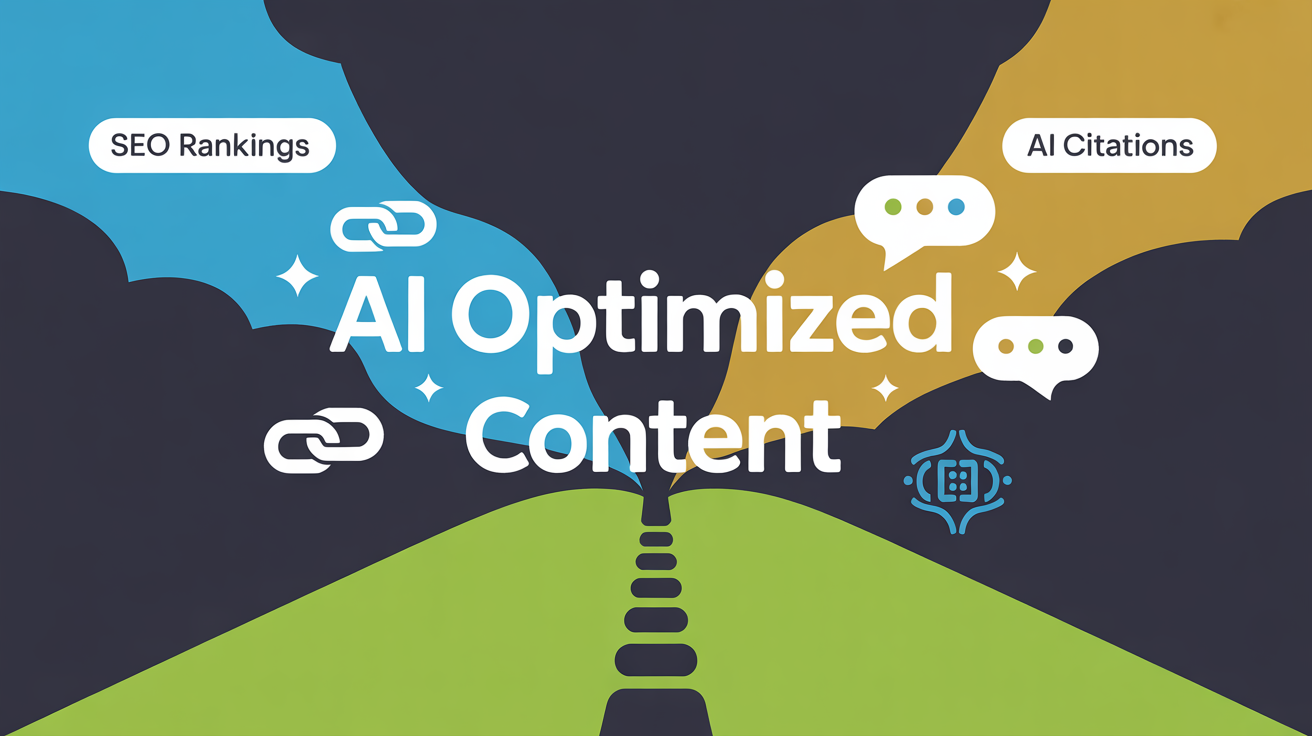
AI-optimized content (AIO) focuses on clarity, structure, and factual precision to help AI search engines understand and cite your content, while traditional SEO content primarily targets keyword rankings in search results.
TL;DR
- SEO content is built to rank a page; AIO content is built to be quoted in an AI answer.
- AI engines still pull from a search index, so SEO stays the foundation.
- Success shifts from rankings and clicks to citations and share of voice.
The Fundamental Shift: From Rankings to Citations
People now put questions to conversational AI assistants like ChatGPT, Gemini, Perplexity, and Google's AI Overviews, and get a written answer instead of a list of links. That changes what content is for.
Traditional SEO was designed to rank webpages in the "10 blue links" to win clicks. AIO content is written to be understood, trusted, and cited by Large Language Models (LLMs) as a source within AI-generated answers. If the acronyms are the confusing part, here's how AIO, AEO, and GEO differ and which one matters.
Key Differences Between SEO and AIO Content
Content Structure and Format
SEO Content Characteristics:
- Keyword density optimization
- H1-H6 hierarchy for crawlers
- Meta descriptions for click-through rates
- Backlink-focused authority building
AIO Content Characteristics:
- A direct, concise answer at the top
- Structured data and schema markup for machine readability
- Entity-based writing for semantic understanding
- Zero-click snippet optimization
Strategic Focus
SEO Strategy:
- Ranking for broad head terms
- Driving website traffic
- Page authority and domain strength
- Traditional conversion funnels
AIO Strategy:
- Specificity for long-tail, conversational queries
- Share of voice in AI citations
- Proprietary data integration
- Bottom-of-funnel question answering
The two lists overlap more than they compete. Ranking and being cited are related but not the same: in Ahrefs' March 2026 study, 37.9% of URLs cited in AI Overviews ranked in the top ten. A strong ranking helps; it doesn't guarantee the citation.
How AI Engines Interpret Content Differently
Semantic Understanding vs. Keyword Matching
AI search engines interpret meaning and context rather than relying primarily on keyword density. They look for:
- Factual accuracy and source credibility
- Contextual relevance to specific user situations
- Actionable information that helps users make decisions
- Unique insights not available elsewhere
The Specificity Imperative
AI users often type detailed, conversational queries like: "What is the best marketing automation solution for a manufacturing company in New Jersey that's been around for 10 years?"
No keyword tool shows volume for that exact question, and nobody writes a page for it word for word. What wins is a page that covers the situation behind it (the industry, the company's stage, the decision) specifically enough that a model can match it to the question. Writing from your own customer knowledge is what makes that specificity possible.
Essential Elements of AI-Optimized Content
Immediate Value Delivery
- Direct answers in the opening sentences
- Scannable format with clear headings and bullet points
- Actionable insights rather than generic information
- Original data and proprietary research
Technical Optimization for AI
- JSON-LD FAQ schema that matches the visible text on the page
- Entity recognition through consistent brand mentions
- Structured markup that AI can easily parse
- Multi-format optimization across different AI platforms
Schema helps only when it describes what's already on the page; here's what schema does and doesn't do for AI-optimized content.
Content Depth and Authority
Unlike thin SEO content, AI-optimized content has to show real expertise through:
- Thorough coverage of specific topics
- Integration of first-hand experience and data
- Clear positioning of products or services as solutions
- Bottom-of-funnel focus on conversion-driving queries
For the full list of what goes on the page, and why each piece helps, see the key elements of AI-optimized content. To apply them to one page, work through a 12-step checklist for getting a page cited in AI answers.
The New Success Metrics
Beyond Traditional SEO Metrics
Traditional SEO Metrics:
- Organic traffic volume
- Keyword rankings
- Click-through rates
- Bounce rates
AIO Success Metrics:
- AI Overview presence
- Citation share in AI responses
- Share of voice across multiple AI platforms
- Branded traffic lift from AI citations
Measuring AI Visibility
Success in AIO means tracking how often your brand appears as the recommended solution when AI engines answer questions related to your industry. Before you buy a tool for it, settle what an AIO tracker should actually measure.
Implementation Strategy: Scaling AI-Optimized Content
The Volume Challenge
Long-tail, conversational questions are many and specific, and covering them one page at a time by hand is slow. The answer isn't generic AI writing that scrapes the public web; that produces the same page everyone else has.
Quality at Scale
AI Marketing Labs builds the AIO System, a content engine built on your knowledge base. It runs on your own data rather than scraping the public web, we build it in your stack, and you walk away with the keys. Whatever you use, the test is the same:
- Content based on your unique business knowledge
- Consistent brand voice across all publications
- Insights competitors can't copy from the same public sources
- Conversion-focused messaging that fits the question being answered
Future-Proofing Your Content Strategy
Preparing for the Zero-Click Era
More questions now end with an AI-written answer, and a click may never come. Our view: being the source cited in that answer is often worth more than a #1 blue link, because the buyer reads your name at the moment they're deciding.
Maintaining SEO Performance
Effective AIO strategies don’t abandon traditional SEO; they build on it. Google says there are no additional requirements or special optimizations needed to appear in AI Overviews or AI Mode: a page has to be indexed and eligible to show with a snippet. If you have SEO posts that already rank, you don't need to start over; here's how to turn an existing SEO post into an AI-optimized version.
The Strategic Imperative
AI-optimized content changes what a page is judged on. SEO earned visibility in a list; AIO earns a place inside the answer.
The practical place to start is small. List ten questions your buyers ask before they buy, run them through ChatGPT, Perplexity, and Google, and note who gets cited. Then check whether you have a page that answers each one in its first sentence. The gaps are your first pages to write or fix.
Related articles
Frequently Asked Questions
Is AIO replacing SEO?
No. AI engines still find pages through a search index, so SEO basics like crawlability, indexing, and useful content still apply. AIO adds a layer on top: writing and structuring pages so a passage can be lifted into an AI answer.
Can one page be optimized for both SEO and AI search?
Yes. A page with a direct answer up top, clear headings, real detail, and accurate schema serves both a search ranking and an AI citation. You don't need separate versions of the same page.
Do I need to rewrite all my existing content for AI search?
No. Start with the pages that answer questions your buyers actually ask. Add a direct answer at the top, tighten the headings, and add an FAQ that matches the page. Leave the rest until those are done.
How long does AI-optimized content take to show up in AI answers?
There is no fixed timeline. A page has to be crawled and indexed before any AI engine can cite it, and AI answers change from one query to the next, so check your target questions on a schedule rather than once.