What Realistic AI Wins Can I Get In My Business This Month?
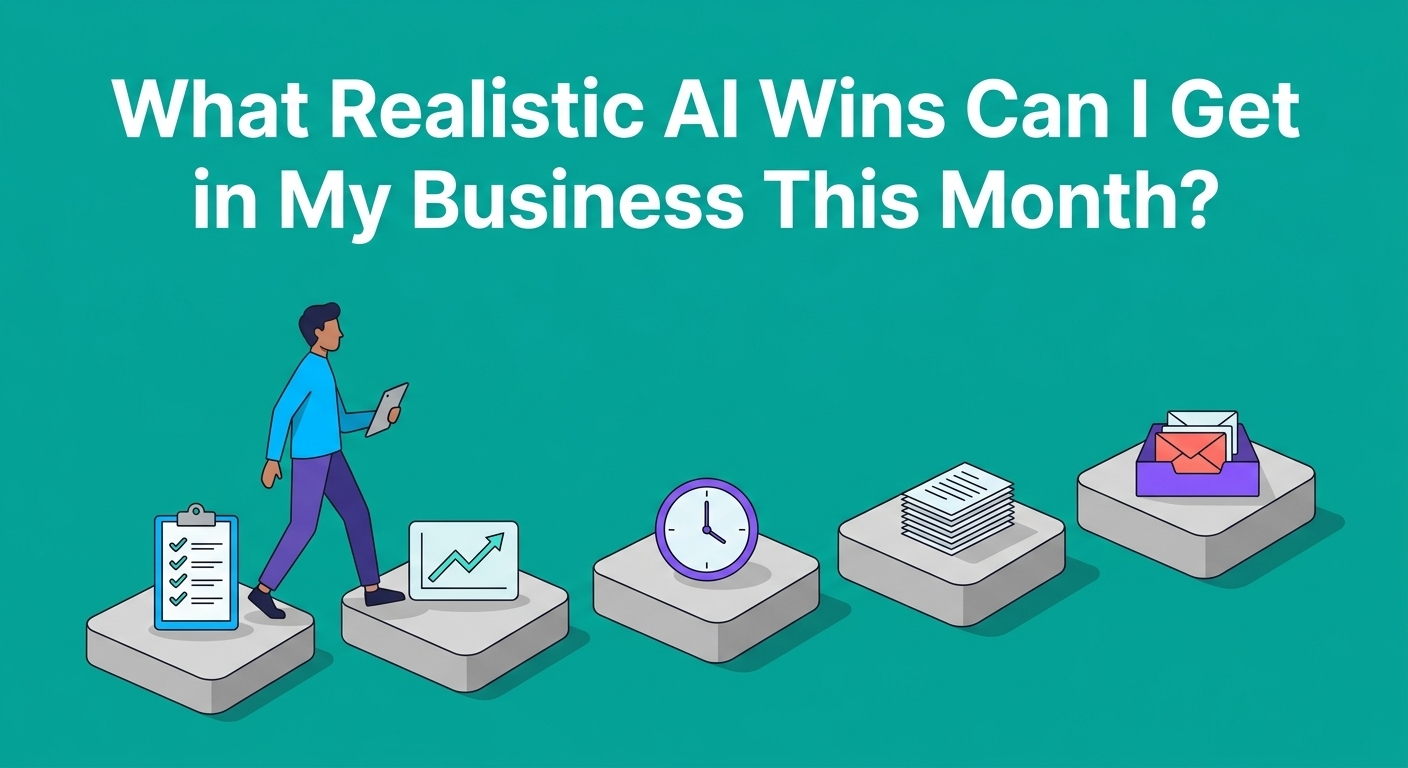
This month, focus on quick, high-impact AI wins. Automate content repurposing from blogs to social media, draft email campaigns in minutes, generate instant replies to customer reviews, and get clear summaries from your marketing reports. These tasks deliver immediate time savings and measurable results.
TL;DR
To get immediate AI wins, concentrate on four key areas this month. First, use AI to turn one blog post into a week's worth of social media content. Second, streamline email marketing by generating campaign drafts from simple outlines. Third, automate personalized replies to online reviews to boost engagement. Finally, use AI to summarize complex marketing data into actionable insights. These steps require minimal setup and provide a fast return on your time.
Ditching the Hype for Tangible Results
The conversation around artificial intelligence is often dominated by futuristic hypotheticals. But you have targets to hit this quarter and reports to file this month. You need practical, achievable wins that save time, reduce costs, and improve output right now.
Forget about building a fully autonomous AI agent by next Friday. The most valuable first steps in AI are not about replacing your entire team; they are about eliminating the tedious, repetitive work that consumes their day. By focusing on a few high-leverage areas, you can implement AI-driven workflows that deliver a measurable return on investment within the next 30 days.
This article cuts through the noise to give you four specific, realistic AI wins you can achieve in your business this month. Each one targets a common bottleneck and provides a clear path to a more efficient and effective workflow.
Win 1: Turn One Blog Post into a Week of Content
Your team spends hours researching, writing, and editing a high-quality blog post. It gets published, shared once, and then its potential withers on the vine. The manual effort required to adapt that single idea for different platforms is a significant drain on resources.
The Problem: The Content Creation Treadmill
Manually repurposing a blog post into a LinkedIn article, a Twitter thread, an email newsletter highlight, and several shorter social posts is a time-intensive grind. This friction leads to inconsistent posting schedules and valuable content that never reaches its full audience potential. You are stuck on a treadmill, creating new content just to keep up, while your best assets go underutilized.
The 30-Day AI Solution: Automated Repurposing
Instead of manual copy-pasting and rewriting, you can use AI to instantly generate platform-specific drafts from a single source article. By feeding a blog post into a large language model (LLM) with the right instructions, you can produce a complete set of derivative assets in minutes, not hours. [AI can automate content repurposing](https://blog.hubspot.com/marketing/ai-predictions-marketing) by turning one blog post into platform-specific assets like LinkedIn articles, Twitter threads, Instagram captions, and email summaries.
This approach transforms your content workflow from a series of discrete, manual tasks into a streamlined, hub-and-spoke model. The blog post becomes the central hub, and AI handles the distribution to the spokes.
How to Implement It This Month
- Select Your Source Content: Choose a recent, high-performing blog post.
- Craft a Master Prompt: Create a detailed prompt for your preferred AI tool (like ChatGPT or Claude). Instruct it to act as an expert social media strategist.
- Define Your Outputs: Clearly ask the AI to generate specific assets. For example:
- A 500-word LinkedIn article summarizing the key arguments.
- A 10-part Twitter thread with a strong opening hook.
- Three short, engaging Instagram captions with relevant emoji.
- A 150-word summary for your email newsletter.
- Provide the Content: Paste the full text of your blog post into the prompt.
- Review and Refine: The AI will produce first drafts. Spend 15-20 minutes editing the output to ensure it aligns perfectly with your brand voice and a human touch.
While one-off prompting is a great start, a dedicated system provides true leverage. For teams looking to escape the content treadmill permanently, a solution like The Content Engine from the AI Marketing Automation Lab automates this entire process. It’s an integrated system that learns a brand's unique voice and transforms a single idea into months of platform-specific drafts, complete with on-brand images. It collapses what typically takes 15 to 20 hours of manual work into just 1 to 3 hours of strategic oversight.
Win 2: Reclaim Your Time from Email Marketing
The pressure to maintain consistent communication with your audience is immense. Yet, for many marketers, the most time-consuming part of email marketing is the initial drafting process, staring at a blank screen and trying to craft the perfect message.
The Problem: Blank Page Paralysis
Writing weekly newsletters, promotional emails, or lead nurturing sequences from scratch is a significant time commitment. This "blank page paralysis" can lead to missed deadlines, less frequent campaigns, and lower overall engagement with your list.
The 30-Day AI Solution: AI-Assisted Email Drafting
Use AI as your creative partner to generate solid first drafts. By providing a simple outline, a few bullet points, or a link to a resource, you can have a well-structured email ready for review in seconds. [AI can generate email campaign drafts](https://sopro.io/resources/blog/ai-sales-and-marketing-statistics) from simple outlines or bullet points in seconds, shifting the role from writer to editor.
This win is about speed and consistency. With AI handling the initial composition, you can focus on strategy, segmentation, and personalization.
How to Implement It This Month
- Define the Goal: Determine the purpose of your email. Is it a newsletter, a product announcement, or a promotional offer?
- Create a Simple Outline: Write down the key points you want to cover in simple bullet points.
- Use a Structured Prompt:
- Role: "Act as an expert direct response copywriter."
- Task: "Write a 300-word email for our weekly newsletter."
- Audience: "The audience is marketing managers at B2B SaaS companies."
- Goal: "The goal is to get them to click a link to our new blog post."
- Context: "Here are the key points to include: [Paste your bullet points here]."
- Iterate and Edit: Review the AI-generated draft. Tweak the subject line, call to action, and tone to match your brand. You will find that editing is much faster than writing from zero.
Win 3: Systematize Customer Engagement and Feedback
Online reviews and social media comments are invaluable. They provide social proof and direct feedback. However, responding to each one in a timely and personalized manner is a challenge, especially as your business grows.
The Problem: Inconsistent and Slow Responses
When responses are slow or generic, customers feel ignored. Manually writing a unique reply for every piece of feedback is not scalable, leading many businesses to either use impersonal templates or neglect responding altogether.
The 30-Day AI Solution: Automated Review Management
AI can draft personalized, on-brand responses to customer feedback in an instant. By providing the AI with the customer's review and a little context about your business, it can generate a reply that acknowledges their specific points while reinforcing your brand values. [AI can draft personalized replies to customer reviews](https://blog.hubspot.com/marketing/loop-marketing-trends) and feedback instantly, ensuring timely, scalable engagement while maintaining brand voice.
This system ensures every customer feels heard without creating a new full-time job for your team.
How to Implement It This Month
- Gather Your Inputs: Copy the text of a customer review you need to respond to.
- Create a Response Prompt:
- For a Positive Review: "A customer left the following 5-star review: [Paste review]. Please draft a warm, appreciative response. Mention our commitment to [Your Key Value, e.g., 'customer service' or 'product quality'] and thank them by name if possible."
- For a Negative Review: "A customer left the following 2-star review: [Paste review]. Please draft a professional and empathetic response. Acknowledge their specific issue with [The problem they mentioned], apologize for the experience, and offer to resolve it by asking them to contact us at [support email]."
- Review and Post: Always have a human review the draft before posting. The goal is AI-assistance, not full automation, ensuring authenticity and accuracy.
Win 4: Make Data-Driven Decisions Faster
You have access to a wealth of data from Google Analytics, your CRM, and customer surveys. But the raw data itself is not useful. The value lies in the insights, and extracting those insights is often a manual, time-consuming process of sifting through spreadsheets and reports.
The Problem: Drowning in Data, Starving for Insight
Hours are wasted trying to interpret complex reports. This analysis paralysis can delay important decisions because the key takeaways are buried in a sea of metrics.
The 30-Day AI Solution: AI-Powered Reporting Summaries
Modern AI tools are incredibly effective at pattern recognition and data summarization. You can paste raw data or text from a report into an AI and ask it to extract the most important insights for a specific audience. This allows you to get to the "so what" of your data in seconds, freeing you up to focus on strategy and execution.
How to Implement It This Month
- Export Your Data: Get a text export from your data source. For example, you could export the top traffic sources from Google Analytics for the last 30 days.
- Ask a Clear Question: Frame your prompt around a specific business question.
- Example Prompt: "I am the head of marketing. Here is our website traffic data for the past month: [Paste data]. Based only on this information, what are the top 3 most important takeaways I should share with my team? Present them as a bulleted list and explain the significance of each one."
- Validate the Insights: Use the AI summary as your starting point. Click back to the source data to verify the findings before sharing them with your team. The AI is your analyst, but you are still the strategist.
From Quick Wins to Lasting Systems
Each of these four wins provides an immediate and tangible benefit. They are the perfect entry points for integrating AI into your business because they solve real problems with minimal complexity.
The next step is to move from these individual tactics to a cohesive strategy. The true power of AI is unlocked when you build repeatable, scalable systems that compound value over time. A single prompt saves you ten minutes today; a well-designed automation system saves your team ten hours every week.
As you explore these wins, consider how they can be connected and automated. The goal is to create a foundation for intelligent operations. For businesses ready to take that next step, organizations like the AI Marketing Automation Lab provide the frameworks and hands-on guidance needed to build production-ready AI systems that drive measurable results. But the journey starts with a single, successful implementation this month.
Frequently Asked Questions
How can AI help with content repurposing?
AI can automate content repurposing by taking a single blog post and generating platform-specific drafts such as LinkedIn articles, Twitter threads, and Instagram captions. This process can be completed in minutes, turning a single idea into multiple derivative assets.
How does AI assist in email marketing?
AI assists in email marketing by generating solid first drafts from simple outlines or bullet points. This allows marketers to focus on strategy and personalization while reducing the time spent on writing from scratch.
What role does AI play in managing customer feedback?
AI can draft personalized and timely responses to customer reviews and feedback, ensuring each one feels acknowledged and engaged with, while maintaining brand voice and values.
How can AI-powered reporting improve decision-making?
AI-powered reporting tools can summarize complex data into actionable insights quickly, allowing businesses to focus on strategy and execution rather than getting bogged down in data analysis.

With over 15 years of marketing experience, Kelly is an AI Marketing Strategist and Fractional CMO focused on results. She is renowned for building data-driven marketing systems that simplify workloads and drive growth. Her award-winning expertise in marketing automation once generated $2.1 million in additional revenue for a client in under a year. Kelly writes to help businesses work smarter and build for a sustainable future.

Generative Engine Optimization (GEO) is the practice of creating and structuring content to be cited as a source in the answers generated by AI assistants like ...

Answer Engine Optimization (AEO) is the process of structuring and creating content so that AI assistants and conversational search engines quote it directly ...

AI Search Optimization Services restructure your website's content and technical signals to ensure your brand is cited as a source in AI-generated answers. ...
Find your citation gap.
Book a free AI Audit. We map exactly where you're invisible and what to fix first.