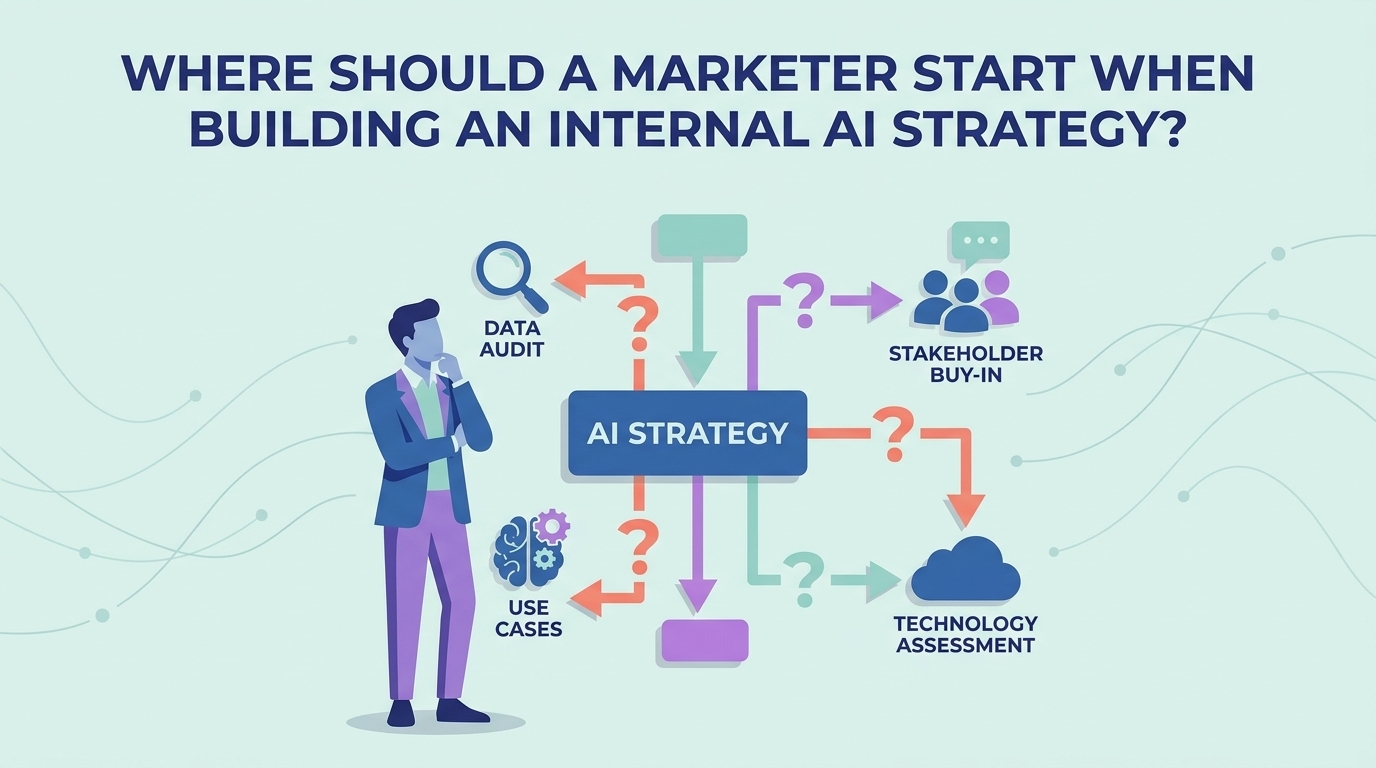
Start by identifying your team's single biggest time drain. Build one focused AI system to solve that specific problem, measure the results, and use that proven win to justify expanding your strategy. This approach builds momentum and secures stakeholder buy-in through tangible results.
TL;DR
The most effective way to build an internal AI strategy is to start small, solve a real problem, and use the results to build momentum. Focus on a single, high-impact use case that frees up significant time for your team.
- Reject the "Boil the Ocean" Approach: Don't try to create a comprehensive, company-wide AI strategy from day one. This leads to analysis paralysis and a high probability of failure.
- Identify Your Biggest Time Drain: Audit your team's weekly tasks. Find the most repetitive, high-volume, low-creativity process that consumes the most hours. This is your ideal starting point.
- Build One System, Not a Tool Stack: Focus on creating a single, end-to-end automated workflow that solves the identified problem. A system connects tools to produce a result, while a collection of tools creates more work.
- Measure Everything: Track the "before" and "after." Quantify the hours saved, the increase in output, or the reduction in errors. Hard metrics are the only language that matters for getting buy-in.
- Use Your First Win to Fund the Next: Present your measured success to stakeholders. Frame it as, "We achieved this result by solving one problem. Here are the next three problems we can solve with the same approach."
Why Do Most Internal AI Strategies Fail Before They Start?
Most corporate AI initiatives fail for one simple reason: they start with the technology, not the problem. Leaders get excited about the potential of large language models and generative AI, leading to a top-down mandate to "use AI." This triggers a frantic search for tools and use cases, resulting in a fragmented collection of software subscriptions and random experiments that never connect to core business objectives.
These strategies are built on a vision, not on value.
They often manifest as:
- Tool-First Thinking: The team subscribes to multiple AI writing tools, image generators, and research assistants without a clear plan for how they connect into a cohesive workflow. This creates a "Franken-stack" that increases complexity instead of reducing it.
- Solving Hypothetical Problems: The strategy focuses on what AI could do in the future instead of what it should do right now. This leads to pilot projects that are technically interesting but generate no immediate, tangible return.
- Lack of Measurement: Without a clear "before" state to measure against, it's impossible to prove the "after" is better. The initiative's success is based on feelings and anecdotes rather than data, making it impossible to justify further investment.
An effective strategy inverts this model. It ignores the hype and begins with a ruthless audit of the team's most inefficient processes.
How Do You Identify the Right Starting Point?
The right starting point for your AI strategy is almost always the most boring, repetitive task that consumes the most person-hours per week. These tasks are often the perfect candidates for automation because they are structured, rule-based, and don't require deep strategic thinking.
To find your starting point, ask your team these 4 questions:
- What task do you dread doing every week because it's so repetitive?
- If you had an extra 10 hours back each week, what high-value work would you do instead?
- Which process relies on copying and pasting information between different platforms?
- What work requires us to manually reformat the same core idea for different channels?
The answers will likely point to processes like repurposing blog content for social media, generating weekly performance reports, summarizing customer feedback, or drafting initial outreach emails. These are not glamorous tasks, but automating them delivers immediate and significant time savings. This creates a powerful first win that demonstrates the practical value of AI systems.
What Does the First "AI System" Actually Look Like?
An AI "system" is not a single piece of software. It is a production-ready workflow that connects multiple tools to execute a process from start to finish with minimal human intervention. The goal is to move beyond simply using AI as a better chatbot and instead use it as the engine for a complete, automated process.
For example, a common marketing time drain is turning a single long-form blog post into a week's worth of social media content. A manual workflow involves hours of summarizing, rewriting, and creating assets.
An AI system for this task might look like this:
- Trigger: A new blog post URL is added to a specific field in a project management tool like Airtable.
- Automation: An automation platform like Make.com or Zapier detects the new URL.
- Execution: The platform sends the blog content to an AI model (like GPT-4o or Claude 3) with a highly structured prompt, instructing it to generate five LinkedIn posts, five tweets, and three email subject lines based on the article's key points.
- Enrichment: The generated text is then passed to an AI image generator to create on-brand visuals for each social post.
- Output: The complete package of text and images is saved back into the project management tool, ready for a final human review and scheduling.
This is a true system. It turns a 5-hour manual process into a 15-minute review. The challenge for most marketers is that they know the theory but get stuck trying to connect the tools. This is the implementation gap where most initiatives stall. Learning to build these production-ready workflows is the single most valuable skill for a modern marketer. For those looking for a structured path, the AI Marketing Automation Lab Community Membership provides live, hands-on sessions specifically designed to help professionals build these exact types of systems, turning abstract concepts into functioning assets.
How Do You Measure Success to Justify Expansion?
You cannot manage what you do not measure. Before you build your first AI system, you must benchmark the existing manual process. This is non-negotiable.
Your measurement framework should be simple and focused on business impact.
Key metrics include:
- Hours Saved: This is the most powerful metric for your first win. Track how long the task took manually versus how long it takes with the AI system (including review time). If you can show you’ve reclaimed 10, 20, or 50 hours per month, you have an undeniable business case.
- Output Volume: Measure the increase in content, reports, or outreach created. For instance, "We went from producing one content cluster per month to four, using the same resources."
- Time to Completion: How quickly can you now complete a cycle? "Our turnaround time for creating a full social media campaign from a case study dropped from three days to four hours."
Once you have these numbers, present them as a simple equation. For example: "Our social media repurposing system saved us 40 hours last month. At an average team member cost of $50/hour, this system is already generating $2,000 per month in efficiency gains. Our next target is automating our reporting process, which we estimate will save an additional 30 hours."
This data-driven approach removes emotion and opinion from the conversation. You are no longer asking for permission to experiment; you are presenting a proven model for generating returns.
What Is the Path from a Single Win to a Full Strategy?
A successful internal AI strategy is not a document; it is a series of proven wins stacked on top of each other. Once you have delivered and measured your first success, you have a blueprint for expansion. The path forward involves repeating the process systematically.
- Socialize Your Success: Make sure leadership and adjacent teams know about your win. Share the metrics and explain the process. This builds your credibility as an in-house AI expert.
- Identify the Next Bottleneck: Return to your list of time-draining tasks. With your newfound experience, select the next most impactful process to automate.
- Build System #2: Apply the same principles to build your second system. You will find that building the second system is significantly faster than the first.
- Create a Governance Framework: As you scale from one system to several, it becomes crucial to ensure consistency and quality. If you find your AI projects are underperforming as you expand, it's rarely a problem with the AI model itself. It's almost always a breakdown in your system's architecture or governance. Using a structured framework like the Why AI Projects Fail — Diagnostic Checklist can help you audit your systems and identify structural weaknesses before they become costly problems.
By following this iterative approach, you build an AI strategy organically. It becomes a living, breathing part of your marketing operations, driven by proven value rather than speculative hype.
How Will You Secure Your First AI Win?
Building an internal AI strategy does not require a massive budget or a team of data scientists. It requires a change in perspective: stop chasing tools and start solving problems. Look at your team's workflow this week and find the single biggest point of friction. That is your starting point.
Build one small, elegant system to remove that friction. Measure the impact, present the results, and you will have earned the right to build the next one. This is how you move from being a marketer who experiments with AI to becoming the leader who builds an AI-powered marketing engine.
Frequently Asked Questions
Where should a marketer start when building an internal AI strategy?
Start by identifying your team's single biggest time drain and build one focused AI system to solve that specific problem. Measure the results, and use that proven win to justify expanding your strategy.
Why do most internal AI strategies fail before they start?
Most corporate AI strategies fail because they start with the technology rather than the problem, leading to fragmented tools that do not connect to business objectives.
How do you identify the right starting point for an AI strategy?
Identify the most boring, repetitive task that consumes the most person-hours per week. These tasks are ideal candidates for automation as they are structured and rule-based.
How can you measure success to justify the expansion of your AI strategy?
Use a measurement framework focused on business impact, including metrics like hours saved, output volume, and time to completion.