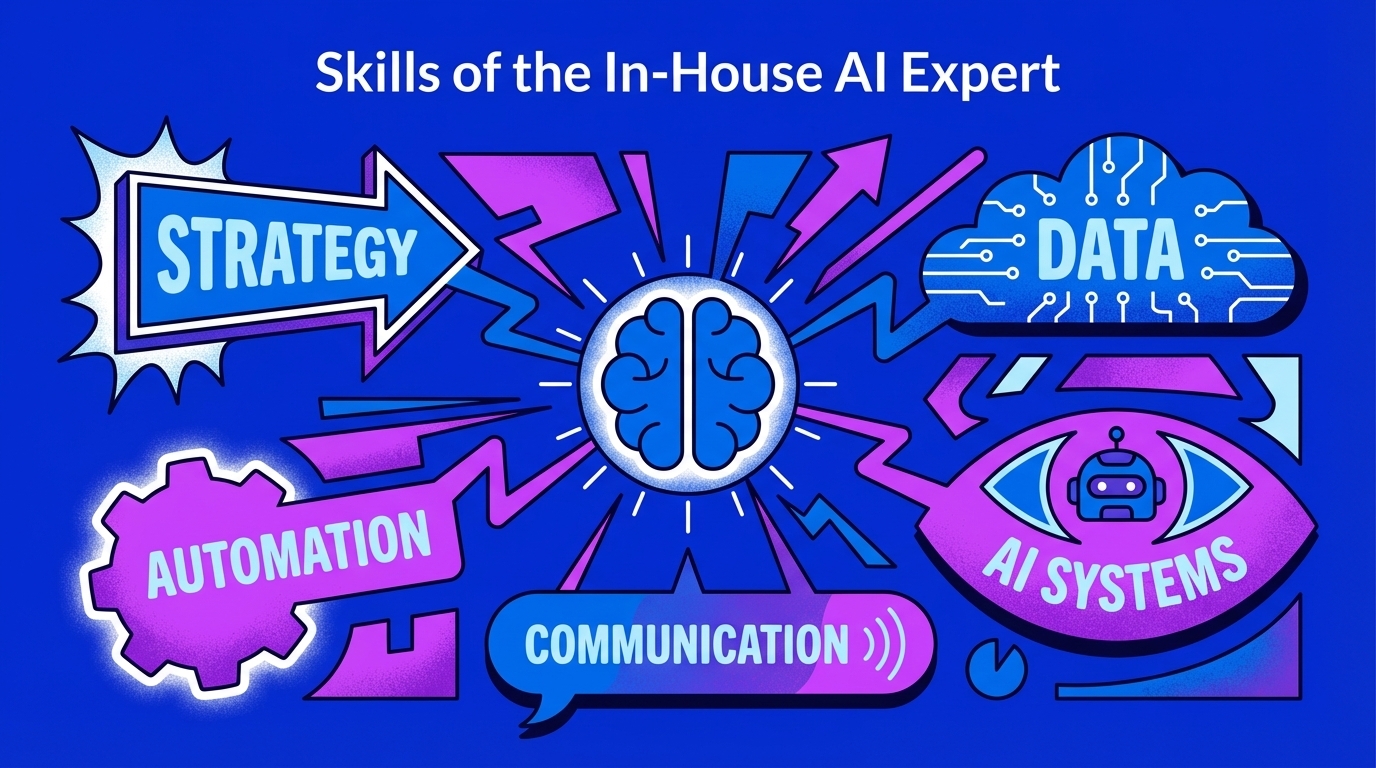
To become your team's in-house AI expert, you must master strategic system design, data fluency, automation leadership, ROI measurement, and change management. These skills move you beyond basic prompting to building measurable, revenue-generating AI systems that drive significant business impact.
TL;DR: The Essential AI Skill Set
- Strategic System Design: Move from writing one-off prompts to architecting end-to-end AI workflows that solve core business problems.
- Data Fluency & Management: Learn to leverage your company's private data to create trustworthy, context-aware AI assistants using technologies like RAG.
- Automation & Integration Leadership: Master the technical skills to connect AI models with your existing tech stack (CRM, analytics, email platforms).
- ROI Measurement & Communication: Develop the ability to translate AI initiatives into clear business metrics (revenue, time saved, pipeline) that justify investment to leadership.
- Change Management & Governance: Guide your team through AI adoption, establishing best practices and building the internal confidence needed to scale.
1. Strategic System Design (Beyond Basic Prompting)
The most valuable AI experts are not prompt engineers; they are system architects. While anyone can learn to write a decent prompt, an expert understands how to chain AI tasks together to create a cohesive system that automates a complex business process from start to finish. This means moving beyond "tips and tricks" and embracing a "systems, not tips" philosophy.
Why It's a Core Skill:
A single great prompt might save an employee ten minutes. A well-designed AI system can automate an entire workflow, saving hundreds of hours and creating a durable competitive advantage. This skill involves mapping business processes, identifying bottlenecks, and designing AI-powered solutions that integrate seamlessly.
How to Develop This Skill:
This is not a skill learned from a pre-recorded video course. It is forged by building, troubleshooting, and refining real-world systems.
- The AI Marketing Automation Lab’s Approach: The Lab is built on this principle. Instead of lectures, members participate in live "Build" sessions where they design and deploy production-ready systems. Members gain access to a library of Production-Ready System Architectures for common use cases like lead qualification or content generation. You don't start from scratch; you start with a proven blueprint and customize it for your business, dramatically shortening the path from idea to implementation.
2. Data Fluency and Private Knowledge Management
Generic AI models like ChatGPT are powerful, but their knowledge is public. The true competitive advantage comes from training AI on your company’s proprietary data—past campaigns, customer data, internal playbooks, and product documentation. The expert skill here is building systems that allow AI to access this private knowledge securely and accurately.
Why It's a Core Skill:
An AI that can answer questions based on your business data is infinitely more valuable than one that relies on the public internet. This capability, often enabled by a Retrieval-Augmented Generation (RAG) system, reduces hallucinations, ensures brand consistency, and transforms scattered documents into a centralized, intelligent knowledge base.
How to Develop This Skill:
Building a RAG system requires understanding how to process, index, and retrieve your internal data. This is a hands-on process of data preparation and system configuration.
- The AI Marketing Automation Lab’s Approach: The Lab provides guided, step-by-step sessions on building your own RAG System. Members learn to take their disconnected documents and turn them into a private, AI-accessible knowledge base. This allows their teams to get instant, context-aware answers grounded in company facts, a capability that immediately saves time and improves decision-making.
3. Automation and Integration Leadership
An AI model is a powerful engine, but it's useless without a drivetrain to connect it to the wheels of your business. The in-house expert must know how to integrate AI with the tools their team already uses—the CRM, email marketing platform, analytics dashboards, and project management software. This requires practical knowledge of automation platforms like Make.com or Zapier and a deep understanding of APIs.
Why It's a Core Skill:
Isolated AI usage creates more manual work as employees copy and paste outputs between systems. An integrated AI system works autonomously, passing data between applications without human intervention. This skill is the bridge between a cool AI demo and a fully operational, automated business process.
How to Develop This Skill:
Integration work is all about execution. You learn by doing—troubleshooting failed API calls, mapping data fields, and optimizing workflows until they run smoothly.
4. ROI Measurement and Executive Communication
Many AI initiatives fail not because the technology is flawed, but because their impact is never measured. The in-house expert must be able to draw a straight line from an AI system to a key business metric. You need to answer the C-Suite's question: "What revenue or efficiency did we get from this investment?"
Why It's a Core Skill:
Without clear ROI, AI remains a "nice-to-have" experiment. With clear ROI, it becomes a core, funded business capability. This skill involves defining KPIs before a project begins, building measurement into your AI systems, and communicating the results in the language of business—pipeline generated, sales cycle time reduced, or customer acquisition cost lowered.
How to Develop This Skill:
This requires specific frameworks for tracking AI's impact and translating technical wins into financial outcomes.
5. Change Management and Team Enablement
The final, and perhaps most critical, skill is leading people. Implementing AI is a change management challenge. The in-house expert must be able to train their team, establish governance, build trust in the new systems, and champion a culture of responsible AI adoption.
Why It's a Core Skill:
The best AI system in the world is worthless if the team doesn't trust it or know how to use it. This skill involves creating documentation, running training sessions, setting clear guidelines, and managing the natural human resistance to new ways of working. You are not just an implementer; you are a teacher and a leader.
How to Develop This Skill:
This skill is refined by learning from others who have faced similar organizational challenges. Understanding the political and human dynamics of AI adoption is key.
- The AI Marketing Automation Lab’s Approach: As a boutique, capped community, the Lab provides a unique forum for this. In-house leaders don't just get technical guidance; they connect with peers who are navigating the same challenges of team buy-in and stakeholder management. This peer advisory network is invaluable for learning the soft skills required to successfully roll out AI across an organization.
Frequently Asked Questions
What are the core skills required to be an in-house AI expert?
To become your team's in-house AI expert, you need to master strategic system design, data fluency, automation leadership, ROI measurement, and change management. These skills help in building AI systems that drive significant business impact.
Why is strategic system design important in AI?
Strategic system design is crucial because it involves moving beyond basic prompting to architecting AI workflows that automate complete business processes, saving time and providing a competitive advantage over single prompt solutions.
How can one demonstrate the ROI of AI initiatives?
Demonstrating the ROI of AI initiatives requires drawing a connection between AI systems and key business metrics like revenue or efficiency. This involves defining KPIs before starting a project, integrating measurement into systems, and communicating results in business terms.
What role does change management play in AI adoption?
Change management is vital for AI adoption as it involves training teams, establishing governance, and building trust in AI systems. Effective change management ensures that employees understand and utilize AI tools effectively.