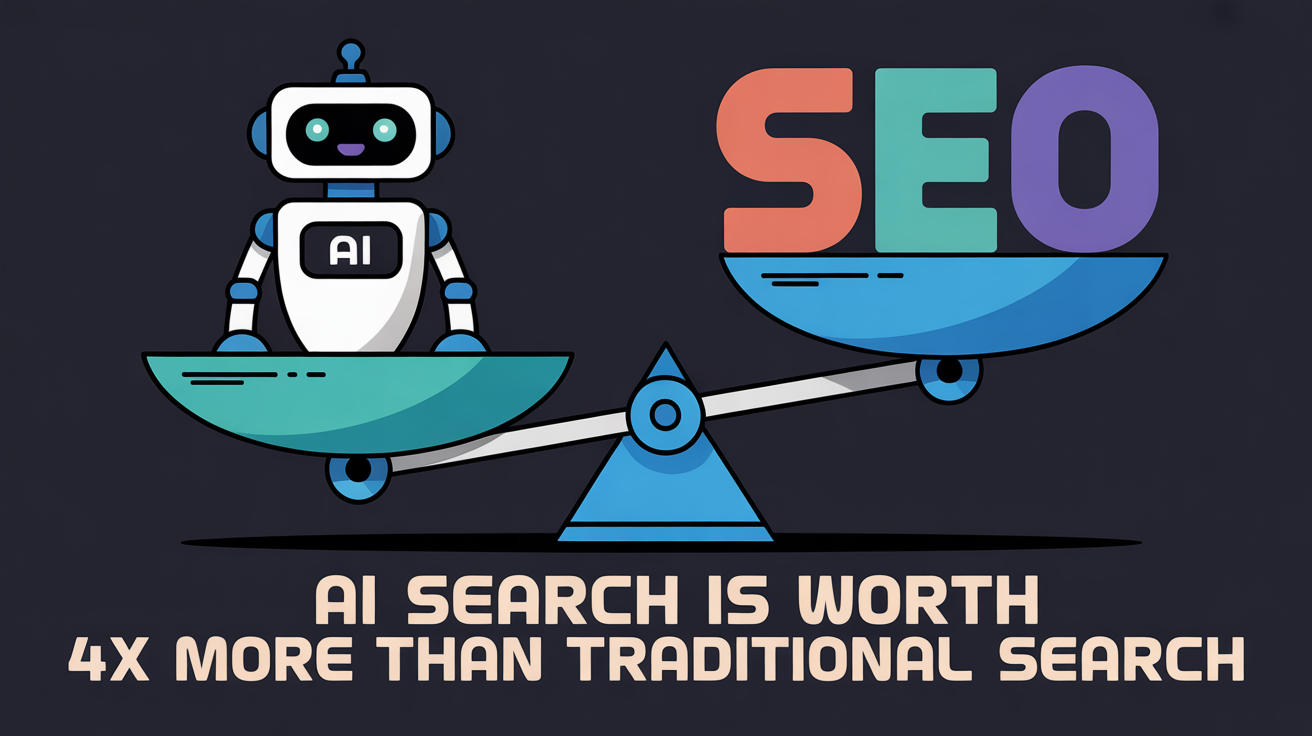
AI search visitors are worth more because they arrive further along in their decision: Semrush found that the average AI search visitor is worth 4.4 times a traditional organic visitor, based on conversion rate. The assistant has already explained the problem and compared options, so the click that reaches your site is closer to a buying decision.
TL;DR
- The 4.4x figure is Semrush's average, measured by conversion rate, not revenue or deal size.
- Expect fewer AI-referred visits, with more of them ready to talk.
- Judge AI search by citations, conversions, and revenue per visitor, not sessions.
Understanding this value difference matters if you're deciding where to spend marketing time and money. It touches how you measure traffic, how you handle new leads, and what content you write.
The 4X Value Multiplier Explained
Semrush's AI search traffic study compared visitors arriving from AI sources like ChatGPT with visitors from traditional organic search, and measured value by conversion rate. The study doesn't break the figure down by industry or deal size, so treat 4.4x as an average to test against your own numbers, not a promise.
The likely reason is the shape of the buyer's journey. The traditional model involved multiple touchpoints over extended periods. A typical journey might look like this:
- Initial discovery through a blog post
- Return visits for additional research
- Guide or whitepaper downloads
- Email nurture sequences
- Multiple site visits over weeks or months
- Eventually, sales contact
With AI search, much of that research can happen inside the AI conversation. People can arrive at your website after the comparing is done, ready to take a next step.
The Compressed Buyer's Journey
The biggest factor behind the higher value is the compression of the buyer's journey. In traditional search, you captured visitors at every stage, from first awareness through consideration to decision. Most of them were gathering information, and only a small share were ready to buy.
AI chatbots change this dynamic. When someone asks ChatGPT or a similar assistant to help solve a business problem, they get a detailed, tailored answer in a single conversation.
The AI:
- Explains the problem and potential solutions
- Compares different options
- Provides specific recommendations
- Addresses objections and concerns
- Offers implementation guidance
By the time someone clicks through to a vendor website, much of the research is done. Semrush makes the same point: AI search users often arrive having already compared options. Google reports a similar pattern for its own AI feature, saying clicks from results pages with AI Overviews are higher quality, meaning people are more likely to spend more time on the site.
Real-World Evidence from Sales Teams
You can check whether this is happening in your own pipeline. Ask every new lead how they found you, and listen for answers like "ChatGPT recommended you" or "Perplexity listed you." Log those answers in your CRM so you can compare AI-referred leads with everyone else over a few months.
If those leads do arrive better informed, the first conversation changes. You can spend less time on basic education and more on fit, scope, and price. Turning AI search content into leads covers how to set that up on the sales side.
The Trust Factor
Context is part of the explanation. An AI answer that recommends you usually explains why, in the terms the person used to describe their problem. That is a different starting point from a list of ten links that the searcher has to sort through alone.
When the recommendation came from a conversation about their specific needs, people have a reason to act on it. Your job is to make sure the facts the assistant repeats about you are accurate and current.
Quality Over Quantity
The shift to AI search changes how you should think about traffic. Traditional SEO often focused on maximizing visitor numbers. More traffic was generally better, even at low conversion rates, because doubling traffic at a steady conversion rate doubled conversions.
AI search changes that math. Total visits from AI sources may be smaller than your organic traffic, while each visit is worth more. That's why visit counts alone undersell the channel, and why you need value-per-visitor numbers to judge it.
The Personalization Advantage
AI chatbots tailor responses to the context a person gives them. When someone searches traditionally, they get the same results as everyone else using those keywords. In an AI conversation, people can describe:
- Company size and industry
- Specific challenges and constraints
- Budget considerations
- Technical requirements
- Timeline and urgency
- Previous context from the conversation
That context makes recommendations more relevant. People spend less time exploring options that don't fit and go more directly to solutions that match their situation.
Impact on Sales Cycles
A compressed research phase could shorten your sales cycle, but no study we've found measures that directly, so don't plan around it until your own data shows it. Some decisions still need several people, a demo, or a budget cycle, no matter how well informed the first contact is.
What you can do is measure it. Tag AI-referred leads in your CRM and compare their time from first contact to close against your other sources. If the gap is real for your business, you'll see it within a quarter or two.
The Cost Efficiency Equation
Winning AI search visitors takes different work than traditional SEO. Compare where the effort goes in the traditional model:
- High content production costs
- Extended nurture campaigns
- Multiple marketing touchpoints
- Long sales cycles
- Lower conversion rates
Versus the AI search model:
- Focused content creation
- Less nurture before a first conversation
- Direct-to-sales engagement
- Shorter research phase
- Higher conversion rates (Semrush's 4.4x average)
Whether that improves your return depends on how many AI-referred visitors you get and what they buy. Run the numbers on your own data before you move budget.
Industry-Specific Variations
The 4.4x figure is an average, and Semrush doesn't report it by industry. It's reasonable to expect the gap to be widest where buying involves a lot of research and comparison, such as B2B software, professional services, and complex purchases, because that is the work the AI conversation absorbs.
Impulse purchases and simple commodity products have less research to compress, so expect a smaller gap there. The more complex the traditional journey, the more an AI answer can shorten it.
Preparing for the Value Shift
Prepare for this shift in four places:
Sales Team Readiness
Whoever handles your sales calls, you or a team, should expect prospects who already know the options. Standard discovery questions can feel redundant to someone who has done the research with an assistant, so ask what they've already learned and start there.
Marketing Attribution
Attribution models built on many touchpoints miss influence that happens inside an AI conversation. Add a "how did you hear about us" field and track AI referrals as their own source.
Content Strategy
Instead of creating content for every stage of a lengthy funnel, focus on content that positions you as the best fit for specific problems and situations. How marketers get found in AI answers walks through the formats that get cited.
Pricing and Packaging
When prospects arrive ready to buy, pricing and packaging must be clear, logical, and easy to find. Complex pricing that requires multiple conversations becomes a conversion barrier.
The Competitive Advantage
If you adopt AI search optimization strategies early, you can capture high-value traffic while competitors still judge success by traditional SEO metrics. The work also builds on itself: every accurate, citable page adds to what assistants can find about you.
The businesses best placed to benefit share several characteristics:
- Clear, specific value propositions
- Detailed product information available publicly
- Consistent facts about the business across the web
- Active engagement in communities that AI systems reference
- Fast response to AI-driven inquiries
Measuring Success in the New Paradigm
Traditional metrics like sessions, pageviews, and even conversion rates tell only part of the story.
You need KPIs that reflect how AI search works:
- AI Visibility Score: How often the brand appears in AI responses
- Recommendation Rate: Percentage of relevant queries where the brand is recommended
- Direct-to-Sales Rate: Proportion of visitors who immediately engage sales
- Time-to-Close: Average sales cycle length for AI-sourced leads
- Revenue per Visitor: Total revenue divided by unique visitors
These metrics capture the value of your AI search work better than traffic alone. How to measure AI search visibility from buyer prompts to pipeline shows how to set them up.
Future Implications
Semrush projects that for marketing and SEO topics, AI search may drive more website visitors than traditional search by early 2028. As that happens, the value gap will likely change. Several factors will shape it:
AI System Sophistication
As AI systems get better at research and comparison, they may handle more of the pre-purchase work, which could widen the gap further.
User Behavior Adaptation
As users get more comfortable with AI recommendations, they may skip vendor websites entirely for simple purchases, affecting how value is captured.
Competitive Dynamics
As more companies optimize for AI search, keeping your visibility will take ongoing work rather than a one-time project.
Platform Evolution
AI platforms will likely introduce new features, potentially including transaction capabilities, that could further compress the buyer's journey.
Action Steps for Marketers
Knowing that AI search visitors convert better is the starting point. Then:
- Reallocate Resources: Shift effort from volume-focused SEO toward pages that answer buyer questions well enough to be cited
- Prepare Your Sales Process: Make sure you, and anyone who takes sales calls, know how AI-informed buyers arrive
- Rebuild Metrics: Measure value per visitor and AI referrals, not just volume
- Create Specific Content: Develop content that directly addresses buyer intent and specific situations
- Monitor Performance: Track how AI systems discuss and recommend your solutions
To put those steps in order, a phased AI search roadmap sets out what to build first, what to scale, and which milestones to check along the way.
Wrap Up
Start with one number this month: the conversion rate of your AI-referred visitors compared with organic visitors, from your own analytics. If it looks anything like Semrush's average, the case for putting more effort into AI search makes itself. If it doesn't, you've learned that before moving budget.
Then check what the assistants say when buyers ask about your category. A visitor who arrives from an AI recommendation is only valuable if the recommendation is about you.
Related articles
Frequently asked questions
Is the 4.4x figure about revenue or conversion rate?
Conversion rate. Semrush measured how often AI search visitors converted compared with traditional organic visitors. It doesn't measure deal size or revenue.
How do I see AI search traffic in my analytics?
Look for referrals from AI sources such as chatgpt.com and perplexity.ai in your analytics referral reports, and add a "how did you hear about us" field to your forms so you catch visits that don't show a referrer.
Should I stop investing in traditional SEO?
No. Pages that rank in traditional search are also available for AI answers to cite, and traditional search still sends you visitors. Treat AI search as an addition to your SEO work.
Does AI search traffic help small businesses or only large brands?
It can help either. An AI answer cites sources that answer the question clearly, so a small business with specific, well-structured pages can be cited alongside larger brands.