Go Back Up

back to blog

Your Content Is Invisible to 73% of Searchers: Here's Your Search Everywhere Strategy

AI Systems • Jan 20, 2026 12:05:34 PM • Written by: Rick Kranz

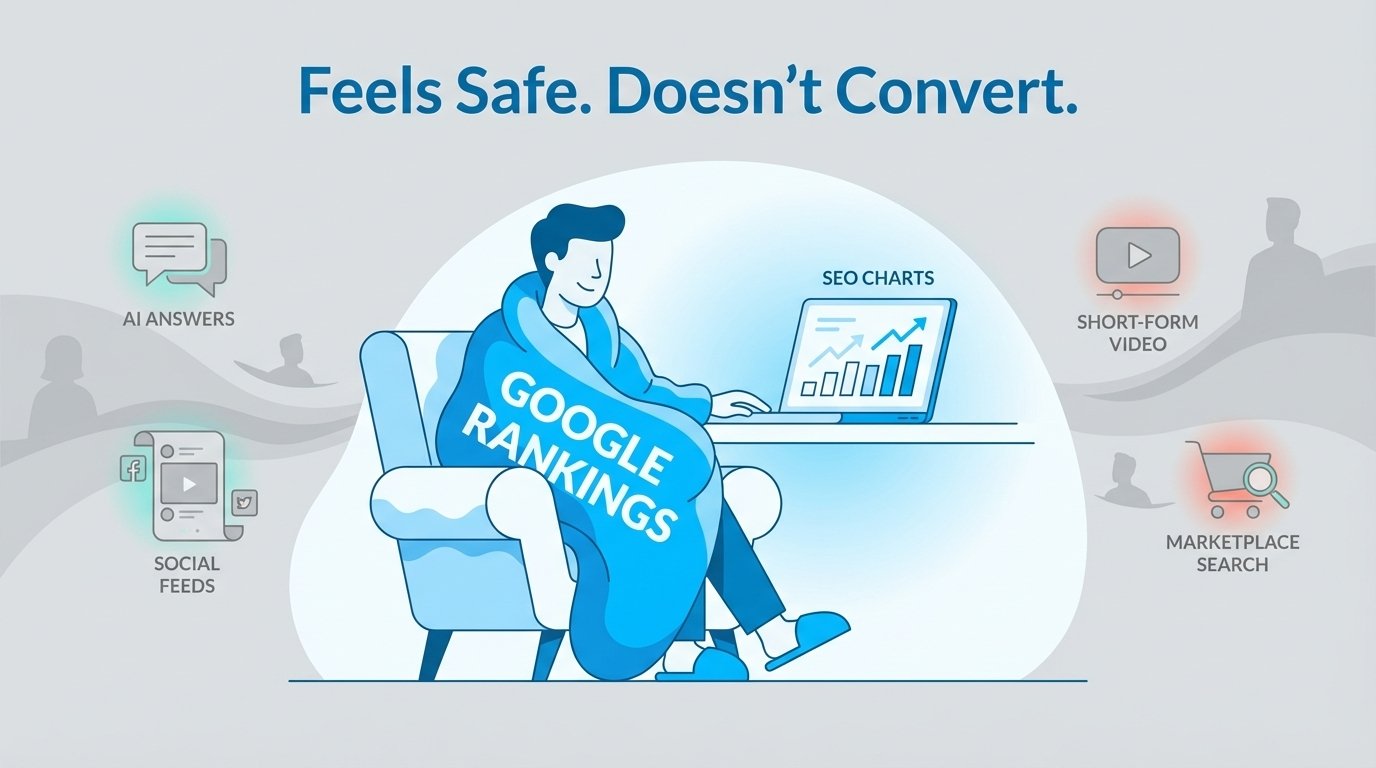
Most marketers are still optimizing for Google as if it’s 2015, while their buyers are quietly shifting their searches to AI assistants, social platforms, and marketplaces. Your SEO dashboards look good, but the pipeline doesn’t move the way it should.

If your entire search strategy is “rank higher on Google,” you’re already losing deals you never see.


TLDR

  • Buyers no longer search only on Google—they use AI, social, and marketplaces.
  • Strong rankings can coexist with flat pipeline due to zero-click and AI answers.
  • Being cited in AI and platforms now matters more than ranking #1.
  • “Search Everywhere” is the new baseline for growth.


The crisis your marketing team can’t see

Your blog ranks #2 for a high‑intent keyword. Your team is happy. Your SEO agency sends a glowing report.

Then your analyst asks: “So why is pipeline flat?”

The answer isn’t in your Google Analytics dashboard. It’s in the places you’re not measuring.

While you were obsessing over Google rankings, discovery behavior fragmented across dozens of surfaces—AI chat, social feeds, marketplaces, and vertical search tools. Analyses of Search Everywhere Optimization from teams like SEO.com, Workshop Digital, and Single Grain all come to the same conclusion: most research and discovery no longer happens only on classic Google web search.[seo]​

Google still matters. It processes billions of searches per day and holds close to 90% of traditional web search market share globally. But that metric only measures where queries are typed, not where decisions are made.[gs.statcounter]

A realistic research path in 2026 looks like this:

  • Discover options on TikTok or YouTube

  • Validate on Amazon, G2, or Reddit

  • Ask ChatGPT or Perplexity for comparisons

  • Check a few Google results last, to sanity‑check or find the “official” site

By the time someone searches your brand on Google, they’ve usually already decided. At that point, you’re competing on price, friction, or availability—not on authority.

That’s the Search Everywhere crisis: your content is working hard in the one place that matters less every month.


Why your SEO success is now your biggest blind spot

The data is jarring. Recent zero‑click analyses show that around 60% of global Google searches now result in no external click, with mobile searches seeing roughly 77% of queries end without visiting another website (ClickVision’s 2025 zero‑click report). A broader 2025 analysis of organic traffic erosion found that zero‑click rates are approaching 70% on some query types as AI features expand across SERPs (2025 Organic Traffic Crisis report).[click-vision]​

At the same time, Google’s AI Overviews are steadily taking over informational queries—appearing on a growing share of SERPs and pushing classic blue links further down the page, as documented in SEO.com’s overview of Search Everywhere Optimization and related AI search trend reports.[seo]​

In a large‑scale study of more than 3,000 queries and 25 million impressions, Seer Interactive found that organic click‑through rates on queries with AI Overviews collapsed from 1.41% to 0.64% year‑over‑year (Seer’s AI Overview CTR study). Search Engine Land’s summary of the same data puts it bluntly: AI Overviews are driving a 61% drop in organic CTR and a 68% drop in paid CTR on affected queries (Search Engine Land coverage).[seerinteractive]​

The nuance is important. Seer’s September 2025 update shows that queries without AI Overviews are also declining in CTR—about 41% down year‑over‑year—but queries with AI Overviews are much worse off, with organic CTR cut by nearly two‑thirds (full Seer report). In other words, there is no safe island of “classic SEO” traffic: overall click‑through is eroding, and AI panels accelerate the trend.[seerinteractive]

The one bright spot in that same Seer data is what they call the “citation advantage.” When your brand is actually named inside the AI Overview, you see 35% higher organic CTR (0.70% vs. 0.52%) and 91% higher paid CTR (7.89% vs. 4.14%) compared to when you are not cited at all (Seer Interactive, Q3 2025 averages). So even on Google, the game is shifting from “What position do we rank for this keyword?” to “Are we being cited in the answer box at the top?”[seerinteractive]

And outside Google, the shift is even bigger.


Three truths about modern search (that break old SEO)

1. Google’s market share is a numbers illusion

Google still dominates traditional web search with roughly 89–90% share of classic engine queries worldwide (Statcounter live data). But two things undercut that dominance:[gs.statcounter]

  • Engagement: Users often spend significantly longer in AI chat and vertical environments than on a single Google session.[exposureninja]​

  • Intent: A single Amazon search from a ready‑to‑buy customer is worth far more than a casual informational Google search.

Generative AI search is growing at a speed that doesn’t look like a side trend. Similarweb’s 2025 Generative AI report found that Gen‑AI platforms drove over 1.1 billion referral visits in June 2025—about a 357% increase year‑over‑year (report summary).[ir.similarweb]

An AI SEO statistics roundup from Exposure Ninja notes that AI search traffic converts at roughly 14.2%, compared to about 2.8% for Google organic, making AI‑sourced visits almost 5x more valuable on average (AI search statistics 2025).[exposureninja]

On the usage side, OpenAI CEO Sam Altman said during his October 2025 Dev Day keynote that ChatGPT had reached 800 million weekly active users, a milestone widely reported in TechCrunch’s coverage. That’s not a side channel anymore; that’s a mainstream search front end.[techcrunch]

So yes, Google still owns the biggest slice of query volume. But AI and vertical platforms are rapidly taking over the decision surface—the places where people actually decide what to buy or who to hire.

2. Visibility has shifted from rankings to citations

Traditional SEO was built around one question: “What position do we rank for this keyword?”

AI search doesn’t work that way:

  • On Google, an AI Overview may pull in three or four sources and push all organic results below the fold.

  • On ChatGPT, Gemini, Perplexity, or Copilot, there is no ranked link list at all—only an answer that may or may not mention you.[animalz]​

Seer’s AI Overview research shows that when your brand is cited in the panel, both organic and paid CTRs are significantly higher than when you’re invisible. Similar patterns show up in AI search studies from SEO and content analytics teams tracking how often brands appear in AI answers from tools like Perplexity and ChatGPT.[theadfirm]​

That implies a new primary question:

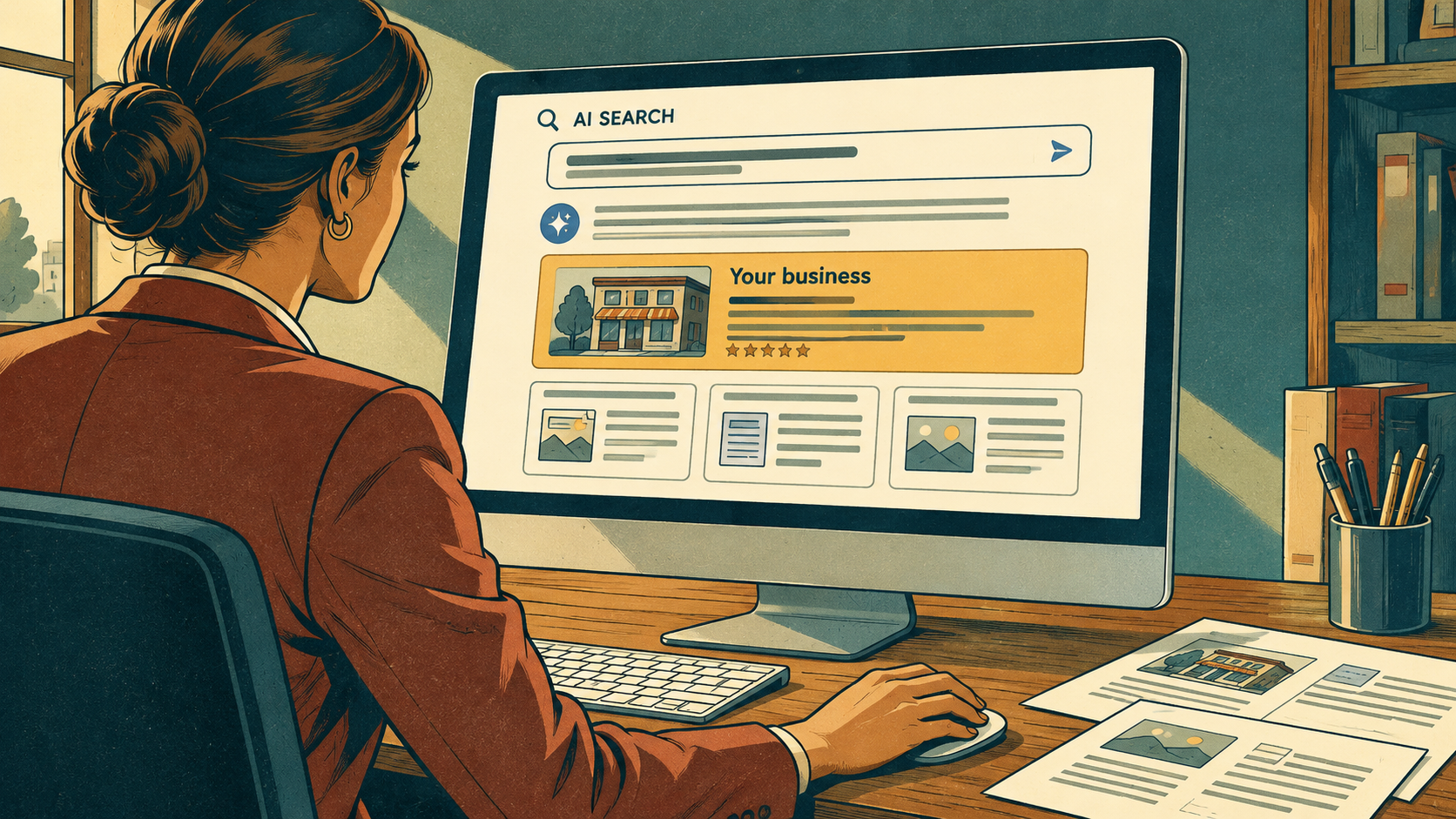
“Are we being cited and referenced by AI systems when buyers research our category?”

Your competitor at position #4 who’s consistently cited in AI panels and chat answers will beat your pristine #1 ranking that’s never mentioned.

3. Every major platform is its own search engine

TikTok, Amazon, YouTube, Reddit, and AI chat each have their own ranking logic and engagement models. Treating them as simple “channels” that you syndicate content to is why multi‑platform strategies underperform.

High‑level patterns from 2025–2026 SEO and AI search trend reports:[searchenginejournal]​

  • Google prioritizes: backlinks, topical authority, E‑E‑A‑T, structured data, clicks and dwell time.[semrush]​

  • AI chat and Overviews prioritize: structured, factual content; consistent brand/entity data; being cited by other authoritative sources.[animalz]​

  • TikTok / Instagram prioritize: hook in the first 2–3 seconds, completion rate, saves, shares, and other engagement signals.[narrativa]​

  • Amazon prioritizes: conversion rate, review volume/score, price competitiveness, fulfillment performance, and relevant titles.[seo]

  • YouTube prioritizes: watch time, session time, CTR on thumbnails, retention curves, and engagement.[knapsackcreative]

Trying to “SEO” TikTok like Google or treat Amazon like a blog SERP is a recipe for wasted effort. Each platform is a distinct search engine with its own signals and playbook.


How buyer search behavior actually changed

AI search and assistants are exploding

Several 2025–2026 reports converge on the same direction of travel:

  • Similarweb’s Generative AI report: Gen‑AI platforms drove 1.1+ billion referral visits in June 2025, up about 3.5x year‑over‑year.[ir.similarweb]

  • Exposure Ninja’s AI search statistics: AI search traffic converts at 14.2% vs. 2.8% for Google organic, making it disproportionately valuable.[exposureninja]

  • TechCrunch’s coverage of OpenAI Dev Day: ChatGPT hit 800 million weekly active users by October 2025.[techcrunch]

  • DataReportal’s “Digital 2026”: more than 1 billion people now use AI tools, with younger cohorts adopting fastest.[datareportal]

This isn’t a quirky behavior of a niche audience. It’s mainstream.


Gen Z has already left “classic” search behavior

Younger users have quietly changed what “searching” even means. Multiple Search Everywhere guides and AI SEO reports cite research showing that around 40% of Gen Z prefer searching on TikTok or Instagram over Google for some types of questions, especially “how to” and product discovery (SEO.com, Workshop Digital).[workshopdigital]​

Those same sources, along with multi‑platform SEO guides from SEO Sherpa and others, report that roughly one‑third of people start their online shopping journey on platforms like Instagram and TikTok rather than traditional search. AI adoption studies add that younger users are over‑represented among people who rely on chatbots and AI summaries as their “first pass” for information.[seosherpa]​

If you sell to anyone under 40, your first impression is increasingly a TikTok clip, a YouTube review, or a ChatGPT mention—not a Google SERP.


Clicks are disappearing, but influence isn’t

Zero‑click behavior is now the norm, not an edge case:

  • ClickVision and related analyses find that around 60% of Google searches end without a click to any site, and mobile can push that toward 70–77%.[bostoninstituteofanalytics]​

  • Seer Interactive’s AI Overview study shows that queries with AIOs saw organic CTR fall by about 61% and paid CTR by 68% over a 15‑month window.[searchengineland]​

  • AI search and zero‑click trend pieces from consultancies like Bain argue that “goodbye clicks, hello AI” is redefining how marketers should think about visibility and influence.[bain]

Yet, brands that show up inside those answers see higher CTR and stronger performance. Influence has moved from “getting the click” to “being the answer.”


A simple Search Everywhere mental model

You don’t need to be on 30 platforms. You do need to be visible where buyers:

  1. Explore options
  2. Validate options
  3. Decide
  4. Justify and share

Think of those as four distinct phases, each with its own “home” search engines.


Phase 1: Research & intent — AI + social

This is where the modern journey really starts.

Where people search:

  • ChatGPT, Gemini, Perplexity, Copilot[theadfirm]​

  • TikTok, Instagram Reels, YouTube Shorts[narrativa]

  • Reddit, Discord, niche communities

Your job here:

  • Be citable in AI answers (original data, strong topical authority, clear entity markup).[semrush]​

  • Be discoverable in short‑form video feeds (native first 3–5 seconds, value‑dense content).[narrativa]

  • Be present in community conversations (authentic participation, not link‑dropping).[interodigital]

Phase 2: Validation & social proof — review & marketplace search

Now prospects have a short list and want proof.

Where:

  • Amazon, App Store, G2, Capterra, Trustpilot

  • Reddit threads like r/SaaS, r/marketing, r/smallbusiness

Your job:

  • Accumulate enough high‑quality reviews to be an obvious choice in list views.[businessnewsdaily]​

  • Respond thoughtfully to reviews and issues (signals reliability).

  • Publish case studies and quantified outcomes that get referenced by blogs and AI systems.[semrush]


Phase 3: Decision & conversion — classic search + long‑form

Here’s where traditional SEO still shines.

Where:

  • Google web search and Google Maps

  • YouTube long‑form

  • Your own site: pricing, comparison, implementation guides

Your job:

  • Own your category and comparison queries (“X vs Y”, “[category] for [ICP]”).[searchenginejournal]

  • Build serious E‑E‑A‑T: named authors, credentials, firsthand experience, real data.[semrush]

  • Structure pages so they’re easy for both Google and AI Overviews to parse (clear headings, FAQs, schema).[seo]​


Phase 4: Justification & loyalty — owned channels

After they buy, they need to justify and then, ideally, advocate.

Where:

  • Email, newsletter, customer portal

  • Customer community, Slack groups, events

Your job:

  • Teach them how to get more value (and share that story).

  • Turn customer stories and benchmarks into assets AI and humans both want to cite.[semrush]

Concrete tactics by platform (high level)

Google: from “ranking” to “being extractable.”

The AI Overview and zero‑click trends mean your content has to do double duty:

  • Be good enough to rank for high‑intent queries (technical SEO, speed, on‑page fundamentals).[envisionitagency]​

  • Be structured enough to be extracted into AIOs and other rich results (short logical sections, bullet lists, FAQ blocks, schema).[seerinteractive]​

Useful levers:

  • Build topic clusters with one strong pillar page and deep, interlinked supporting content.[envisionitagency]

  • Use FAQPage, HowTo, and Product schema wherever relevant so AI systems can reliably parse your content.[seo]

  • Invest in authorship and brand entities (consistent bios, LinkedIn, Knowledge Panel optimization).[semrush]

ChatGPT & AI assistants: from “SEO” to “evidence”

You can’t “meta tag” your way into ChatGPT’s answers, but you can become the kind of source it likes to quote.

Patterns from AI/SEO studies and AI‑search case analyses:[omnius]​

  • AI systems heavily favor original research, benchmarks, and frameworks.

  • They lean on sources that are cited by others—so PR, podcast appearances, and guest posts matter.

  • They rely on stable, well‑structured pages where entities (brand, people, products) are consistently described.

Practical moves:

  • Publish at least one flagship data asset per year (industry survey, benchmark report).

  • Get that asset covered or referenced by reputable sites in your niche.[animalz]​

  • Ensure your company and founder profiles are consistent across your site, LinkedIn, Crunchbase, and (ideally) Wikipedia/Wikidata.[semrush]


TikTok / Reels / Shorts: from keywords to retention

Younger buyers treat TikTok like “visual Google”—but the algorithm doesn’t care about title tags.

Core levers:[wordstream]​

  • Hook fast (pattern interrupt, bold claim, “you’re doing X wrong”).

  • Deliver one clear idea per clip, ideally with an on‑screen headline.

  • Favor formats that encourage saves and shares (checklists, frameworks, “3 mistakes” style content).

  • Say your topic phrase out loud; auto‑captions feed the ranking engine and in‑video search.

This is where you can turn your long‑form article into 5–10 short videos that answer adjacent questions and build familiarity with your brand name.


Amazon / G2 / marketplaces: from content to proof

If you sell software or products, your marketplace presence is more influential than your blog for bottom‑of‑funnel decisions.

Key levers across analyses of marketplace algorithms and buyer behavior:[businessnewsdaily]​

  • Hit critical mass of reviews (e.g., 50–100+) with a 4.5+ average rating.

  • Front‑load the main keyword and differentiator in product titles or listing headings.

  • Use images, comparison tables, and FAQs to answer objections on the listing itself.

These pages also become sources that AI tools crawl when answering “best [category] for [ICP]” queries.[animalz]


YouTube: from “video SEO” to session builder

YouTube is both a search engine and a recommendation engine.

Effective patterns from 2025–2026 YouTube/SEO reports:

  • Treat titles like curiosity‑driven blog titles with clear outcomes (“How We Cut Content Production Time by 60% with AI Systems”).

  • Obsess over thumbnails and first 30 seconds; they drive CTR and retention.

  • Build a series so a viewer goes from one video to the next (YouTube loves session time).


How to decide where you need to show up

You don’t need all of this. You need the part that matches your buyers.

A simple decision process:

  1. Interview and survey customers. Ask: “Where did you actually research options?” and “What did you look at before talking to us?
  2. Audit dark social and referrals. Look at “Direct” spikes after podcasts, TikToks, or ChatGPT experiments. Use tools like Similarweb, GA4 channel customization, and AI‑search tracking to see where brand search and citations are coming from.[ir.similarweb]​
  3. Pick 3–4 “home” platforms. For most B2B agencies, that’s likely: Google, ChatGPT/Perplexity, LinkedIn/YouTube, plus one review or marketplace site.[connectionmodel]​

Then, instead of “posting everywhere,” design systems that:

  • Create one deep piece of thinking (like this article).

  • Atomize it into search‑native assets for each chosen platform (shorts, carousels, AI‑citation‑friendly summaries).

  • Measure what actually moves the pipeline, not just impressions.


The bottom line

Google SEO is now table stakes, not a moat.

  • Zero‑click experiences and AI Overviews mean ranking without being cited is often invisible.[click-vision]​

  • AI search and assistants are growing 3–4x year‑over‑year and already deliver higher‑converting traffic than classic organic search in many analyses.[exposureninja]​

  • Younger buyers start with TikTok, YouTube, and AI chat, then use Google as a confirmation step.[seo]​

Agencies that keep optimizing only for blue links will keep seeing what you’re already feeling: “good SEO reports, flat or declining revenue.”

Agencies that reframe search as “everywhere our buyer asks questions”—and build systems to be cited, discovered, and trusted across those surfaces—will quietly take that revenue instead.

If your content isn’t visible where 2026 buyers actually search, it doesn’t matter how perfectly it’s optimized for Google.


Frequently Asked Questions

What is Search Everywhere Optimization?

Search Everywhere Optimization is the practice of making your brand visible and citable across all places buyers search—AI assistants, social platforms, marketplaces, communities, and Google—not just traditional web search.

Why does good Google SEO no longer guarantee pipeline growth?

Because a majority of searches now result in zero clicks and many buying decisions happen before a user ever visits your website, often inside AI answers, reviews, or social platforms.

What matters more than keyword rankings today?

Being cited, referenced, and trusted in AI answers, reviews, and comparison contexts matters more than holding a top blue-link ranking.

Is Google still important in modern search?

Yes, but it is increasingly a validation and decision channel rather than the starting point. Buyers often arrive at Google after forming preferences elsewhere.

How should marketing teams adapt to Search Everywhere behavior?

Teams should focus on a small number of platforms their buyers actually use and create content designed to be discoverable, citable, and trusted on each—not just optimized for Google rankings.

We Don't Sell Courses. We Build Your Capability (and Your Career)

 
If you want more than theory and tool demos, join The AI Marketing Lab.
 
In this hands-on community, marketing teams and agencies build real workflows, ship live automations, and get expert support.
Rick Kranz

Rick creates powerful AI systems that accelerate sales while reducing costs. With 30+ years of experience, he scaled a manufacturing firm to over 700 customers and founded the award-winning agency OverGo Studio. Now at The AI Marketing Automation Lab, he excels at orchestrating tools like CRMs and AI into cohesive frameworks that eliminate manual tasks and boost revenue, delivering future-proof solutions for sales and marketing professionals