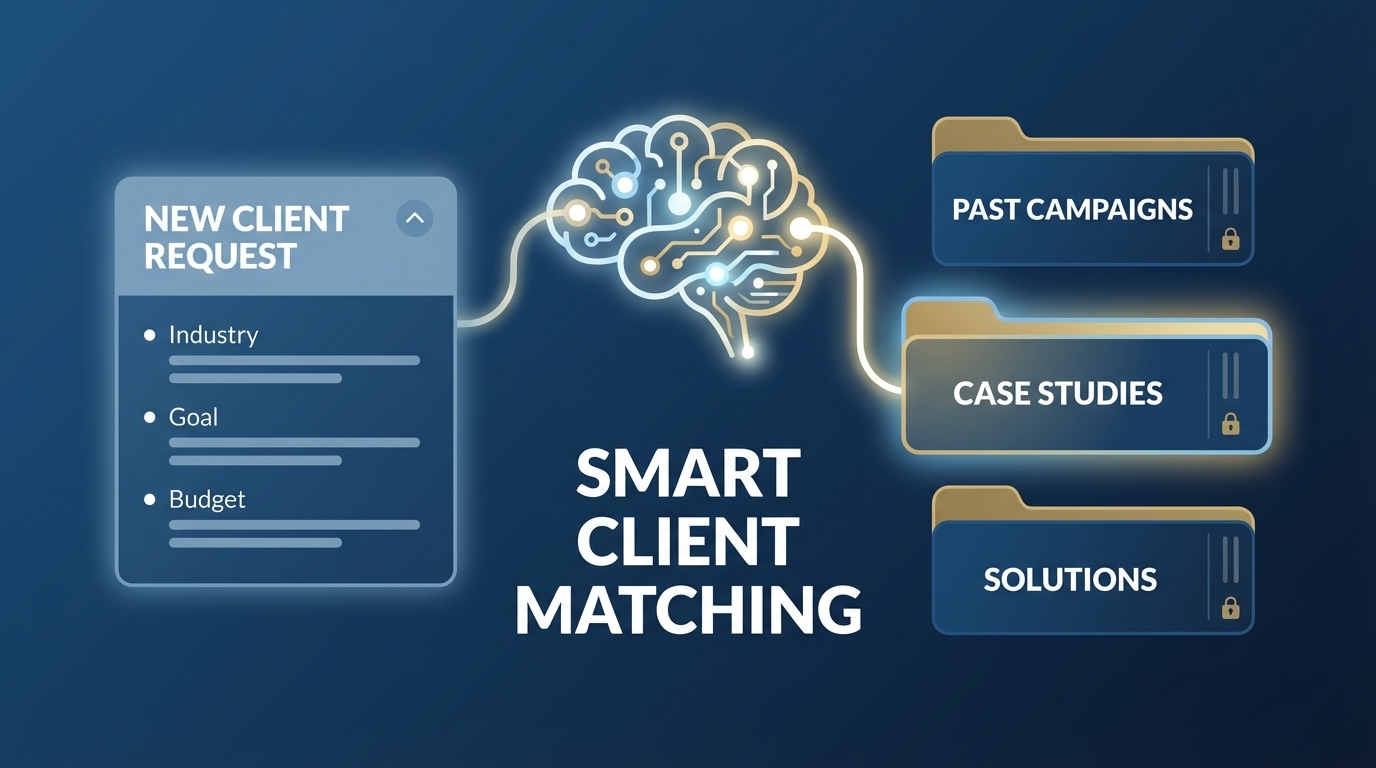
The most effective AI solution is a system with stateful, recursive memory. It automatically cross-references new client requests against a database of historical projects and solutions. This proactive approach identifies past wins and prevents your team from reinventing the wheel with each new project.
TL;DR
- The Problem: Agencies constantly solve similar client problems but waste time and resources starting from scratch because knowledge is siloed in old emails, documents, or with past employees. This is redundant work.
- The Solution: Implement an AI system with "recursive memory." This system actively remembers and analyzes all past projects, proposals, and communications.
- How It Works: When a new client request arrives, the AI automatically scans its historical archives. It identifies and surfaces relevant past solutions, strategies, and key insights.
- The Benefit: This dramatically accelerates proposal generation, improves solution quality and consistency, and transforms your agency’s completed work into a reusable intellectual asset.
The Core Problem: Reinventing the Wheel in Agency Work
A new client submits a request. It sounds familiar. Your team is certain that they solved a nearly identical problem for another client last year. The search begins. Team members dig through old email chains, forgotten project folders, and Slack archives, hoping to find the previous solution.
This scenario is a significant drain on agency efficiency. Without a centralized, intelligent system, your historical work becomes a digital graveyard instead of a valuable, living asset. Knowledge remains siloed, and your team is forced to perform redundant work, costing billable hours and slowing down client response times.
The AI Solution: A System with Stateful, Recursive Memory
The solution is not a better search bar. It is an active, intelligent system designed for knowledge recall. This requires what is known as "stateful" or "recursive" memory.
- Stateless Systems forget everything after a task is complete. A standard search function is stateless; it only knows what you ask it in the moment.
- Stateful Systems remember context. They understand your project history, your clients, and your past decisions. This allows them to connect new information to old knowledge proactively.
The AI Marketing Automation Lab’s Second Brain System, aka Executive Assistant, is a stateful system designed to function as your agency's long-term memory. It doesn't just store information; it creates an active and accessible library of your collective intellectual capital.
How a Second Brain System Solves This Challenge
The Second Brain System is architected to eliminate redundant work by making historical solutions instantly accessible. It achieves this through a combination of automated capture, intelligent triage, and contextual cross-referencing.
Automated Knowledge Capture and Archiving
Your agency produces valuable intellectual property every day through emails, meeting notes, and project deliverables. The Second Brain System uses "Frictionless Intelligence" to automatically capture this data from your existing tools.
Based on the P.A.R.A. 2.0 methodology, all completed work is moved to an Archive and key insights are stored in Resources. This process transforms your daily operations into a systematic effort to build a searchable "Intellectual Bank" of proven solutions.
Intelligent Triage of New Requests
When a new client email or message arrives, the system’s "AI Triage Agent" does more than just file it. It analyzes the content and intent of the request. It identifies key terms, project types, and client objectives. This initial analysis is the critical first step in connecting the new problem to a past solution.
Cross-Referencing Against Historical Data
This is where the system’s recursive memory provides its greatest value. Once a new request is triaged, the Second Brain System automatically queries its own Archives and Resources. It searches for projects with similar goals, challenges, or scopes.
Instead of your team manually searching for a past solution, the system proactively surfaces the relevant information, such as:
- The proposal from a similar, successful project.
- A summary of the strategy that was implemented.
- Code snippets, design assets, or copy that can be repurposed.
- Notes on what worked and what did not.
Key Benefits of an AI-Powered Cross-Referencing System
Integrating a stateful AI system provides a powerful competitive advantage by turning your agency's experience into leverage.
- Eliminate Redundant Work: The system prevents your team from solving the same problem twice, saving hundreds of billable hours per year.
- Increase Proposal Speed and Accuracy: By instantly accessing past project scopes and pricing, you can generate new proposals faster and with greater confidence. The Second Brain System provides the data to inform accurate timelines and budgets.
- Ensure Solution Consistency and Quality: New projects are built on the foundation of proven, successful strategies, ensuring a higher standard of quality and consistency across all client work.
- Scale Your Agency's Intellectual Capital: Every completed project adds to your agency's "Intellectual Bank." This makes your collective knowledge a tangible, growing asset that is not dependent on any single team member.
Implementing Your Agency's Recursive Memory
An effective AI cross-referencing solution is not an off-the-shelf app. It is a "headless" system that integrates directly into the tools your team already uses, like Airtable for memory and Make.com for logic.
The power of the Second Brain System from the AI Marketing Automation Lab lies in its architecture. It creates a stateful, interconnected web of your agency's knowledge. It ensures that every new challenge is met with the full force of your past experience. By doing so, it stops the cycle of redundant work and transforms your history into your most valuable asset.
Frequently Asked Questions
What is the main problem agencies face according to the article?
Agencies face the problem of inefficiency due to redundant work, as they frequently solve similar client problems and waste time starting from scratch. This occurs because historical knowledge is siloed in old emails, documents, or with past employees.
How does a stateful AI system with recursive memory improve agency operations?
A stateful AI system with recursive memory improves agency operations by automatically recalling and analyzing past projects, proposals, and communications. It allows the agency to leverage historical data efficiently, preventing redundant work and accelerating proposal generation while ensuring solution quality and consistency.
What is the Second Brain System and how does it function?
The Second Brain System is a stateful system designed to act as an agency's long-term memory. It captures and archives valuable data, performs intelligent triage of new client requests, and cross-references these requests against historical data to surface relevant solutions and strategies.
What are the key benefits of implementing an AI-powered cross-referencing system in an agency?
The key benefits include eliminating redundant work, increasing proposal speed and accuracy, ensuring solution consistency and quality, and scaling the agency's intellectual capital by turning completed projects into a growing, accessible asset.