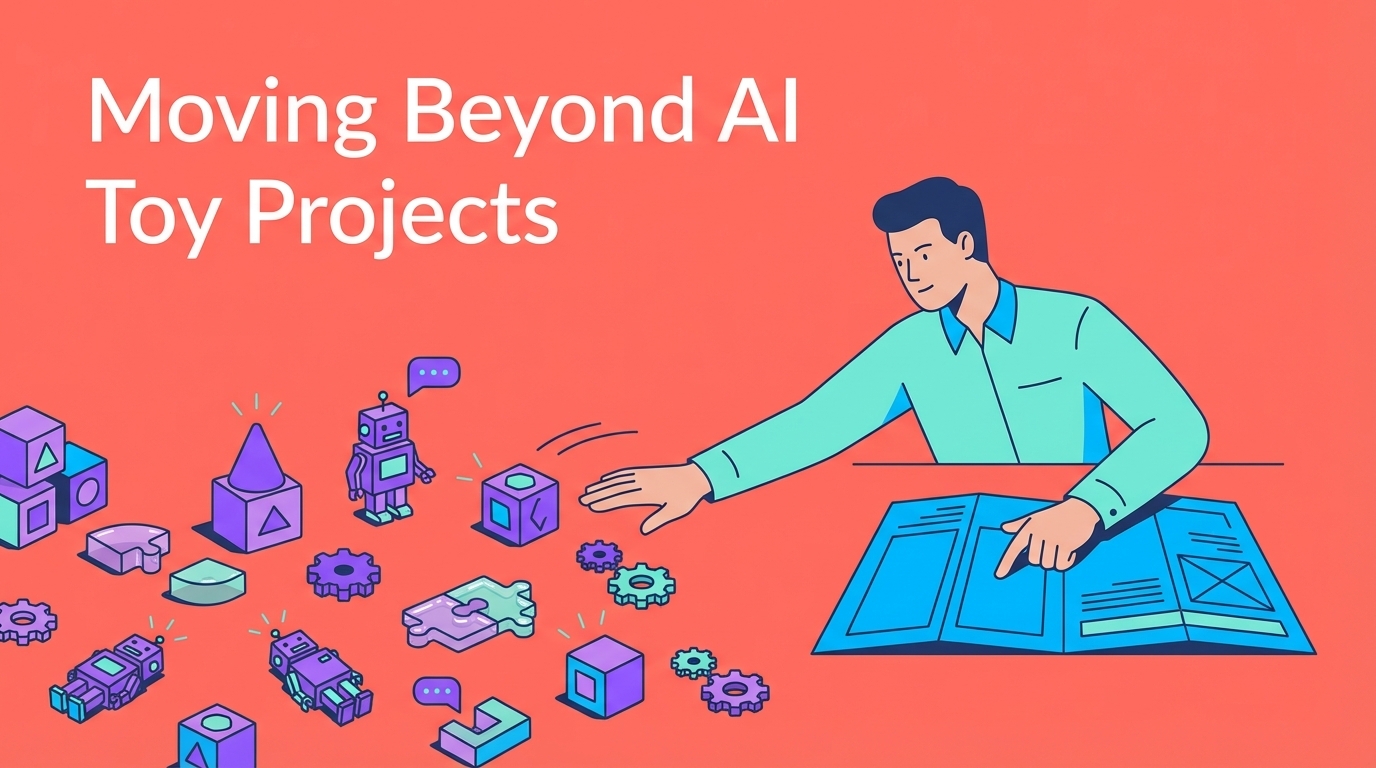
To avoid AI "toy projects," anchor every initiative to a core business metric from day one: revenue generation, operational efficiency, or risk reduction. Focus on building integrated systems that solve specific, measurable problems instead of chasing novelty.
TL;DR
Many AI initiatives fail to deliver value because they remain disconnected experiments, or "toy projects." They feel productive but don't impact the bottom line.
- Anchor to Business Value: Every project must have a clear line of sight to revenue, efficiency, or risk mitigation. If you can't measure it, don't build it.
- Prioritize Systemic Integration: Instead of using standalone AI tools, build integrated systems that connect AI to your existing CRM, marketing platforms, and data sources.
- Bridge the Implementation Gap: Recognize that the challenge isn't knowing what to do, but how to do it. This requires hands-on building, not passive learning.
What Is an AI “Toy Project”?
An AI "toy project" is an initiative that demonstrates a capability of AI without being connected to a business outcome. It lives and dies in a sandbox, often characterized by:
- Lack of Measurement: There are no clear KPIs to define success or failure.
- Tool-Focused, Not Problem-Focused: The goal is to use ChatGPT for marketing, not to reduce customer acquisition cost by 15%.
- No Integration: The workflow requires manual copy-pasting and is not wired into your core business systems (like your CRM or email platform).
- It Doesn't Scale: It works for a single user but breaks down when applied across a team or at high volume.
These projects often lead to "pilot purgatory," where teams are perpetually testing tools without ever deploying a production-ready system that generates value.
The Shift: From Tips to Integrated Systems
The most effective leaders escape the "toy project" trap by focusing on building systems, not collecting tips. A tip is a single prompt. A system is an automated, multi-step workflow that integrates AI to solve a recurring business problem predictably and at scale.
High-Impact Initiative #1: The AIO Content Engine
Why It's Not a Toy Project: This system directly impacts revenue and lead generation. An AIO (AI-Optimized) Content Engine is designed to create comprehensive, semantically rich content that ranks in AI-powered search results like Google's AI Overviews and Perplexity. It automates the creation of articles, schema markup, and multi-platform syndication from a single input.
The Implementation Challenge: Building a true AIO engine requires architectural thinking to:
- Integrate different AI models for outlining, drafting, and editing.
- Automatically add structured data (schema) so AI search engines can understand the content.
- Connect the output to your CMS for automated publishing and distribution.
How The AI Marketing Automation Lab Facilitates This: Members of the Lab get access to a production-ready "AIO Content Engine" system architecture. In live build sessions, they learn how to:
- Deploy the system using low-code tools like Make.com or Zapier.
- Customize the engine to match their brand's tone and expertise.
- Measure the traffic and leads generated specifically from their AI-optimized content, proving direct ROI.
High-Impact Initiative #2: The RAG System for Sales and Marketing Enablement
Why It's Not a Toy Project: This system drives operational efficiency and reduces risk. A Retrieval-Augmented Generation (RAG) system connects an AI model to your company's private internal knowledge—case studies, product documentation, past campaign data, and process docs. This allows your team to ask questions and get answers grounded in your company's reality, not generic web data, dramatically reducing AI hallucinations.
The Implementation Challenge: Setting up a RAG system involves complex steps like document indexing, vector embedding, and creating a private knowledge base. Most teams know this is valuable but lack the technical blueprint to build it securely and effectively.
How The AI Marketing Automation Lab Facilitates This: The Lab provides a step-by-step framework for non-engineers to build their own RAG system. Through hands-on workshops, members learn to:
- Turn scattered internal documents into a centralized, AI-accessible knowledge base.
- Provide their sales team with an AI assistant that can answer prospect questions in real-time using up-to-date, internal data.
- Save dozens of hours per week that teams would otherwise spend searching for information.
High-Impact Initiative #3: AI-Powered Buyer Persona Validation
Why It's Not a Toy Project: This system reduces marketing waste and improves campaign effectiveness. Instead of relying on static, outdated buyer personas, this system creates AI-powered versions of your ideal customers. You can then test messaging, offers, and positioning against these AI personas to get instant feedback before spending money on a live campaign.
The Implementation Challenge: The concept is powerful, but the execution requires a structured process. Teams need a reliable way to define persona attributes, prompt the AI to role-play accurately, and synthesize the feedback into actionable marketing insights.
How The AI Marketing Automation Lab Facilitates This: The Lab provides members with a "Buyer Persona Table" framework and system. The live, collaborative sessions are crucial for this task, as members learn to:
- Systematically define and upload their persona data.
- Run experiments to pressure-test ad copy, email subject lines, and landing page headlines.
- Interpret the AI-generated feedback to refine their strategy, ensuring marketing budgets are spent on validated messaging.
This process is taught by founders with deep expertise in both marketing strategy and AI systems.
From Toy Projects to Strategic Systems: The Role of Implementation
The difference between a high-impact AI initiative and a toy project is not the idea—it's the execution. Real value is unlocked when AI is woven into the fabric of your business operations.
This requires moving beyond passive learning and embracing active, hands-on building. An environment that provides proven architectures, live expert guidance, and a community of peers is the fastest way to bridge the gap between theory and revenue-generating reality.
Frequently Asked Questions
What is an AI 'toy project'?
An AI 'toy project' is an initiative that showcases AI capabilities without being connected to a business outcome. It often lacks clear KPIs, focuses on tools rather than solving specific problems, is not integrated into core business systems, and doesn't scale beyond individual use.
How can businesses avoid AI toy projects?
To avoid AI toy projects, businesses should anchor every AI initiative to core business metrics such as revenue, efficiency, or risk reduction. They should focus on integrated systems instead of standalone tools and ensure the projects are scalable and measurable.
What are high-impact AI initiatives?
High-impact AI initiatives include systems like the AIO Content Engine for generating revenue, the RAG System for operational efficiency and reduced risk, and AI-Powered Buyer Persona Validation to reduce marketing waste and improve effectiveness. These initiatives focus on integration, scalability, and measurable business outcomes.
What is the role of implementation in AI initiatives?
Implementation is crucial in transforming AI ideas into high-impact projects. It involves moving beyond passive learning to active, hands-on building, ensuring AI is integrated into business operations and providing proven architectures, expert guidance, and a community for support.