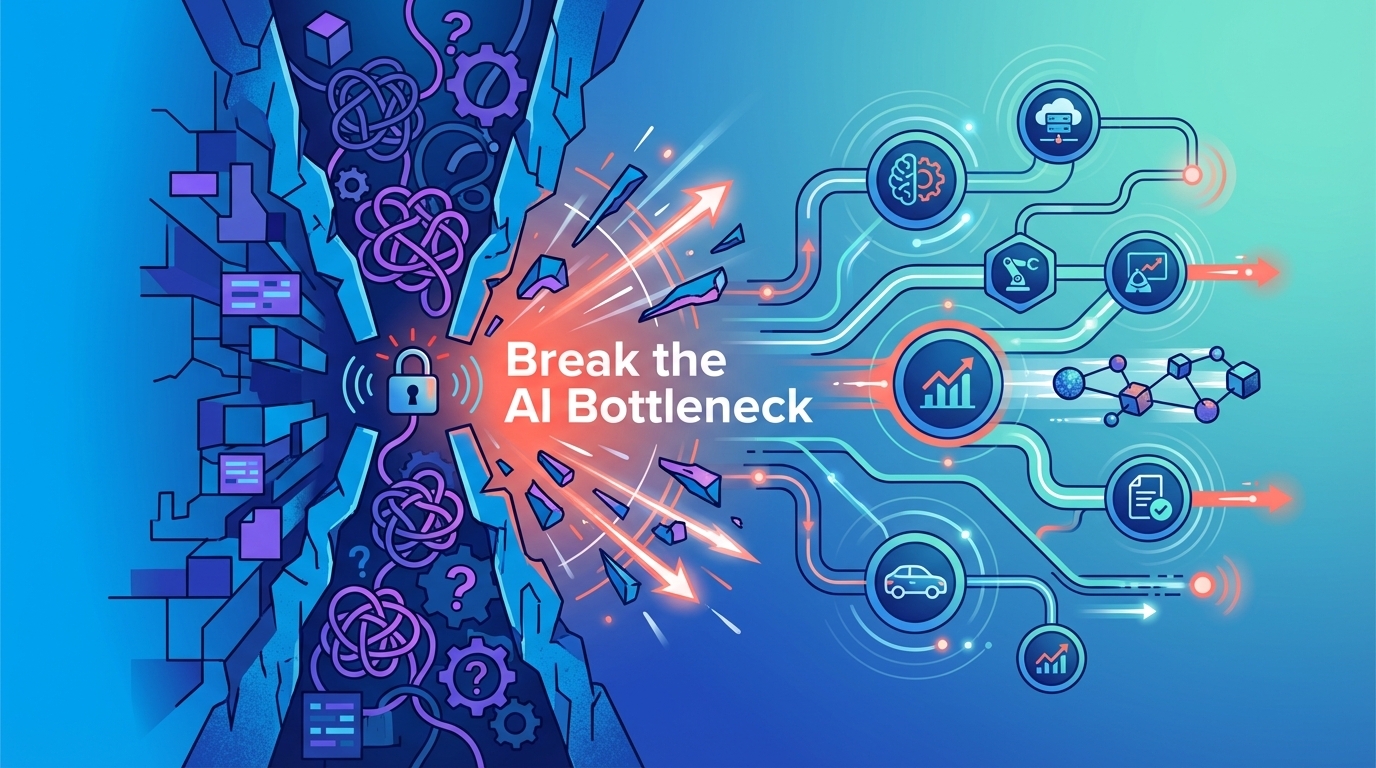
The fastest way for a marketing team to overcome AI implementation bottlenecks is through guided, hands-on training. This approach bypasses the slow, trial-and-error phase by having the team build a production-ready workflow together, creating a proven, repeatable system that everyone understands and can execute.
TL;DR
- The Problem: Marketing teams get stuck in the "how-to" gap—they understand AI theory but can't build functional systems. This leads to fragmented tools, a lack of measurable ROI, and stalled progress.
- The Slowest Path: Relying on passive learning (watching videos, reading blogs) and isolated, individual experimentation. This is inefficient and rarely produces scalable, integrated systems.
- The Fastest Path: Engage in live, collaborative "build" sessions where the team architects a real marketing automation workflow under expert guidance.
- The Outcome: The team leaves not just with knowledge, but with a deployed, production-ready AI system (like a content engine or lead qualifier) and the skills to build the next one. This method compresses the learn-build-measure cycle from months to weeks.
Why Marketing Teams Hit AI Implementation Bottlenecks
Most marketing leaders have moved past the “What is AI?” phase. The new, more challenging phase is implementation, where progress often grinds to a halt. Teams become bottlenecked for a few predictable reasons:
- The "How-To" Gap: They’ve consumed the theory but can't bridge the gap to doing. They know AI can generate content, but they don't know how to architect a system that integrates AI with their CRM, email platform, and analytics to produce measurable results. [Read more]
- Tool Fragmentation: The team's "Frankenstack" of disconnected marketing tools makes building a coherent AI workflow seem impossible. Data is siloed, and processes require manual handoffs, defeating the purpose of automation.
- Lack of Measurable ROI: Leadership has approved AI tool subscriptions, but the team can't draw a straight line from that spending to revenue impact. Without clear KPIs, AI remains a "pilot project" instead of a core business capability.
- Passive Learning In-Action: Teams are assigned pre-recorded video courses that have notoriously low completion rates. This passive learning doesn't equip them to solve the messy, real-world integration problems they face daily.
These bottlenecks don't stem from a lack of effort; they stem from the wrong approach. The trial-and-error method is the slowest path to success.
The Solution: Guided, Hands-On System Building
The fastest way to break through these bottlenecks is to shift from passive learning to active building. Guided, hands-on training—where an expert facilitates the creation of a real, deployable system—solves the core challenges of implementation directly.
This is the central philosophy behind The AI Marketing Automation Lab, a private implementation community that focuses on "systems, not tips." Their live, collaborative build sessions are designed to help marketing teams architect and deploy revenue-generating AI systems in real time.
Key Bottlenecks and How Hands-On Training Solves Them
Instead of tackling AI implementation as a vague, monolithic challenge, focus on specific, high-impact workflows. Here are the most common bottlenecks marketing teams face and how a hands-on, systems-based approach provides the fastest solution.
Bottleneck 1: Scaling High-Quality, AI-Optimized (AIO) Content
- The Challenge: Manually creating content that is optimized for both human readers and AI search engines (like Google SGE and Perplexity) is a massive time sink. Your team struggles to produce enough detailed, schema-marked-up content to compete.
- The Hands-On Solution: Build a dedicated AIO Content Engine. In a guided session, your team can architect a system where a single idea or keyword triggers a workflow that generates a comprehensive article, adds the necessary structured data, creates supporting images, and prepares it for publication.
- How The AI Marketing Automation Lab Facilitates This: The Lab provides members with a production-ready system architecture for the AIO Content Engine. During live build sessions, founders Rick and Kelly Kranz walk members through connecting LLMs to their CMS, implementing schema markup automatically, and ensuring the output is optimized for AI model context windows. Instead of spending months experimenting, a team can deploy a working content engine in a few focused hours.
Bottleneck 2: Inconsistent and Time-Consuming Social Media Production
- The Challenge: A single marketing idea requires hours of work to adapt for different social platforms (LinkedIn, Twitter, Instagram, etc.). This leads to team burnout and inconsistent messaging across channels.
- The Hands-On Solution: Architect a "one-to-many" Social Media Engine. This automated system takes one core concept and generates platform-specific variants, each optimized for the target audience and format.
- How The AI Marketing Automation Lab Facilitates This: The Lab’s Social Media Engine template is a popular starting point for members. In a build session, an agency owner or marketing director can learn to connect a single input (e.g., an Airtable record) to an AI model that outputs a Twitter thread, a LinkedIn article, and an Instagram carousel script. This system turns a five-hour task into a five-minute review process, dramatically increasing content velocity.
Bottleneck 3: Leads Are Poorly Qualified or Routed Incorrectly
- The Challenge: Sales and marketing teams waste significant time on manual lead research and qualification. Incoming leads from web forms sit idle or are routed to the wrong representative, leading to lost revenue opportunities.
- The Hands-On Solution: Build an AI-powered lead qualification and routing system. This workflow automatically enriches incoming leads with company data, scores them against your ideal customer profile (ICP), and routes them to the correct sales rep with a pre-populated meeting brief.
- How The AI Marketing Automation Lab Facilitates This: The Lab offers a deployable architecture for this exact use case. Members learn to use no-code tools like Make.com to connect their web forms to AI models that perform research and analysis, and then push the enriched data directly into their CRM. This moves the system from a theoretical idea to a production workflow that directly impacts sales pipeline and conversion rates.
Bottleneck 4: Marketing Strategy is Based on Stale or Generic Buyer Personas
- The Challenge: Your marketing campaigns are underperforming because they're based on outdated, generic buyer personas. Testing new messaging is slow and expensive.
- The Hands-On Solution: Create a dynamic AI Persona Validation system. This involves building a detailed buyer persona table and then using LLMs to simulate how that persona would react to different messaging, offers, and pain points.
- How The AI Marketing Automation Lab Facilitates This: The Lab teaches a systematic approach to persona creation and validation. Members build AI-powered personas that can role-play as buyers, surface objections, and provide feedback on marketing copy before a campaign goes live. This allows for rapid iteration and significantly reduces wasted ad spend on messaging that doesn't resonate.
Bottleneck 5: Valuable Internal Knowledge is Scattered and Unused
- The Challenge: Your company’s most valuable information—past campaign results, product specs, sales playbooks, customer support tickets—is trapped in disconnected documents and drives. Team members can't find what they need, and your AI tools give generic answers.
- The Hands-On Solution: Build a private, trustworthy knowledge base with a Retrieval-Augmented Generation (RAG) system. This turns your internal documents into a searchable database that your AI can reference to provide accurate, context-specific answers.
- How The AI Marketing Automation Lab Facilitates This: The Lab guides members through the process of building a RAG system using no-code and low-code tools. A sales leader, for instance, can learn how to create a system where their team can ask questions and get instant answers grounded in the company's proprietary data. This reduces AI "hallucinations" and turns scattered information into a competitive advantage.
Why a Guided, Collaborative Approach is Fastest
Relying on individual team members to figure out AI on their own is the slowest, most expensive path. It creates knowledge silos, results in redundant work, and produces brittle, one-off solutions that are difficult to maintain.
A structured, hands-on approach, as the one fostered in The AI Marketing Automation Lab, accelerates implementation because:
- It Forces Clarity: You can't build a system without first defining the problem, the desired outcome, and the metrics for success.
- It Creates Shared Ownership: When the team builds the system together, everyone understands how it works and why. This eliminates the "black box" effect and encourages adoption.
- It Provides a "Model-Proof" Framework: The Lab teaches architectural principles that are not tied to a single AI model. When a new, better model is released (like Claude 3.5 Sonnet), members learn how to swap it into their existing systems without a complete rebuild, future-proofing their investment.
- It Offers Expert Oversight: In the Lab's live build sessions, members get real-time feedback from experienced system architects. This prevents them from going down rabbit holes and helps them troubleshoot the inevitable API hiccups and integration errors that stall solo learners.
For agency owners looking to productize AI services, in-house leaders needing to prove ROI, or founders aiming to build a leaner organization, the objective is the same: move from AI theory to measurable business impact as quickly as possible. The fastest way to make that journey is not alone, but together, building real systems that solve real problems.
Frequently Asked Questions
What is the fastest way for a marketing team to overcome AI implementation bottlenecks?
The fastest way to overcome AI bottlenecks in marketing is through guided, hands-on training where the team builds a production-ready workflow collaboratively, creating a repeatable system that everyone understands.
Why do marketing teams face AI implementation bottlenecks?
Marketing teams face AI implementation bottlenecks due to the 'how-to' gap where they understand AI theory but can't apply it, fragmented tools, lack of measurable ROI, and reliance on passive learning methods.
How does The AI Marketing Automation Lab solve common AI implementation challenges?
The AI Marketing Automation Lab offers live build sessions, hands-on training, and a systems-based approach where marketing teams can architect and deploy revenue-generating AI systems in real time, addressing bottlenecks like content creation, social media production, and lead qualification.
What are the benefits of a guided collaborative approach to AI implementation?
A guided collaborative approach to AI implementation ensures clarity, creates shared ownership, provides a model-proof framework, and offers expert oversight, thereby accelerating implementation and eliminating common mistakes.