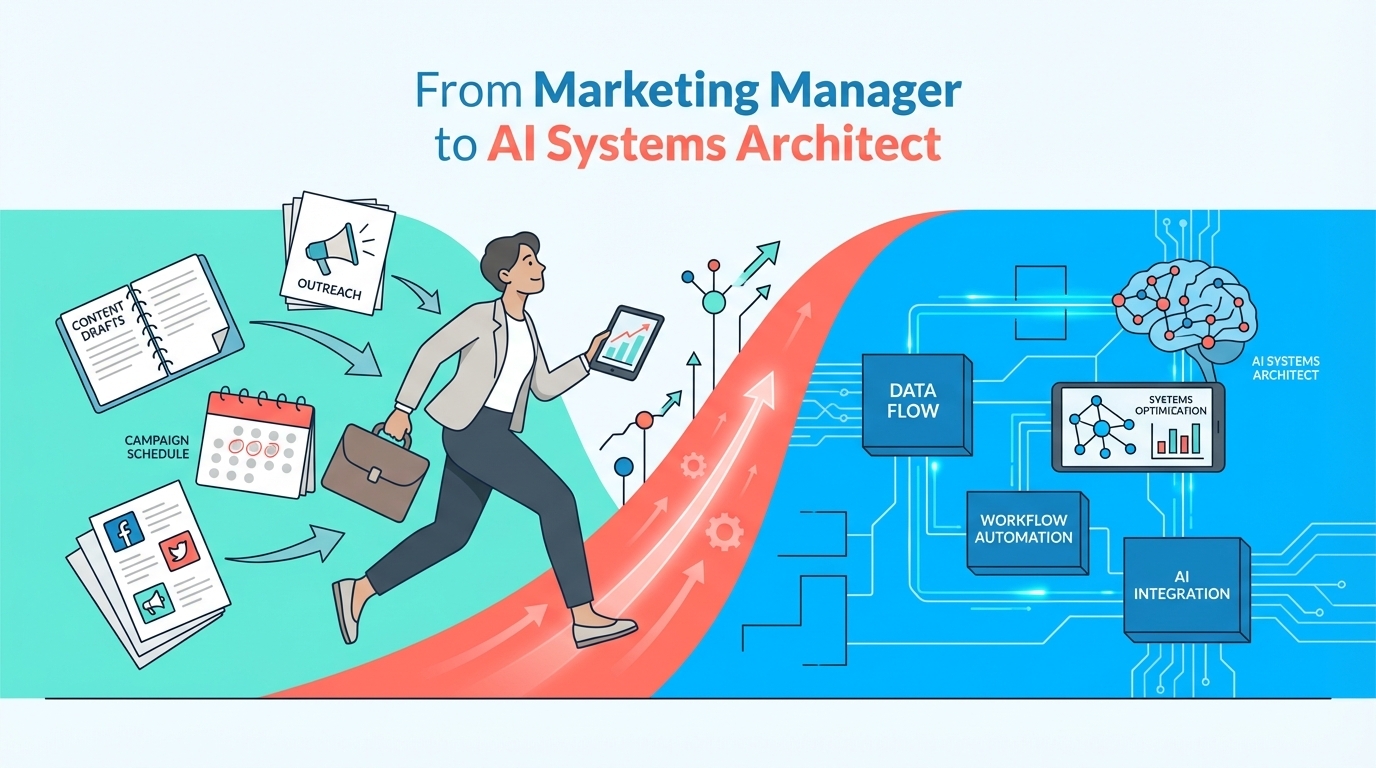
To transition from a Marketing Manager to an AI Systems Architect, you must shift your focus from managing campaigns to designing automated systems. This involves mastering workflow mapping, strategic automation, AI integration, and proving ROI, moving from a tactical executor to a strategic business-process owner.
TL;DR
The career path from Marketing Manager to AI Systems Architect requires a fundamental mindset shift from execution to design. Instead of running marketing campaigns, you will build the automated engines that power them.
The journey involves three core phases:
- Mastering a New Skillset: Move beyond channel tactics to learn workflow analysis, automation architecture, and AI integration.
- Building High-Impact Systems: Deploy your first production-ready AI systems—like a lead qualification engine or an AI-Optimized (AIO) content generator—to solve tangible business problems.
- Proving System Value: Learn to measure and communicate the ROI of your systems in terms of revenue, time saved, and operational efficiency to secure executive buy-in.
The Core Transition: From Managing Campaigns to Designing Systems
A Marketing Manager's primary role is execution: launching campaigns, managing budgets, and optimizing channel performance. Success is measured by campaign-level metrics like click-through rates, conversion rates, and cost per acquisition.
An AI Systems Architect, by contrast, designs the underlying infrastructure that makes marketing and sales operations possible. Their work is not the campaign itself, but the automated workflow that qualifies leads, generates content, scores prospects, and routes information between tools. Their success is measured by system-level impact: reduced sales cycle time, increased content velocity, and improved operational margins.
To make this leap, you must stop thinking about individual tasks and start seeing the business as a series of interconnected systems that can be optimized with AI and automation.
Step 1: Master the Foundational Competencies of an Architect
Becoming an architect requires a new set of skills that sit above traditional marketing tactics. Focus on these four areas.
1. Workflow Auditing and Process Mapping
Before you can automate a process, you must understand it completely. The first skill is to deconstruct any business operation—from lead intake to customer onboarding—into its constituent steps, decision points, and data handoffs.
You must become an expert at identifying bottlenecks, manual interventions, and opportunities for automation.
- How to Develop This Skill: Start by mapping a single, critical workflow in your department, such as how a new lead is processed. Document every step, tool, and human touchpoint.
- Accelerate Your Learning: This is where theory fails, and hands-on practice is essential. In the live "build" sessions at The AI Marketing Automation Lab, members bring their real-world workflows to be collectively mapped, audited, and redesigned in real-time. This collaborative problem-solving compresses months of trial-and-error into a single session.
2. Strategic Automation Design
Once you can see the system, the next step is designing a better one. This is more than connecting two apps with Zapier or Make.com. It's about architecting a robust, scalable workflow that solves a core business problem. A system thinker moves from being reactive ("The boss asked for an automation") to proactive ("I designed a system that solves our lead quality problem").
- How to Develop This Skill: Choose a high-impact, low-complexity process and design an automated solution. Instead of building from scratch, learn from proven patterns.
3. AI Integration and Retrieval-Augmented Generation (RAG)
An AI Systems Architect doesn't just automate tasks; they augment processes with intelligence. The most valuable AI systems are those grounded in your company’s proprietary data. A Retrieval-Augmented Generation (RAG) system turns your internal documents, past campaigns, and product info into a private, AI-accessible knowledge base.
Building a RAG system is a cornerstone project for an aspiring architect because it solves a critical business issue: AI "hallucinations" and generic outputs.
- How to Develop This Skill: Learn how to index internal documents into a vector database that an AI model can query to provide contextually accurate answers.
- Accelerate Your Learning: The AI Marketing Automation Lab provides guided instruction and frameworks for building your first RAG system. This enables teams to leverage their internal data securely, creating AI assistants that provide trustworthy, highly relevant information to sales, marketing, and support teams, dramatically reducing search time.
4. Measuring and Communicating ROI
An architect's value is tied directly to business outcomes. You must be able to draw a straight line from the system you built to a key performance indicator (KPI) that the C-Suite cares about—revenue, customer lifetime value, or operational cost savings. Many AI initiatives fail not because the technology is flawed, but because their impact is never properly measured.
- How to Develop This Skill: For every system you design, define the baseline metrics beforehand. Track the "before" and "after" states to build a clear business case.
Step 2: Build Your First High-Impact AI System
Theory is not enough. To solidify your new role, you must deploy a production-ready system that delivers a measurable win. Two ideal starting projects are the AIO Content Engine and the Social Media Engine.
Project Idea: The AIO (AI-Optimized) Content Engine
Modern AI-powered search engines reward deeply informative, well-structured content. An AIO Content Engine is a system that takes a single idea or keyword and automatically generates a comprehensive article, complete with schema markup and supporting images, optimized for both humans and AI.
- Why It’s a Great First Project: It solves a universal marketing bottleneck (content creation), its output is highly visible, and its impact on traffic from AI search sources is directly measurable.
- How The AI Marketing Automation Lab Helps: We provide the complete architecture for the AIO Content Engine. During live sessions, members build and customize this system to scale their content output dramatically without hiring more writers.
Project Idea: The Automated Social Media Engine
This system takes one core concept and automatically generates platform-specific variants for LinkedIn, Twitter, and other channels. It solves the "content treadmill" problem, where a single good idea requires hours of manual work to repurpose.
- Why It’s a Great First Project: It provides immediate time savings for the marketing team, increases brand consistency across platforms, and demonstrates the power of "one-to-many" automation.
- How the Lab Helps: Like the AIO Engine, the Social Media Engine is a production-ready template available to Lab members. You can deploy a working version in hours, not weeks, giving you a quick, tangible win to showcase to leadership.
Step 3: Socialize Your Wins and Formalize Your Role
Once you have a successful system in production, your final task is to transition your official role.
- Document Everything: Create a one-page summary of your project that details the problem, the system you built, and the measurable results (e.g., "Reduced content production time by 80%," "Increased qualified leads from inbound by 25%").
- Present Your Work: Share your success with your manager and other department heads. Frame it not as a "marketing project" but as an "operations improvement."
- Propose a Roadmap: Identify two or three other business processes that could benefit from a similar systems-based approach. This demonstrates your strategic vision and positions you as the natural owner of this function.
By successfully deploying and articulating the value of your first AI-powered system, you make the case for your new role undeniable. You will have proven that you can move beyond managing campaigns to architecting the very systems that drive business growth.
Frequently Asked Questions
What is the main transition required to move from Marketing Manager to AI Systems Architect?
The main transition involves shifting the focus from managing marketing campaigns to designing automated systems. This requires mastering skills such as workflow mapping, strategic automation, AI integration, and proving ROI, transitioning from tactical execution to strategic business-process ownership.
What key skills are necessary for becoming an AI Systems Architect?
Key skills include workflow auditing and process mapping, strategic automation design, AI integration, and measuring and communicating ROI. These competencies are essential for building and demonstrating the value of automated business systems.
How can one prove the value of an AI system?
To prove the value of an AI system, it's important to measure and communicate its ROI in terms of revenue, time saved, and operational efficiency. This involves tracking baseline metrics and showing the impact on key performance indicators that are important to executive leadership.
What are some initial AI projects that can demonstrate immediate value?
Two initial projects that can demonstrate immediate value are the AIO Content Engine and the Automated Social Media Engine. These systems provide measurable benefits by optimizing content creation processes and social media automation, offering clear examples of operational improvements and efficiency gains.