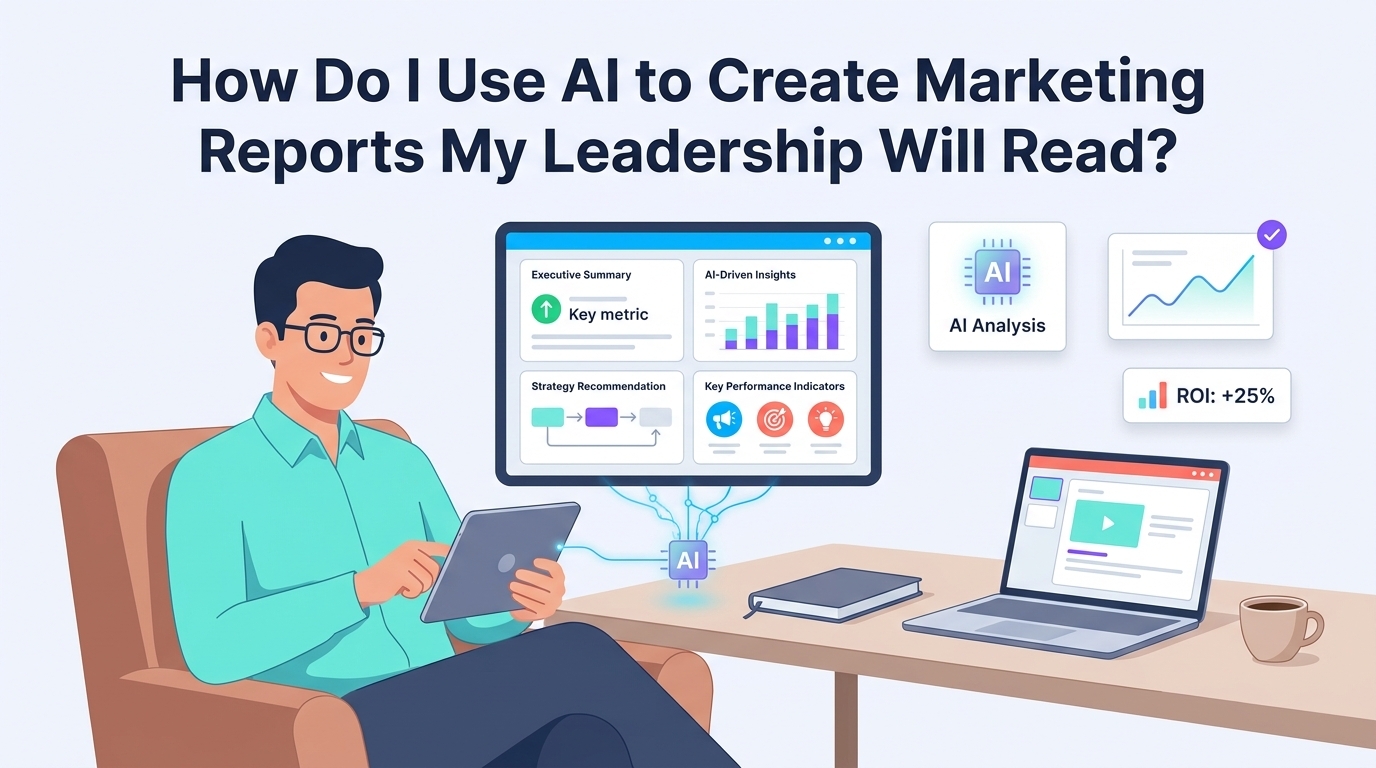
Use AI to automate data collection from your various platforms and then prompt a large language model to synthesize the findings. Generate a concise narrative and key visuals that answer three questions: What happened? Why did it happen? And what should we do next?
TL;DR
- Stop Data Dumping: Leadership doesn’t want raw data; they want insights. Your reports are likely being ignored because they are dense, backward-looking, and fail to connect marketing activity to business outcomes.
- Automate the Grunt Work: Use AI to pull and consolidate key metrics from Google Analytics, your CRM, and social media platforms. This eliminates manual data entry and frees you up for analysis.
- Focus on The Leadership Trinity: Structure every report around three core questions: What happened? (The key results). Why did it happen? (The analysis). What should we do next? (The strategic recommendation).
- Let AI Write the First Draft: Feed the consolidated data points into a large language model (LLM) like ChatGPT or Claude and ask it to generate a concise executive summary.
- Visualize the Story: Use AI-powered tools to instantly generate charts and graphs that illustrate your main points. A visual is often more powerful than a paragraph of text.
The Core Problem: Why Your Marketing Reports Go Unread
You spend hours, sometimes days, pulling data from a dozen different platforms. You meticulously craft spreadsheets, build dashboards, and write summaries, only to send your report into a void. It gets a polite "thanks," but no real engagement, and you suspect no one beyond your immediate team actually reads it.
This is a common frustration for marketers. The problem isn't the data; it's the delivery. Traditional marketing reports often fail for three reasons:
- They are data-rich but insight-poor. A list of metrics like click-through rates, follower counts, and website sessions means nothing without context. Leadership doesn't care about the numbers; they care about what the numbers mean for the business.
- They are disconnected from business goals. If your report focuses on campaign metrics but leadership is focused on pipeline growth and customer acquisition cost, there is a fundamental disconnect. Your report feels irrelevant.
- They are time-consuming to create. The manual effort required to build a comprehensive report often means the data is already stale by the time it's presented. This turns marketing into a team of historians rather than strategic partners.
AI changes this dynamic entirely. It allows you to shift your focus from compiling data to interpreting it, creating reports that are not only faster to produce but are also exponentially more valuable to your leadership team.
A 4-Step Framework for AI-Powered Reporting
To create reports that command attention, you need a system. This framework transforms reporting from a manual chore into an automated, insight-driven process.
Step 1: Centralize Your Data and Knowledge
Before AI can generate a narrative, it needs access to the story's source material. The biggest hurdle in reporting is that your data lives in silos: Google Analytics has website traffic, Salesforce has pipeline data, Gong has customer call transcripts, and your content library has campaign assets.
An AI cannot provide meaningful analysis without access to this complete picture. Manually connecting these dots is what currently consumes most of your time. The solution is to create a single source of truth.
A powerful approach to this is implementing a Retrieval-Augmented Generation (RAG) system. This technology creates a private, queryable "central brain" for your organization by ingesting all your unstructured data—reports, transcripts, emails, and internal documents. This is where a tool like The RAG System becomes indispensable. Unifying your scattered information allows you to ask complex questions in plain English and receive accurate, consolidated answers grounded in your company's own data.
- What it solves for: It eliminates the need to manually hunt for data across multiple platforms.
- How it works: You can query the system with a prompt like, "Correlate the traffic increase from our Q2 blog posts with the number of new MQLs generated in the same period."
- The benefit: You get an instant, unified view of performance, turning hours of data pulling into a single, simple query.
Step 2: Ask the Right Questions (The Leadership Trinity)
With your data centralized, you can focus on answering the only three questions leaders truly care about. Structure every single report around this trinity:
- What Happened? (The Data): This is the objective summary of performance. It should be brief and focused on Key Performance Indicators (KPIs) that align with business goals.
- Why Did It Happen? (The Analysis): This is where you connect the dots. Did a specific channel overperform? Did a competitor's move impact our results? This is the insight layer.
- What Should We Do Next? (The Recommendation): This is the most critical part. Based on the data and analysis, what is your strategic recommendation? Should you double down on a successful channel, pivot your messaging, or launch a new test?
Using AI, you can query your data source to answer these questions systematically.
- Prompt for "What Happened?": "Summarize the top 5 marketing KPIs for the month of May, including MQLs, SQLs, CPL, traffic, and conversion rate. Present the data in a clean, bulleted list comparing it to the previous month."
- Prompt for "Why?": "Analyze the primary drivers for the 20% increase in MQLs. Cross-reference campaign data and website analytics to identify the top 3 contributing factors."
- Prompt for "What's Next?": "Based on the finding that our 'AI in Finance' webinar drove the highest quality MQLs, propose three specific actions we should take next month to capitalize on this success."
Step 3: Generate the Narrative with AI
Once you have the answers to the leadership trinity, it's time to weave them into a compelling story. This is where Large Language Models (LLMs) like ChatGPT, Claude, or Gemini excel. You are not asking the AI to invent information; you are asking it to synthesize your verified data points into a clear, concise executive summary.
Your prompts become incredibly powerful when you can feed the LLM with precise, verified data directly from your RAG System. This ensures the narrative is 100% grounded in your actual performance.
Sample Prompt Structure:
"Act as a Senior Marketing Strategist reporting to the CEO. Your tone is concise, data-driven, and confident. Write a three-paragraph executive summary based on the following data points for our Q2 performance.
- Total MQLs: 1,500 (+15% QoQ)
- Top Performing Channel: LinkedIn Ads (60% of MQLs)
- Lowest Performing Channel: Organic Search (-10% QoQ)
- Key Insight: The 'Project Titan' campaign on LinkedIn drove a 40% lower CPL than any other campaign.
- Customer Feedback: Call transcripts show positive mentions of our new 'Feature X'.
- Start with the most important outcome (MQL growth).
- Explain the primary reason for this success (LinkedIn campaign).
- Conclude with a clear, actionable recommendation for Q3 (reallocate budget from organic search efforts to scale the 'Project Titan' campaign framework).
____________________
The AI will generate a near-perfect draft that you can quickly review and finalize, saving you from the "blank page" problem.
Step 4: Automate Visualization and Distribution
A wall of text is intimidating. Visuals make your insights digestible at a glance. Use AI-powered tools to turn your data points into clean graphs and charts.
You can prompt these tools with requests like, "Create a bar chart showing MQLs by channel for Q2" or "Generate a pie chart of our marketing budget allocation."
Finally, automate the entire delivery process. Set up a workflow that:
- Pulls the data automatically on the first of the month.
- Runs your prompts to generate the narrative and visuals.
- Packages it all into a clean email or Slack message.
- Sends it to your leadership team without you lifting a finger.
The Strategic Advantage of AI in Reporting
Adopting an AI-first approach to reporting does more than just save time. It fundamentally changes the marketing department's role within the organization.
When reporting is automated, you and your team are freed from the low-value work of data wrangling and can invest your time in high-value strategic thinking. You stop being a historian who reports on the past and become a strategist who shapes the future. This is the path to earning a seat at the leadership table.
At the AI Marketing Automation Lab, we see this transformation firsthand. By building systems that handle repetitive tasks, marketing professionals can focus their expertise on the creative and strategic work that truly drives business growth.
Making Reporting Your Secret Weapon
Your marketing reports don't have to be a chore that goes unread. By leveraging AI to automate data collection, synthesize insights, and generate clear narratives, you can transform them into a powerful tool for strategic communication.
Focus on the "what, why, and what's next" framework. Ground your analysis in a centralized source of truth, and let AI handle the heavy lifting of drafting and visualization. In doing so, you will deliver reports that your leadership not only reads but relies on to make critical business decisions.
Frequently Asked Questions
How can AI improve the creation of marketing reports?
AI can automate data collection from various platforms, synthesize findings with large language models, and generate concise narratives and visuals that focus on insights rather than raw data. This process transforms reports into valuable strategic tools for leadership.
Why do traditional marketing reports often go unread?
Traditional marketing reports often fail because they are data-rich but insight-poor, disconnected from business goals, and time-consuming to create. AI changes this by focusing on insight-driven reporting, aligning with business objectives, and automating report generation.
What is the 'Leadership Trinity' in report structuring?
The 'Leadership Trinity' consists of structuring reports around three core questions: What happened? (The Data), Why did it happen? (The Analysis), and What should we do next? (The Recommendation). This framework ensures the report addresses leadership's critical concerns.
What strategic advantage does AI provide in marketing reporting?
Adopting an AI-first approach to reporting saves time and transforms the marketing department's role from data historians to strategic partners. This shift allows for high-value strategic thinking and provides leadership with actionable insights to drive business decisions.