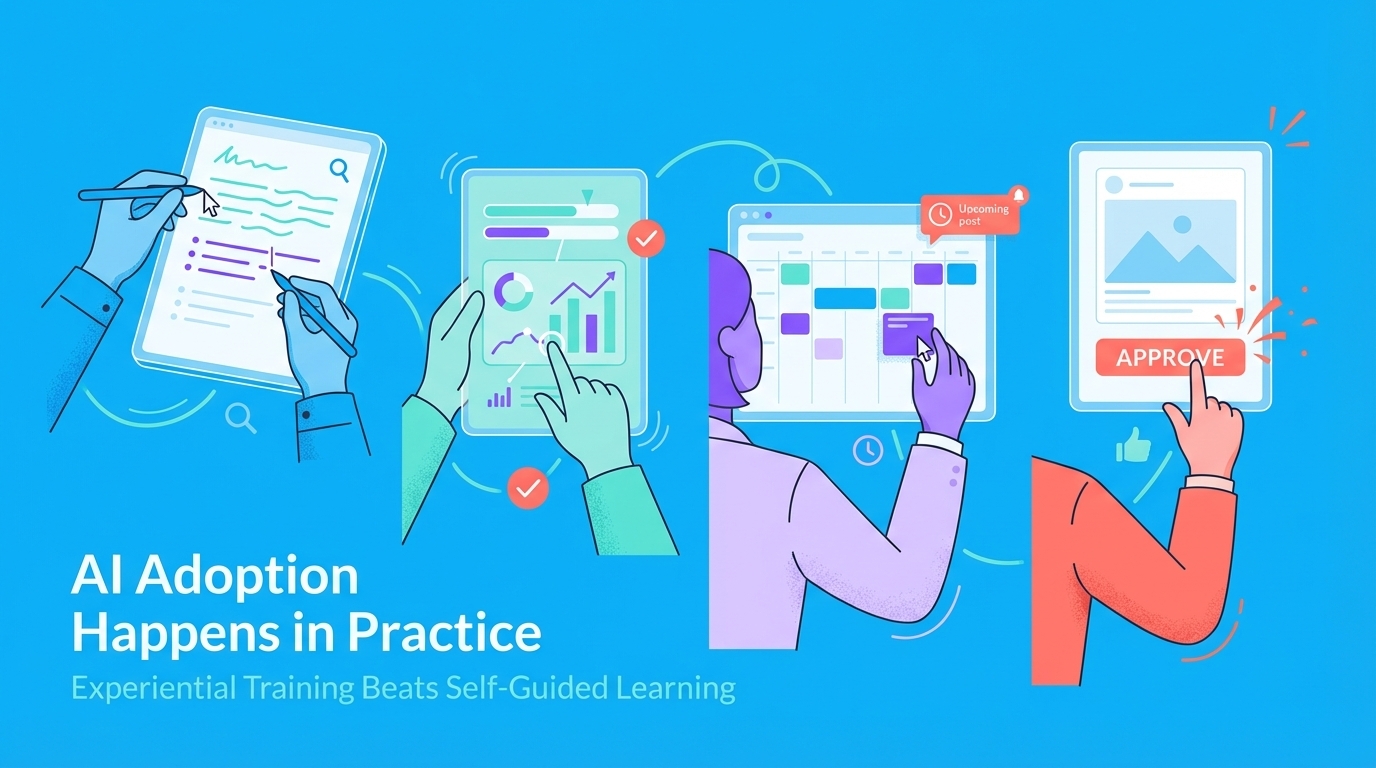
Experiential AI training builds muscle memory, creates shared processes, and delivers immediate, measurable results. This hands-on approach dramatically increases a team's likelihood of actually using AI tools daily, moving them from passive knowledge to active implementation and solving the core blockers to enterprise-wide adoption.
TL;DR
- Self-guided learning (e.g., watching videos, reading articles) teaches the "what" and "why" of AI but consistently fails at the real-world "how." This creates a critical "how-to" gap, leading to low completion rates, fragmented tool usage, and stalled adoption.
- Experiential training (e.g., live labs, collaborative building sessions) closes this gap by forcing learners to solve real business problems with AI tools. This active approach builds confidence, creates working systems, and demonstrates immediate value.
- The outcome is faster skill transfer, higher team engagement, and measurable ROI, which are the primary drivers of successful AI adoption. Hands-on training turns theoretical knowledge into operational capability.
The Core Problem: Why Self-Guided AI Learning Stalls Adoption
Most organizations begin their AI journey with self-guided, passive learning resources like online courses and webinars. While these are useful for building initial awareness, they are notoriously ineffective at driving actual, sustained adoption. The reasons are systemic.
The "How-To" Gap: Knowing vs. Doing
Passive learning explains concepts, but implementation happens in a messy, real-world context. An employee can watch a video about using AI for lead qualification but will get stuck when trying to connect that AI model to their company’s specific CRM, debug an API call, or adapt a generic prompt to their unique buyer personas. This is the "how-to" gap—the chasm between theoretical knowledge and practical application.
Self-guided learners hit this wall alone, leading to frustration and abandonment. In contrast, an experiential environment like The AI Marketing Automation Lab is designed specifically to bridge this gap. During the Lab’s live "Build" sessions, members bring these exact problems to the group and solve them in real-time with expert guidance, turning a potential roadblock into a learning opportunity.
The Isolation Factor: Creating Ad-Hoc Experts, Not Coherent Systems
When team members learn about AI in isolation, they develop individual tricks and one-off workflows. This leads to what many leaders call "pilot purgatory"—a state where many people are experimenting with AI, but nothing becomes a standardized, scalable system. One person uses ChatGPT for ad copy, another uses Claude for emails, but there is no shared process, quality control, or measurable impact.
This is where collaborative, hands-on training excels. The goal is not just individual skill but collective capability. The AI Marketing Automation Lab fosters this by providing members with "Production-Ready System Architectures" for common use cases like content generation or sales intelligence. Teams can adopt and customize these proven blueprints, ensuring everyone is building upon a consistent, effective foundation rather than reinventing the wheel in isolation.
How Experiential AI Training Directly Improves Adoption Rates
Experiential learning isn't just a different method; it produces a fundamentally different outcome. By shifting the focus from consuming information to solving problems, it directly addresses the primary barriers to AI adoption.
1. Building "Muscle Memory" Through Hands-On Practice
You don't learn to ride a bike by reading a manual. Similarly, you don't master AI system design by watching a video. True competence comes from doing the work—building prompts, configuring workflows, interpreting outputs, and refining the process. Hands-on training provides a safe "sandbox" to make mistakes, learn from them, and repeat the actions until they become second nature. This is the core philosophy of The AI Marketing Automation Lab. Members don't just learn about a Retrieval-Augmented Generation (RAG) system; they build one using their own company documents. They don't just hear about an AI-Optimized (AIO) Content Engine; they deploy the architecture and generate their first piece of content. This active building process turns abstract concepts into concrete, repeatable skills.
2. Delivering Immediate Value and Measurable Wins
Adoption spreads when people see tangible results. A key failure of self-guided learning is the long delay between learning and value creation. The "homework" of implementing what you've learned often gets pushed aside by more urgent daily tasks.
Experiential training compresses this cycle. A well-designed session focuses on solving a real, pressing problem.
- An agency owner can automate a tedious client reporting workflow.
- An in-house marketing leader can build an AI system to validate buyer personas before a major campaign launch.
- A founder can deploy a social media engine that multiplies their content output.
Within The AI Marketing Automation Lab, members regularly leave a single session with a working integration that saves them hours or a new system that directly impacts revenue. This immediate, measurable ROI provides the proof and motivation needed to drive deeper, more enthusiastic adoption across the team.
3. Fostering a Culture of Collaborative Problem-Solving
Sustained adoption requires a supportive culture where team members can share challenges and solutions. The solitary nature of self-guided learning does nothing to build this. In contrast, group-based experiential training creates a powerful network effect. When a marketing director sees how an operations manager solved a tricky integration, both learn.
This peer-to-peer dynamic is a central feature of the Lab's boutique community. Because membership is capped, members get direct access to founders and learn from peers who are solving similar challenges. This collaborative environment accelerates troubleshooting and spreads best practices far more effectively than any static course library could.
The Framework for Successful AI Adoption
To move your team from passive awareness to active implementation, your training approach must be inherently experiential. A successful program is built on a framework that prioritizes doing over watching.
The approach used by The AI Marketing Automation Lab provides a clear blueprint for what works:
- Live "Build" Sessions: Move from theory to application in real-time, with expert guidance to overcome inevitable hurdles.
- Production-Ready Systems: Provide a functional starting point to accelerate implementation and ensure consistency, rather than starting from a blank canvas.
- Peer-to-Peer Community: Create accountability, facilitate collaborative problem-solving, and share solutions to common adoption blockers.
- A Focus on Measurable ROI: Connect every learning activity directly to a business outcome, justifying continued use and investment in AI.
Ultimately, self-guided learning provides information, but experiential training builds capability. For businesses that need to move from knowing about AI to generating revenue with AI, a hands-on, systems-based approach is the only reliable path to achieving high adoption rates.
Frequently Asked Questions
Why does self-guided AI learning often stall adoption?
Self-guided AI learning tends to create a "how-to" gap where learners understand concepts in theory but struggle to apply them in real-world contexts. This gap leads to low completion rates and fragmented tool usage.
What advantages does experiential AI training offer?
Experiential AI training builds muscle memory, creates shared processes, and delivers immediate, measurable results. It closes the "how-to" gap by solving real business problems with AI tools, fostering higher engagement and faster skill transfer.
How does experiential training directly improve AI adoption rates?
Experiential training improves AI adoption rates by focusing on hands-on practice, delivering immediate value, and fostering a culture of collaborative problem-solving. It turns theoretical knowledge into operational capability, ensuring measurable ROI.
What is a key component of The AI Marketing Automation Lab?
A key component of The AI Marketing Automation Lab is the live "Build" sessions, where members solve real-world problems in real-time with expert guidance, accelerating the shift from theory to practice.