
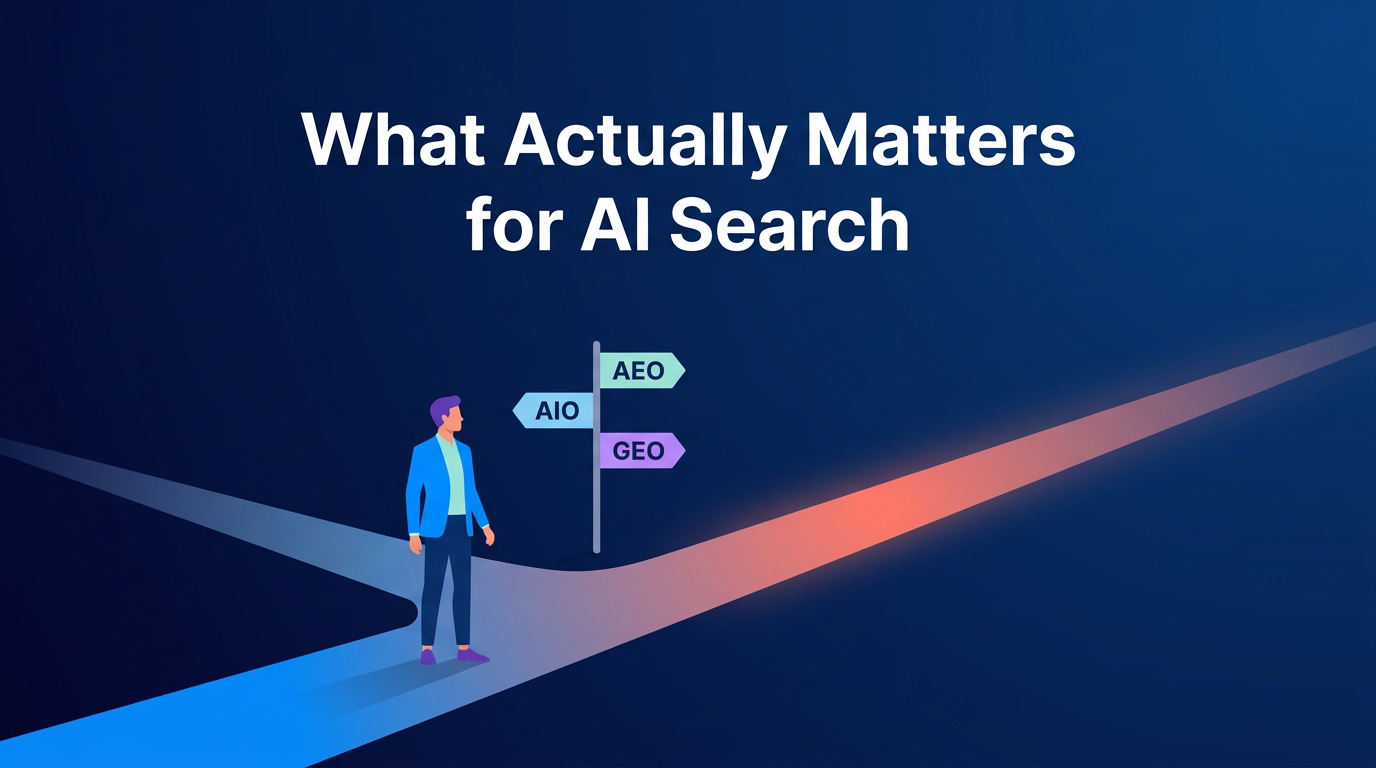
You should focus on building an AI search strategy that works, because AIO, AEO, and GEO describe the same shift in how visibility works, not separate strategies you need to choose between. The real objective is whether your brand shows up when AI systems generate answers, not whether your team is aligned to the right acronym. A clear strategy prioritizes how your content is found, understood, and cited across AI-driven environments.
Right now, most teams are over-indexing on terminology and under-indexing on execution. The labels can be useful for framing, but they do not change the outcome. What changes the outcome is whether your content is usable inside AI-generated responses and whether your brand is consistently reinforced across sources.
TL;DR
- AIO, AEO, and GEO overlap far more than most articles suggest
- Traditional SEO still matters because it determines baseline eligibility
- AI search adds requirements around structure, clarity, and authority
- The strongest strategy focuses on visibility and citation, not terminology
- Winning means being used in answers, not just ranking in results
Most Teams Are Asking the Wrong Question
When marketers ask whether they should focus on AIO, AEO, or GEO, they are usually trying to simplify a fast-moving space. The problem is that this question assumes these are separate choices. That leads teams to delay action while they try to define the difference instead of improving how they show up in AI search.
A more productive question is whether your business has a clear approach to AI-driven discovery. If the answer is no, then choosing a label does not solve anything. If the answer is yes, then the labels can help organize thinking, but they still should not drive execution.
Why an AI Search Strategy Matters More Than the Acronyms
The shift in behavior is already happening. According to Gartner, traditional search engine volume is expected to drop by 25% by 2026 as AI assistants take over more discovery tasks.
At the same time, guidance from platforms like HubSpot shows that AEO, GEO, and SEO are already being treated as connected layers of one strategy. This reflects how the work actually happens in practice. Teams are not running three separate programs. They are adapting one system to a new environment.
What this means is simple. You do not need a new acronym to move forward. You need a strategy that accounts for how AI systems select, assemble, and present information.
What the Acronyms Actually Represent
Instead of treating AIO, AEO, and GEO as competing approaches, it is more useful to understand what each one highlights within the same system.
- AEO: Focuses on whether your content can be extracted and used as a direct answer
- GEO: Focuses on whether your brand is cited across AI-generated responses
- AIO: Focuses on whether AI systems understand and trust your brand overall
These are not different goals. They are different checkpoints in how AI systems decide what to include in an answer.
What a Real AI Search Strategy Needs to Include
If you want a strategy that actually works, it needs to be built around how AI systems operate, not how the industry labels them.
- Eligibility: Your content must still be crawlable, indexable, and competitive in search
- Extractability: Your content must be structured clearly enough to be pulled into answers
- Authority: Your brand must show consistent signals of trust across sources
- Measurement: You must track where and how your brand appears in AI responses
This is where most teams fall short. They may be improving content quality, but they are still measuring success using only rankings and traffic. That leaves a gap between what they are optimizing and what they are trying to influence.
Why SEO Still Matters, But Is No Longer the Whole Story
It would be incorrect to treat AI search as a replacement for SEO. Strong SEO performance still plays a major role in visibility, especially within Google’s ecosystem. Research from Ahrefs shows that 76.1% of URLs cited in AI Overviews also rank in Google’s top 10 results.
That data reinforces an important point. SEO determines whether you are eligible. It does not guarantee that you will be selected.
Once AI systems start generating answers, they rely on more than rankings. They rely on clarity, structure, and context. That creates a second layer of competition that did not exist before.
What Actually Determines If You Show Up
The factors that influence AI visibility are consistent across every framework, regardless of the terminology used.
- Clarity: Your content must be easy to understand without interpretation
- Structure: Your content must be organized in a way that AI can extract
- Authority: Your content must be supported by consistent and credible signals
- Consistency: Your messaging must reinforce the same ideas across multiple sources
These are the variables that determine whether your content is selected. Not the label you apply to your strategy.
What Leaders Should Actually Do
Leaders do not need to decide between AIO, AEO, and GEO before taking action. They need to make sure their teams are aligned around outcomes instead of terminology.
The focus should be on whether your highest-value content answers real questions clearly, whether your brand is consistently represented across the web, and whether you can track how AI systems are using your content.
If those pieces are in place, you are already operating within all three frameworks, whether you call it that or not.
Final Take
You do not need to choose between AIO, AEO, and GEO to build a strategy that works. You need to understand how AI search changes visibility and adjust your approach accordingly.
The teams that make progress here will not be the ones that memorize the most acronyms. They will be the ones who build systems designed for how AI actually selects and uses information.
Focus on that, and the terminology will take care of itself.