
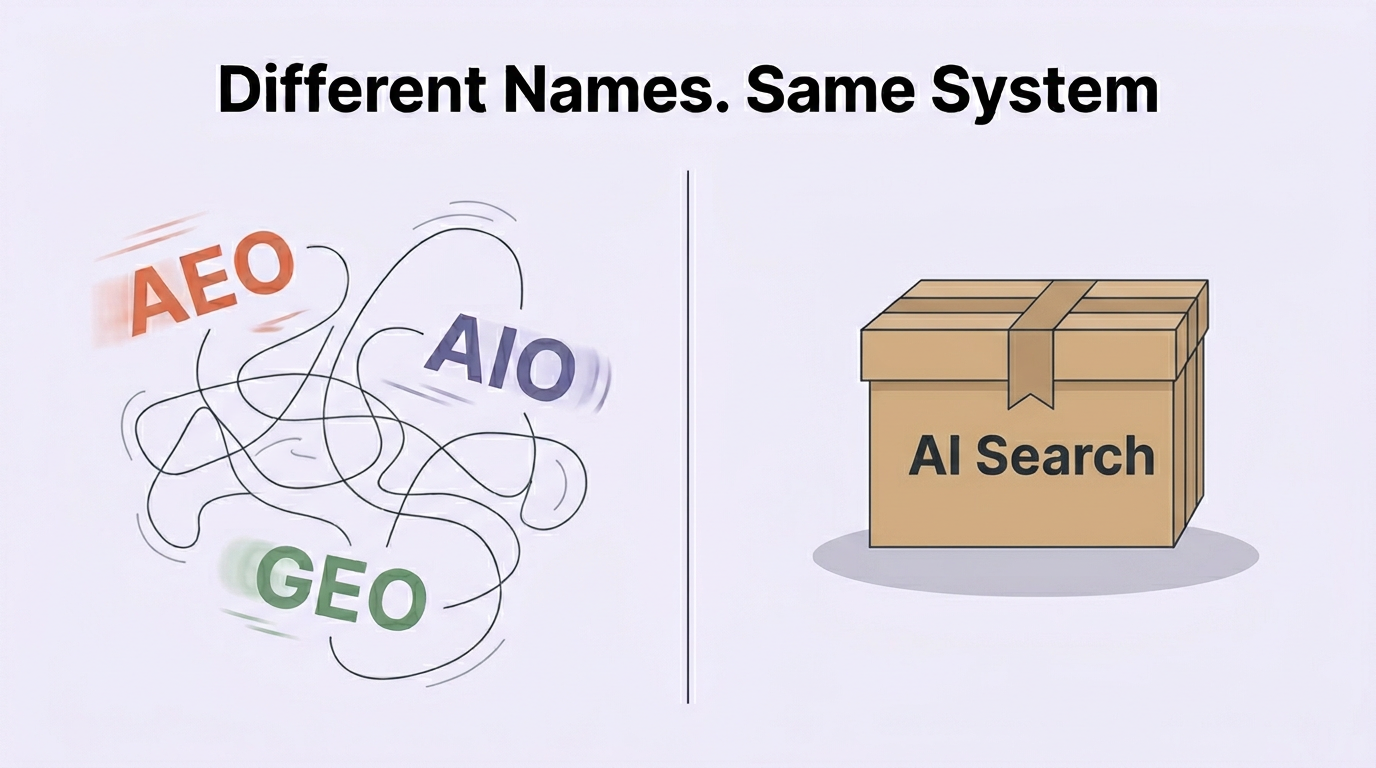
AIO, AEO, and GEO are not separate strategies. They are different ways of describing the same shift in search, and what actually matters is whether your content is selected and cited by AI systems, not which acronym you follow.
TL;DR
- AIO, AEO, and GEO describe the same shift from rankings to answers
- SEO is still required, but no longer sufficient
- AI engines reward clarity, authority, and structure over keyword tactics
- The naming debate matters less than your ability to be cited
- Focus on becoming the answer, not winning the acronym
What’s Actually Going On Here
If you have spent any time in AI search conversations lately, you have likely seen AIO, AEO, and GEO used interchangeably, sometimes presented as distinct strategies and sometimes treated as if one replaces the others. That framing makes it seem like you need to choose between them or adopt all three separately.
In practice, that is not what is happening. These terms exist because the industry is trying to describe a major shift in how discovery works, but has not aligned on a single way to explain it.
The Shift Behind All Three Terms
Search is no longer just a list of links. It is increasingly a system that generates answers.
That shift changes the objective. Instead of competing for position on a results page, you are competing to be included in the answer itself. Instead of focusing only on clicks, you are influencing how information is presented before a click even occurs.
There is strong evidence that this change is already underway. Forecasts point to a decline in traditional search behavior as AI answer engines become more capable. According to Gartner, traditional search engine volume is expected to decline by 25% by 2026 as users shift toward AI-powered answers and conversational interfaces. At the same time, AI-referred traffic is growing quickly and often converts at higher rates because the recommendation has already been filtered and summarized.
This means visibility is no longer defined only by where you rank. It is defined by whether you are used.
Why the Industry Created Three Different Terms
When a system changes quickly, the industry tends to create multiple labels to describe it from different angles. That is exactly what has happened here.
Each term emphasizes a different part of the same process. When you look at them together, they are not competing strategies. They are different perspectives on how AI systems discover, interpret, and use content.
AEO Focuses on Being the Answer
Answer Engine Optimization centers on whether your content can be selected and used as a direct answer.
This requires content that is structured in a way AI systems can easily extract. Clear questions paired with direct responses perform better than long, abstract explanations. Concise sections make it easier for models to pull information without needing to interpret intent.
AEO aligns closely with how answer-based surfaces behave, especially in environments where the system is trying to return a clear response rather than a list of options. If your content cannot be lifted cleanly into an answer, it is far less likely to appear.
GEO Focuses on Being Cited Consistently
Generative Engine Optimization expands beyond a single answer and looks at how often your brand is referenced across different AI-generated outputs.
This is less about one page winning one query and more about building a presence that shows up repeatedly across related topics. AI systems rely on patterns, and those patterns are built through repeated signals across multiple sources.
That means your content needs to reinforce your authority across a category. When AI models see consistent coverage, consistent terminology, and consistent references, they are more likely to include your brand in responses.
GEO is about consistency and reinforcement across the system.
AIO Focuses on Being Understood and Trusted
Artificial Intelligence Optimization operates at a broader level. It focuses on how AI systems interpret your brand, your content, and your authority as a whole.
This includes how clearly you define what you do, how consistently you use language, and how well your expertise is supported by external signals. It also includes how structured your content and data are so that AI systems can interpret relationships between topics.
AIO is not limited to search. It is about how your business is understood across AI-driven environments. If AEO is about being selected and GEO is about being cited, AIO is about being understood in the first place.
Where Most Teams Get This Wrong
The most common mistake is treating these as separate initiatives. Teams will try to apply AEO tactics in one place, think about GEO in another, and treat AIO as a separate strategic effort.
Industry analysis from BrightEdge suggests that fragmented optimization strategies can reduce overall search performance, while integrated approaches improve visibility across both traditional and AI-driven search environments.
That approach creates fragmentation. It leads to duplicated work and inconsistent execution because each piece is handled in isolation.
In reality, these are connected stages within the same system.
A More Useful Way to Think About It
- SEO determines whether your content can be found and indexed
- AEO determines whether your content can be extracted and used as an answer
- GEO determines whether your brand is cited consistently across responses
- AIO determines whether AI systems understand and trust your brand
These are not competing strategies. They are connected steps in the same pipeline.
What Actually Drives AI Visibility
- Strong SEO establishes eligibility for inclusion
- Clear structure allows AI systems to extract information
- Authority signals increase the likelihood of being cited
- Consistency across content reinforces trust and recognition
These factors show up regardless of which label you use. They are the common denominator behind AI visibility.
So Which One Actually Matters
The terminology does not change the outcome.
What matters is whether your content is used when AI systems generate answers in your category.
If your content is not structured clearly, supported by authority, and aligned with how AI systems interpret information, it will not be selected, regardless of which framework you follow.
Final Take
The market has created multiple names to describe a single shift. That shift is from ranking in search results to being included in generated answers.
The teams that perform well in this environment are not the ones that choose the right acronym. They are the ones who build content and systems that AI can understand, extract, and trust.
If your content meets those criteria, it will show up. If it does not, no framework will compensate for that gap.
The opportunity is not in mastering the terminology. It is in adapting to how visibility actually works now.