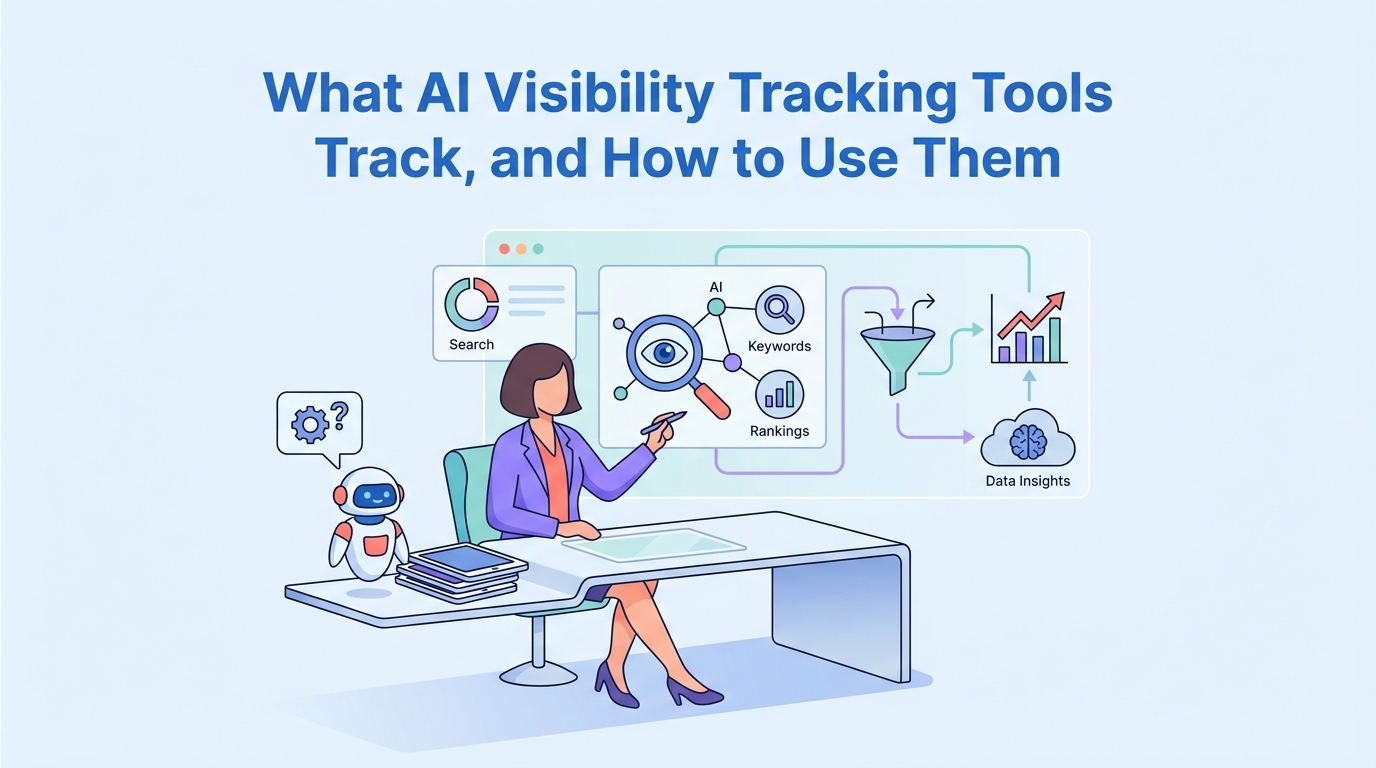
AI visibility tracking tools monitor what AI assistants like ChatGPT say about your brand. They track brand citations, share of voice, and sentiment against competitors, helping you identify and fix content gaps to improve your AI search presence and win more recommendations.
TL;DR
AI visibility tracking tools provide critical intelligence on how your brand is perceived and represented within generative AI responses. They automate the process of querying AI models to see if you, your products, or your competitors are mentioned. This data allows you to proactively manage your brand’s narrative in the new era of AI-powered search.
- What They Track: The core metrics include brand citations (how often you are mentioned), share of voice (your visibility vs. competitors), sentiment analysis (positive, neutral, or negative mentions), and source attribution (what content AI uses to form its answers).
- How to Use Them: Use the data to pinpoint and fill content gaps where AI fails to mention you. Correct factual inaccuracies and address negative sentiment. Identify and amplify the content that AI already trusts and cites.
- Why It Matters: AI assistants are the new top of the funnel. If they do not recommend you, you are losing potential customers before they ever visit a website. Tracking visibility is no longer optional; it is essential for survival and growth.
What Key Metrics Do AI Visibility Tools Track?
AI visibility platforms move beyond traditional SEO metrics to focus on a new set of signals specific to conversational AI outputs. They reveal what AI models have learned about your brand from the public web and how they communicate that understanding to users.
Brand Citations and Mentions
This is the most fundamental metric. An AI visibility tracking tool logs every time your brand, products, or key personnel are mentioned in response to relevant buyer queries. It answers the simple question: "When a potential customer asks for a solution like ours, does the AI mention us?" Consistent, accurate mentions are the first sign of a strong AI presence.
Share of Voice (SoV)
Share of Voice measures your brand’s visibility relative to your direct competitors. The tool runs a set of high-intent queries (e.g., "best project management software for small teams") and calculates the percentage of times your brand is mentioned compared to others in the space. A low SoV indicates that AI models consider your competitors more authoritative or relevant for that topic.
Sentiment Analysis
It is not enough to be mentioned; the context of the mention matters. Sentiment analysis categorizes each brand citation as positive, negative, or neutral. A negative mention could involve an AI highlighting a common customer complaint it found in review sites or forum discussions. This metric helps you identify and address reputation issues that are actively being surfaced to potential buyers.
Source Attribution
This is perhaps the most actionable metric. When an AI cites your brand, where is it getting the information? Advanced tools can often trace a response back to the specific articles, press releases, or third-party reviews it used as source material. This allows you to see which of your content assets are performing well and which ones are being ignored or misinterpreted.
Competitive Benchmarking
These tools do not just track your brand in isolation. They run the same queries for your top three to five competitors, creating a side-by-side comparison of all key metrics. This provides a clear, data-driven picture of the competitive landscape as AI sees it, highlighting who is winning the AI recommendation battle and why.
How Do You Use AI Visibility Data to Improve Your Marketing?
Tracking AI visibility is a diagnostic act. The real value comes from using the data to inform your content and marketing strategy. The insights generated by these tools should lead directly to specific actions designed to improve your standing.
Pinpoint and Fill Content Gaps
If a tool reveals that AI never mentions you when users ask "how to solve X," and you know your product solves X, you have found a critical content gap. The AI does not have a clear, authoritative source to learn from. The solution is to create definitive, well-structured content that directly answers that query and explicitly connects the problem to your solution.
Correct Inaccuracies and Address Negative Sentiment
AI models sometimes get things wrong or amplify outdated negative feedback. If a tracker shows an AI consistently misstating your product’s features or citing an old negative review, you have a clear mandate. Your task is to publish new, authoritative content that corrects the record. This could be a detailed blog post, an updated FAQ page, or a press release that directly addresses the misinformation. Over time, the AI will ingest this new data and adjust its responses.
Double Down on What Works
Source attribution data shows you which content pieces AI already trusts. If you see that an AI repeatedly cites your case study on "how Acme Corp saved 50% on costs," that asset is a high-performing piece of content for AI Optimization (AIO). You should amplify its core messages. Create spin-off content, reference it in new articles, and build more content with similar structures and depths to give the AI more of what it clearly values.
Inform Your Overall Content Strategy
The first step to improving your AI visibility is establishing a baseline. You cannot fix what you cannot see. Tools like the free AIScope AI Search Brand Report from AI Marketing Automation Lab can run these initial queries for you, generating a clear report on what AI engines like ChatGPT, Claude, and Gemini are telling your potential customers. This initial report provides the blueprint for your strategy, showing you exactly where the biggest opportunities and threats are.
Why Is Tracking AI Visibility Critical for Modern Brands?
For two decades, Google's "10 blue links" were the primary gateway to customers. That era is ending. AI-powered search and conversational assistants are becoming the first touchpoint for a rapidly growing number of users, fundamentally changing how information is discovered.
When a user asks an AI assistant for a recommendation, they receive a synthesized, direct answer, not a list of websites to visit. This is a "zero-click" world. If your brand is not mentioned in that direct answer, you are invisible to that potential customer. The opportunity is lost before you ever had a chance to compete.
Failing to monitor your AI presence is the modern equivalent of ignoring your search engine rankings 15 years ago. It leaves your brand's reputation and visibility to chance, allowing competitors, misinformation, or a simple lack of data to define you. Proactive tracking is the only way to exert influence over how AI models perceive and portray your brand to the world.
What Should You Look for in an AI Tracking Tool?
As this category of software matures, several key features are emerging as standard. When evaluating a tool, look for a solution that provides comprehensive and actionable insights.
- Multi-Engine Support: It must track your visibility across all major AI models, including ChatGPT, Gemini, Claude, and Perplexity, as each may have a different understanding of your brand.
- Scheduled and Automated Reporting: The platform should be able to run queries on a set schedule (e.g., weekly or monthly) and automatically generate reports that highlight changes over time.
- Deep Competitive Analysis: Look for features that allow you to track a cohort of your key competitors and benchmark your performance directly against theirs across all metrics.
- Clear Source Analysis: The ability to trace AI answers back to their source documents is non-negotiable. Without it, you cannot diagnose why an AI is saying what it is saying.
While robust, paid platforms offer deep analytics, getting started does not require a large investment. Running an initial diagnostic with a tool like AIScope can provide the immediate clarity needed to start making smarter content decisions today.
Turn Visibility Insights into Action
Monitoring your AI visibility is the first step toward mastering AI-powered search. These tools provide the map, but you still have to drive the car. They illuminate the path by showing you where your brand is strong, where it is weak, and where it is completely invisible. Use this data not as a passive report card but as an active, strategic guide. By systematically identifying and closing content gaps, correcting inaccuracies, and amplifying what works, you can ensure that when customers ask for the best solution, AI gives them your name.
Frequently Asked Questions
What are AI visibility tracking tools and why are they important?
AI visibility tracking tools monitor what AI assistants like ChatGPT say about your brand. They track brand citations, share of voice, and sentiment against competitors, helping you identify and fix content gaps to improve your AI search presence. These tools are important because they allow you to proactively manage your brand’s narrative in the era of AI-powered search.
What key metrics do AI visibility tools track?
AI visibility tools track several core metrics: brand citations (how often you are mentioned), share of voice (your visibility vs. competitors), sentiment analysis (positive, neutral, or negative mentions), and source attribution (what content AI uses to form its answers).
How can AI visibility data be used to improve marketing?
AI visibility data can be used to pinpoint and fill content gaps, correct factual inaccuracies and address negative sentiment, and amplify content that AI already trusts. This data informs content strategy and can lead to improved visibility in AI outputs.
What features should you look for in an AI tracking tool?
Essential features of an AI tracking tool include multi-engine support, scheduled and automated reporting, deep competitive analysis, and clear source analysis. These features ensure comprehensive and actionable insights into your brand's AI visibility.