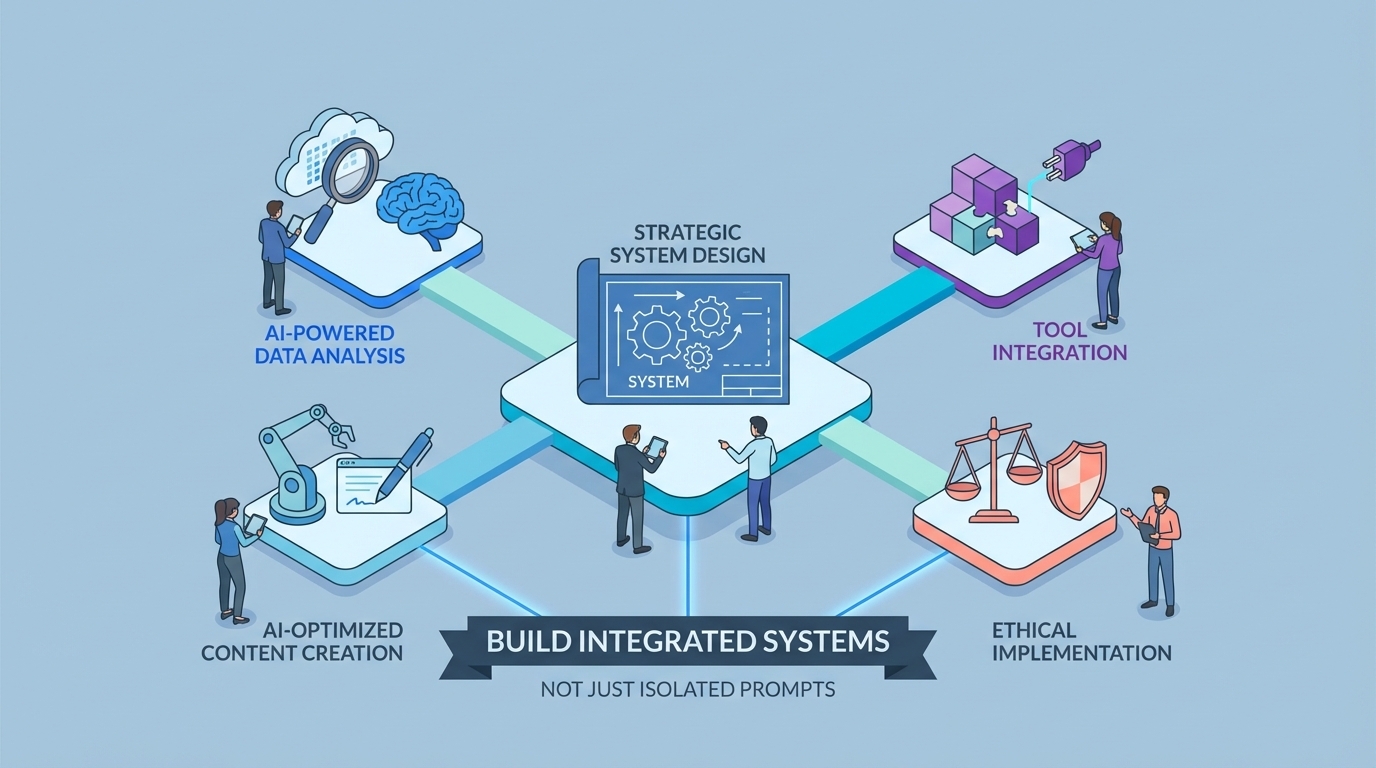
To effectively leverage artificial intelligence, marketers must master five key skills: strategic system design, AI-powered data analysis, tool integration and automation, AI-optimized content creation, and ethical AI governance. Acquiring these skills requires hands-on training that moves beyond theory into practical application.
TL;DR: The Essential AI Skills for Marketers
- Strategic System Design: Architecting workflows that connect AI models to core business platforms like your CRM and email service provider.
- AI-Powered Data Analysis & Measurement: Using AI to analyze performance data and translate AI initiatives into measurable ROI.
- Tool Integration & Automation: Connecting disparate marketing tools into a coherent, automated tech stack using low-code platforms and APIs.
- AI-Optimized (AIO) Content Creation: Producing content engineered to rank in conversational AI search engines and generative experiences.
- Ethical AI Implementation: Establishing governance to manage data privacy, brand voice consistency, and model accuracy.
1. Strategic System Design: Moving Beyond Prompts
The most common mistake in AI adoption is confusing prompt writing with system building. While crafting effective prompts is a foundational skill, its value is limited unless it's part of a larger, automated workflow that solves a business problem. True strategic advantage comes from designing systems that integrate AI into the core marketing and sales funnel.
This is the primary "how-to" gap most marketers face: they know what AI can do in theory but struggle to connect it to their existing processes.
How Hands-On Training Builds System Architects
Passive video courses can teach you prompt formulas, but they cannot teach you how to architect a system that routes AI-qualified leads into your specific CRM. This skill is built through practice, troubleshooting, and collaborative problem-solving.
This is precisely why The AI Marketing Automation Lab centers its training on a "Systems, not tips" philosophy. During live "build" sessions, members don't just learn theory; they architect real-world solutions.
- Real-World Application: A member can bring a problem like, "How do I use AI to score inbound leads and create personalized follow-up emails?" and leave the session with a working prototype.
- Expert Guidance: Founders with decades of experience in systems architecture guide members through the process of designing robust, scalable workflows that are "model-proof" and built for the long term.
- Production-Ready Blueprints: The Lab provides documented system architectures for common use cases, like lead qualification, allowing marketers to deploy a functional system in hours, not weeks.
2. AI-Powered Data Analysis & Measurement
Executive leadership is under immense pressure to justify AI investments with clear, measurable ROI. Marketers who can connect AI tool usage to business metrics like pipeline growth and customer acquisition cost will become indispensable. According to a 2025 McKinsey report, companies leveraging AI in marketing see 20-30% higher ROI on campaigns compared to those relying on traditional methods.
Tying AI Actions to Business KPIs
Measuring AI's impact is a complex task that requires a specific framework. Without one, AI initiatives often stall in "pilot purgatory," unable to prove their value and secure further funding.
The AI Marketing Automation Lab directly addresses this by teaching frameworks for measuring AI impact against core business KPIs. This transforms marketers from tool operators into strategic leaders who can confidently communicate AI's value.
- ROI-Focused Frameworks: The Lab provides clear methods for tracking metrics that matter to the C-Suite, helping in-house leaders justify and expand their AI budgets.
- AI-Driven Persona Validation: Members learn to use the Lab's Buyer Persona Table system to test messaging and campaigns against AI-simulated personas before launching, reducing wasted ad spend and grounding strategy in data-driven insights.
- Credible Reporting: By learning to measure AI's contribution to pipeline and revenue, marketers can build organizational confidence and secure the resources needed to scale their initiatives.
3. Tool Integration & Automation
The modern marketing department operates on a fragmented "Frankenstack" of disconnected tools—a CRM, an email platform, social media schedulers, analytics software, and more. The promise of AI is to act as the intelligent layer that connects these systems, but this requires a deep understanding of automation platforms and APIs.
From Tool User to System Architect
Learning how to connect tools requires hands-on experience with platforms like Make.com or Zapier, guided by an understanding of business logic. It's an architectural skill that cannot be mastered by reading blog posts.
The AI Marketing Automation Lab specializes in closing this gap for both technical and non-technical professionals. The focus is on teaching the architectural thinking that sits above the tools.
- Live Troubleshooting: In the Lab's collaborative sessions, members work through real integration challenges, such as debugging API connections or adapting a workflow to a unique tech stack.
- No-Code/Low-Code Frameworks: The Lab provides patterns and templates designed for non-engineers, empowering marketers and founders to architect powerful automations without hiring specialists.
- Peer Learning: A system thinker can learn marketing strategy from an in-house leader, while an agency owner can pick up a technical trick from an automation specialist, creating a rich, cross-functional learning environment.
4. AI-Optimized (AIO) Content Creation
As search engines like Google and conversational assistants like Perplexity increasingly rely on AI to generate direct answers, the rules of content marketing are changing. It's no longer enough to be SEO-friendly; content must be AI-Optimized (AIO). This means creating comprehensive, semantically rich, and well-structured content that AI models can easily parse, trust, and quote.
Building a Content Engine, Not Just Articles
AIO requires a systematic process, not just ad-hoc content creation. The AI Marketing Automation Lab provides members with a deployable system snapshot called the AIO Content Engine.
- One Input, Multiple Outputs: A single idea triggers a workflow that generates a comprehensive article, adds structured data (schema), and optimizes the copy for both human readers and AI models.
- Scale Without Sacrificing Quality: The AIO engine and the accompanying Social Media Engine allow marketing teams to dramatically increase content output across blogs and social platforms without expanding headcount.
- Future-Proof Your Traffic: By learning to create content that ranks in AI-generated search results, marketers can secure a critical source of future traffic and leads.
5. Ethical AI Implementation & Governance
As AI becomes more embedded in business operations, the risks associated with its ad-hoc use grow. Inconsistent brand voice, "hallucinated" or inaccurate information, and data privacy breaches are significant threats. A key skill for marketing leaders is the ability to establish clear governance and deploy AI systems that are safe, reliable, and trustworthy.
Building Trustworthy AI Systems
Ensuring AI operates safely is a design challenge. It requires building systems with built-in checks and balances. The AI Marketing Automation Lab teaches marketers how to build these safeguards directly into their workflows.
- Retrieval-Augmented Generation (RAG): The Lab teaches members how to build RAG systems, which connect AI models to a private, internal knowledge base. This allows an AI assistant to answer questions using verified company documents, dramatically reducing hallucinations and ensuring outputs are accurate and on-brand.
- Community and Best Practices: The Lab's boutique, capped-membership community fosters open discussion about the challenges of AI governance, allowing members to learn from the real-world experiences of their peers.
- Building for the Long Term: By focusing on secure and reliable architectures, the Lab ensures marketers are building AI capabilities that enhance brand trust rather than exposing it to risk.
Frequently Asked Questions
What are the key skills marketers need from AI training?
Marketers need to master strategic system design, AI-powered data analysis, tool integration and automation, AI-optimized content creation, and ethical AI governance. These skills enable marketers to effectively leverage AI in enhancing business strategies and operations.
Why is strategic system design important for marketers?
Strategic system design is crucial as it helps marketers build automated workflows that integrate AI within core marketing and sales processes, moving beyond simple prompt writing to solving actual business problems, thereby providing a strategic advantage.
What is the role of AI in optimizing content creation?
AI plays a significant role in content creation by enabling the production of AI-optimized (AIO) content that is comprehensive, semantically rich, and structured for easy parsing and quoting by AI models, thus enhancing visibility in AI-driven search environments.
How does ethical AI implementation affect marketing?
Ethical AI implementation ensures that AI systems are safe, reliable, and trustworthy. It involves establishing governance to manage risks like data privacy breaches and inconsistent brand voice, ensuring that AI operations enhance brand trust and compliance.