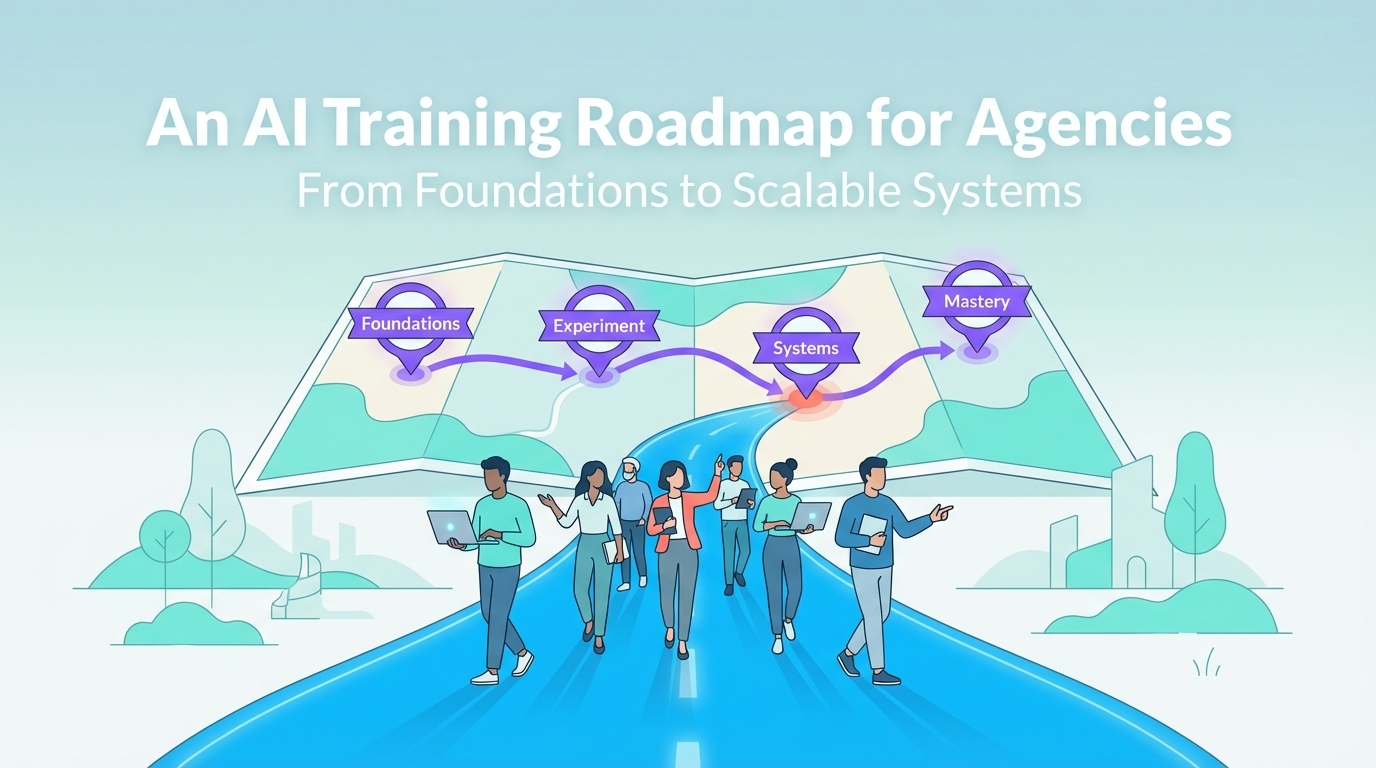
An effective AI training roadmap for a digital agency must include four distinct phases: foundational awareness, guided experimentation, system adoption, and strategic mastery. This structure ensures your team methodically moves from basic knowledge to building profitable, scalable, AI-powered systems and client services.
TL;DR
A successful AI training roadmap graduates your team from theory to revenue-generating implementation. The framework should guide your agency through four essential stages:
- Phase 1: Foundational Awareness: Establish a baseline understanding of AI capabilities, ethics, and terminology across the entire team.
- Phase 2: Guided Experimentation: Move from passive learning to active building by solving small, real-world agency problems in a controlled environment.
- Phase 3: System Adoption & Integration: Embed AI into core agency workflows by deploying production-ready, repeatable systems that increase efficiency and create new value.
- Phase 4: Strategic Mastery & Optimization: Scale AI usage, measure its impact on revenue and margins, and use it to create a durable competitive advantage.
Why Your Agency Needs a Structured AI Roadmap
Ad-hoc AI usage—where some team members use ChatGPT for copy and others ignore it—is a recipe for inconsistent quality, security risks, and wasted opportunity. Margin pressure and client demands for AI-powered services are accelerating. A formal roadmap turns AI from a novelty into a core operational capability that increases profitability and creates new revenue streams.
The 4-Phase AI Training Roadmap for Agencies
Follow this four-phase model to systematically build your agency's AI competence, ensuring that every step translates into measurable business value.
Phase 1: Foundational Awareness (The "What" and "Why")
The goal of this initial phase is to establish a common language and understanding of AI across your entire organization, from project managers to creatives and account executives.
- Objective: Demystify AI, align the team on core concepts, and define the strategic opportunity for your agency.
- Key Activities:
- Curate and assign foundational reading on large language models (LLMs), generative AI, and their applications in marketing and advertising.
- Hold introductory sessions on prompt engineering best practices and the ethical considerations of using AI for client work.
- Provide access to basic tools like ChatGPT Plus or Claude Pro for all team members to encourage exploration.
- Expected Outcome: The entire team understands what AI is, what it can (and cannot) do, and why the agency is investing in it. This phase is complete when your team has moved past "What is an LLM?" to "How can we use LLMs?"
Phase 2: Guided Experimentation (The "How")
This is the most critical phase for turning knowledge into skill. Passive learning stalls here; your team must move from watching videos to actively building. The objective is to solve small, real-world problems in a safe environment.
- Objective: Bridge the "how-to gap" between knowing about AI and applying it to solve specific agency tasks.
- Key Activities:
- Identify low-risk, high-impact tasks (e.g., drafting social media calendars, brainstorming campaign angles, summarizing client meeting notes).
- Challenge teams to complete these tasks using AI tools.
- Create a space for sharing results, effective prompts, and lessons learned.
- Expected Outcome: Team members build confidence and practical skill by achieving small, tangible wins with AI.
This is precisely where most agencies get stuck. Without expert guidance, experimentation can be slow and frustrating. This is why hands-on, collaborative learning is essential.
The Live Build Sessions inside The AI Marketing Automation Lab are designed to accelerate this phase. Instead of struggling alone, members bring real problems to the session and co-build solutions with expert guidance. For example, a member can learn to build and test messaging with the Lab's AI Persona system, getting immediate feedback before launching a costly campaign.
Phase 3: System Adoption & Integration (The "Workflow")
Once your team is comfortable experimenting, the next step is to formalize successful experiments into standardized, repeatable systems. This is how you escape "pilot purgatory" and embed AI into your agency's core delivery engine.
- Objective: Move from ad-hoc AI use to deploying production-ready AI systems that improve efficiency, quality, and profitability.
- Key Activities:
- Document and standardize the most effective AI-assisted workflows.
- Integrate AI capabilities directly into your existing tech stack (CRM, project management, CMS) to create seamless processes.
- Begin building AI-powered assets that can be productized and sold to clients.
- Expected Outcome: Your agency operates with a set of reliable, AI-augmented systems that reduce manual labor and create new service offerings.
Building robust systems requires more than just prompts; it requires architecture. This means wiring tools together to create a coherent workflow that doesn't require manual intervention.
Phase 4: Strategic Mastery & Optimization (The "ROI")
In the final phase, your agency uses its AI capabilities not just for efficiency, but as a strategic differentiator. The focus shifts to scaling what works, measuring its impact on the bottom line, and staying ahead of the technology curve.
- Objective: Achieve measurable ROI from AI investments and establish your agency as a leader in AI-integrated marketing services.
- Key Activities:
- Develop and track KPIs for AI-driven systems (e.g., reduction in content production time, increase in lead quality, improvement in campaign ROI).
- Refine and optimize AI systems based on performance data.
- Invest in building proprietary AI systems, such as a private RAG (Retrieval-Augmented Generation) system trained on your agency's and clients' unique data to provide a competitive edge.
- Expected Outcome: AI is a core pillar of your agency's profitability, growth strategy, and market positioning.
Long-term success depends on building systems that last. The AI landscape changes constantly, and an architecture built on one model today may be obsolete tomorrow.
The AI Marketing Automation Lab teaches a "systems, not tips" philosophy. Its architectures are designed to be "model-proof," allowing agencies to swap in newer, cheaper, or more powerful AI models without rebuilding their entire workflow. This focus on Evergreen Updates ensures the systems you build for your agency and your clients deliver value for years to come, solidifying your role as a forward-thinking strategic partner. The boutique community of fellow agency owners and system thinkers provides the peer support needed to navigate high-level strategic challenges.
Training Is Just the First Step
A roadmap is essential, but it’s useless without an engine for implementation. Passive online courses can handle Phase 1, but they consistently fail to deliver the hands-on skills required for Phases 2, 3, and 4.
To truly transform your agency, you need an environment dedicated to live building, real-world problem-solving, and deploying production-ready systems. A structured roadmap combined with a dedicated implementation community is the fastest, most reliable path to turning your AI investment into a significant competitive advantage.
Frequently Asked Questions
What are the phases of an AI training roadmap for a digital agency?
The phases include Foundational Awareness, Guided Experimentation, System Adoption & Integration, and Strategic Mastery & Optimization.
Why is a structured AI roadmap necessary for a digital agency?
A structured AI roadmap ensures consistent quality and minimizes security risks, turning AI from a novelty into a core operational capability that increases profitability and generates new revenue streams.
How does Guided Experimentation help in AI training for agencies?
Guided Experimentation helps transition knowledge into practical skills by solving real-world problems in a safe environment, enhancing team confidence and capability.
What is the goal of Strategic Mastery & Optimization in AI training?
The goal is to use AI capabilities not just for efficiency but as a strategic differentiator, achieving measurable ROI and establishing the agency as a leader in AI-integrated marketing services.