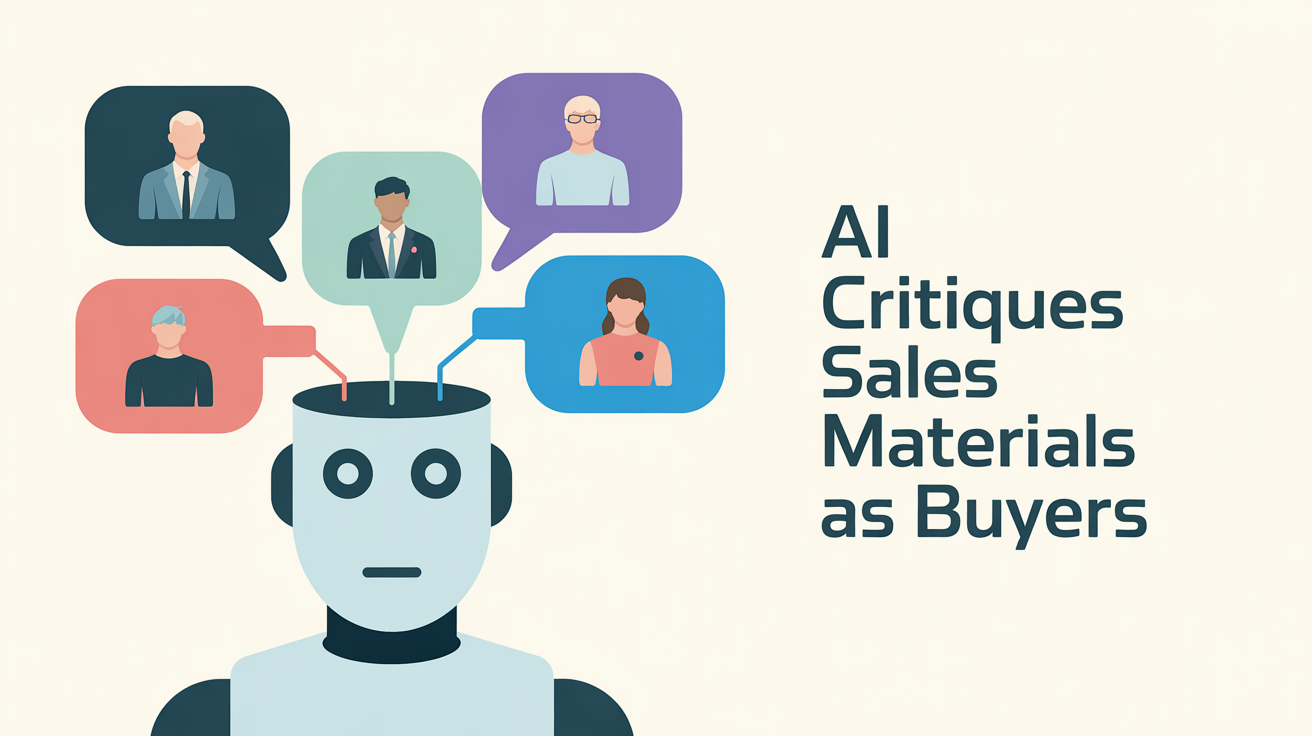
Yes. Give ChatGPT a detailed buyer persona (job, company size, what they're measured on, what went wrong with the last vendor) and ask it to read your sales collateral as that person and tell you what would make them say no. Done with a real persona instead of a job title, it surfaces the missing proof, the unclear value claim, and the objection you'd otherwise hear in the meeting, in ten minutes and before anything goes out. Done with "pretend you're a CFO," it produces the generic feedback you could have written yourself. The persona is the whole technique.
TL;DR
- One piece of collateral, one detailed persona, one prompt. Start there.
- Ask for rejections and missing proof, not "feedback."
- Log recurring objections; they're your sales training and your FAQ.
Why does buyer role-play work?
Because you're too close to the product to read your own one-pager the way a stranger does, and the stranger won't tell you. Gartner's buying research finds 75% of B2B buyers prefer a rep-free sales experience, which means the collateral often does the selling with nobody in the room to answer questions. A model playing the buyer reads it the way the buyer will: cold, skeptical, and looking for a reason to move on. It's not a substitute for talking to customers. It's the rehearsal you do before you do.
What goes in the persona?
Five things, and the more specific each is, the better the objections.
- Role and company. "Operations manager at a 60-person commercial cleaning company," not "operations."
- What they're measured on. Margin, uptime, headcount, complaints. The objection follows the KPI.
- Budget and approval. Can they sign, or do they have to sell it upward? Who else has to say yes?
- Vendor history. The last tool that overpromised, the rollout that ran long. Burned buyers object differently.
- What's going on in their industry. Labor shortage, price pressure, a regulation change. Context sharpens the skepticism.
Build one persona for each person who touches the decision. The economic buyer who signs, the technical buyer who checks whether it works, the user who'll live with it, and the internal champion who has to defend it. Each reads the same page and wants a different sentence.
What do you ask?
For rejections, not opinions. Three prompts that work:
"As the owner of a 60-person commercial cleaning company who's been burned by scheduling software before, what concerns would you have about this proposal?"
"What proof would you need to see before recommending this to your partner?"
"Which parts of this page would lose your attention in the first five minutes?"
The useful answers fall into four buckets: missing credibility (no customer, no number, no name), an ROI claim with nothing under it, a vague timeline, and a differentiation claim the buyer doesn't believe. Fix those four and most of the rest resolves itself.
How do you test for stage and competition?
Change the persona's situation, not the collateral. "As someone who just realized this problem exists, is this page for me?" tells you whether it works at the top of the funnel. "As someone comparing three vendors, what's missing?" tells you whether it survives a shortlist. "As someone choosing between you and one other option, what would tip it?" tells you what the closing page needs.
Then put a competitor in the room: "How would you compare this to [competitor]?" / "What would make you choose the cheaper alternative?" / "What's your biggest concern about switching from what you use now?" The switching question is the one small businesses skip, and it's usually the real objection.
What did this look like on a real product?
At AI Marketing Labs we run the same technique with a panel of pre-built personas at once, which is what the Buyer's Table is. Testing marketing material for fiber laser cutting equipment, four personas read the same page and asked for four different things: the owner wanted real shop examples and a bottom-line price, the production manager wanted performance numbers, the welding supervisor wanted specs like kerf width, and the manufacturing engineer wanted compatibility detail. The page had been written for one of them. The fix wasn't a better paragraph; it was a page per reader. You find that out in an afternoon instead of a quarter.
How do you make it a habit?
Start with your best-performing piece, not your worst, so you learn why it works before you try to fix anything. Keep a running list of objections the personas raise more than once; it becomes the FAQ on your site and the objection sheet for whoever sells. And check the model against reality: when a prospect raises an objection the persona predicted, the method is calibrated; when they raise one it missed, add that detail to the persona. Running a full proposal through the same loop, including the ROI numbers, is in how AI can analyze a sales proposal.
Frequently asked questions
Is AI buyer feedback as good as talking to real customers?
No, and it isn't meant to be. It's the rehearsal before the conversation: it catches the gaps a cold reader would catch, so the real conversation is about the things only a real customer can tell you.
How detailed does the persona need to be?
Detailed enough that two people in your company would describe the same person. Role, company size, what they're measured on, what they've been burned by, and who they answer to. Five lines is enough; one line is not.
Can I do this with Claude or Gemini instead of ChatGPT?
Yes. The technique is the persona and the prompts, not the model. Use whichever assistant you already work in, so the personas stay in one place and you can reuse them on the next piece.