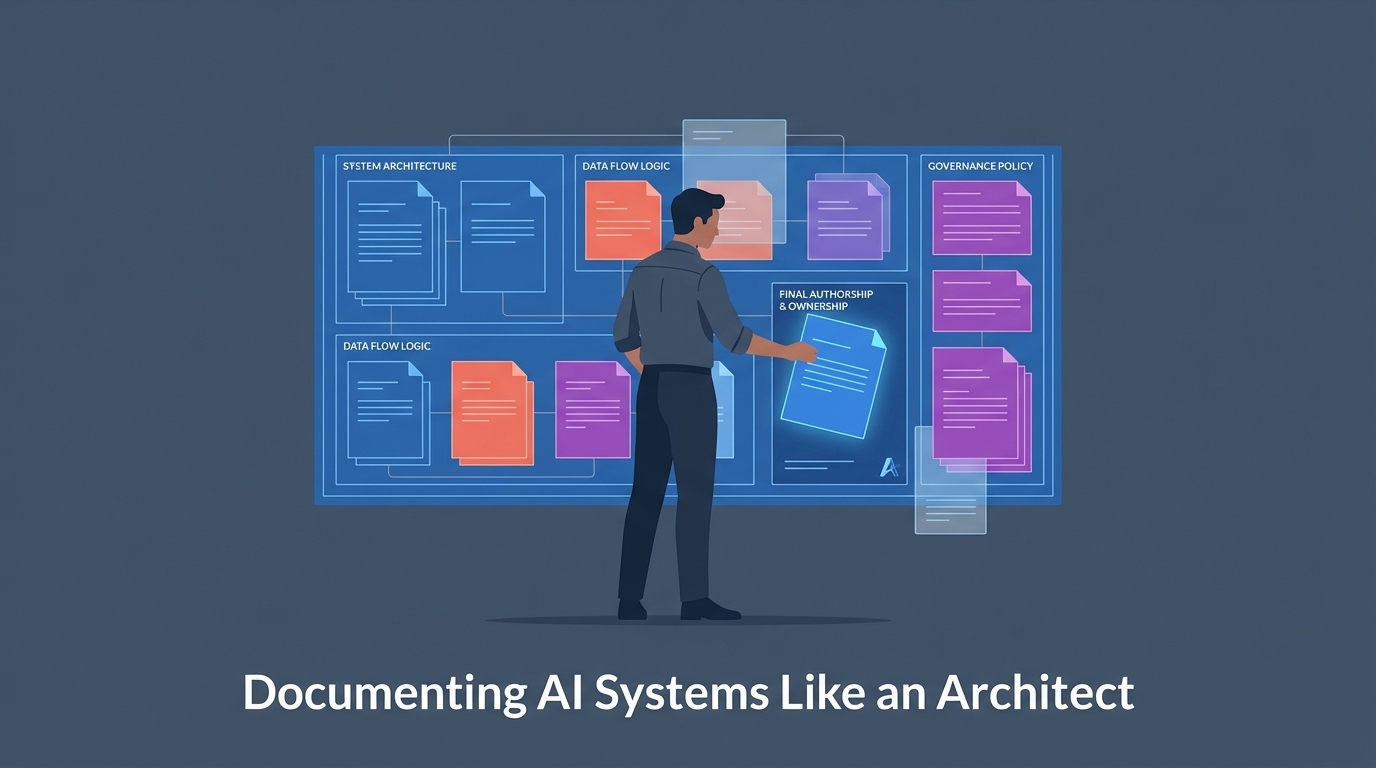
To document AI systems effectively, focus on the strategy, decisions, and business outcomes—not just the code or prompts. This approach transforms your documentation from a technical manual into a strategic blueprint, positioning you as the system’s indispensable architect.
TL;DR
To be recognized as an AI architect, your documentation must go beyond technical specifications. It needs to tell a story of value. The essential components are a System Charter (the business 'why'), an Architectural Diagram (the visual blueprint), a Decision Log (the strategic reasoning), an ROI Framework (the measured impact), and an Operational Playbook (the guide for users). This comprehensive approach demonstrates strategic ownership.
The Critical Shift: From AI Technician to AI Architect
Many professionals are becoming adept at using AI tools. They can write prompts, connect APIs, and automate simple tasks. While valuable, these skills often brand them as technicians—the people who execute on a strategy defined by others.
The real organizational power and visibility belong to the architect. An architect doesn't just build; they design the blueprint. They understand the business problem, map the entire system, justify the design choices, and prove the value. Proper documentation is the primary tool that elevates your role from a doer to a designer. It is the tangible proof of your strategic contribution.
The Core Components of Architectural AI Documentation
To build your reputation as an architect, your documentation must be clear, strategic, and focused on business value. Here are the five essential components to include.
1. The System Charter: Defining the Why
Before you document a single workflow, you must articulate the system's purpose in business terms. The System Charter is a high-level, one-page document that serves as your foundation.
- What It Is: A concise summary outlining:
- The Business Problem: What specific pain point does this system solve? (e.g., "Our lead qualification process is slow and manual, causing us to lose high-intent prospects.")
- The Desired Outcome: What measurable business metric will this system improve? (e.g., "Reduce lead response time by 50% and increase sales-qualified leads by 15%.")
- Key Stakeholders: Who benefits from this system, and who is responsible for its success?
- Why It Matters: This document immediately frames your work around revenue, efficiency, or customer value—the language of leadership. It proves you're solving business problems, not just playing with new technology.
2. The Architectural Diagram: The Visual Blueprint
An architect’s most powerful tool is the blueprint. For AI systems, this is a visual diagram that shows how all the pieces connect and interact.
- What It Is: A flowchart or diagram illustrating:
- Data Sources: Where does information enter the system? (e.g., a web form, CRM, email inbox).
- Tools & Platforms: What applications are involved? (e.g., Make.com, Airtable, OpenAI API, your CRM).
- Core Logic: Where do AI models and decision points sit in the workflow?
- Outputs & Actions: What does the system produce? (e.g., an email, a CRM update, a report).
- Human Touchpoints: Where do people review, approve, or interact with the system?
- Why It Matters: A diagram makes complexity understandable at a glance. It demonstrates that you grasp the entire ecosystem, not just a single tool, and solidifies your role as the person with the "big picture" view.
3. The Decision Log: Justifying Your Choices
A true architect makes deliberate, defensible choices. A Decision Log is a simple but powerful document that records the "why" behind your system's design.
- What It Is: A running list of key decisions made during the building process, along with the rationale. Examples include:
- “Chose Claude 3.5 Sonnet over GPT-4o for this content summarization task due to its lower cost and sufficient performance in testing.”
- “Built the RAG system using our internal product guides first to ensure AI outputs are grounded in company facts.”
- “Used a webhook instead of polling to reduce API calls and operational costs.”
- Why It Matters: This log demonstrates foresight and strategic thinking. It preemptively answers questions from leadership and technical teams, showing that your system is the result of careful consideration, not just trial and error.
4. The ROI & Measurement Framework: Proving the Value
Your work is not complete until you can prove its impact. An ROI framework connects your system directly to the KPIs you defined in the System Charter.
- What It Is: A dashboard, report, or simple spreadsheet that tracks the system’s performance against key metrics.
- Efficiency Gains: Time saved per week, tasks automated per month.
- Revenue Impact: Increase in conversion rates, reduction in sales cycle time, pipeline generated.
- Cost Savings: Reduced software spend, lower cost-per-lead, decreased content production overhead.
- Why It Matters: This is the ultimate proof of your value. Data silences skepticism and justifies future investment. When you can present a clear line from your system to business growth, you are no longer seen as a cost center but as a revenue driver.
5. The Operational Playbook: Ensuring Longevity and Adoption
An architect designs systems that can be operated and maintained by others. The Operational Playbook ensures your system lives on and scales across the organization.
- What It Is: A user-friendly guide for the people who will interact with or maintain the system. It includes:
- Standard Operating Procedures (SOPs): Step-by-step instructions for using the system.
- Troubleshooting Guide: What to do when common errors occur.
- Governance Rules: Guidelines on data privacy, brand voice, and acceptable use.
- Feedback Loop: How users can request changes or report issues.
- Why It Matters: This proves you are a systems thinker who builds for the organization, not just for yourself. A well-documented system that others can use is a durable asset, whereas a complex system only you understand is a liability.
- How the Lab Helps: The Lab is a working implementation community, not a course platform. The focus is on building production-ready systems that teams can actually use. Through peer learning and collaborative problem-solving in live sessions, members learn the practical details of change management and user training needed to ensure their systems are adopted and valued.
From Documentation to Authority
These five components—Charter, Diagram, Log, ROI Framework, and Playbook—do more than just describe your AI system. Together, they create a comprehensive portfolio that tells a compelling story of strategic value.
This isn't tedious paperwork; it is the most effective communication tool you have for building your internal brand. It is the evidence that establishes you as a thoughtful, business-focused AI architect.
Creating this level of documentation from scratch can be daunting. It requires a blend of strategic thinking, technical knowledge, and clear communication—the very skills honed in The AI Marketing Automation Lab. The Lab provides the blueprints, frameworks, and live, expert guidance to not only build powerful AI systems but to document them in a way that gets you recognized.
To stop being seen as just a technician and start being valued as the architect, you must document your work with strategic intent.
Frequently Asked Questions
What is the role of a System Charter in AI system documentation?
The System Charter is a high-level, one-page document that articulates the system's purpose in business terms. It defines the business problem, desired outcome, and key stakeholders, framing your work around revenue, efficiency, or customer value, thus proving you're solving business problems.
Why is an Architectural Diagram important in AI systems?
An Architectural Diagram is important because it is a visual blueprint that shows how all the pieces of the AI system connect and interact. It makes complexity understandable at a glance and demonstrates that you have a comprehensive understanding of the entire ecosystem.
How does a Decision Log contribute to AI system documentation?
A Decision Log records key decisions made during the system-building process along with their rationale. It shows foresight and strategic thinking, preemptively answering questions from leadership and technical teams, and demonstrating that your system results from careful consideration.
What is the purpose of an ROI Framework in AI documentation?
An ROI Framework proves the value of your AI system by connecting it to key performance indicators such as efficiency gains, revenue impact, and cost savings. It provides tangible proof of your system's impact, transforming perception from cost center to revenue driver.