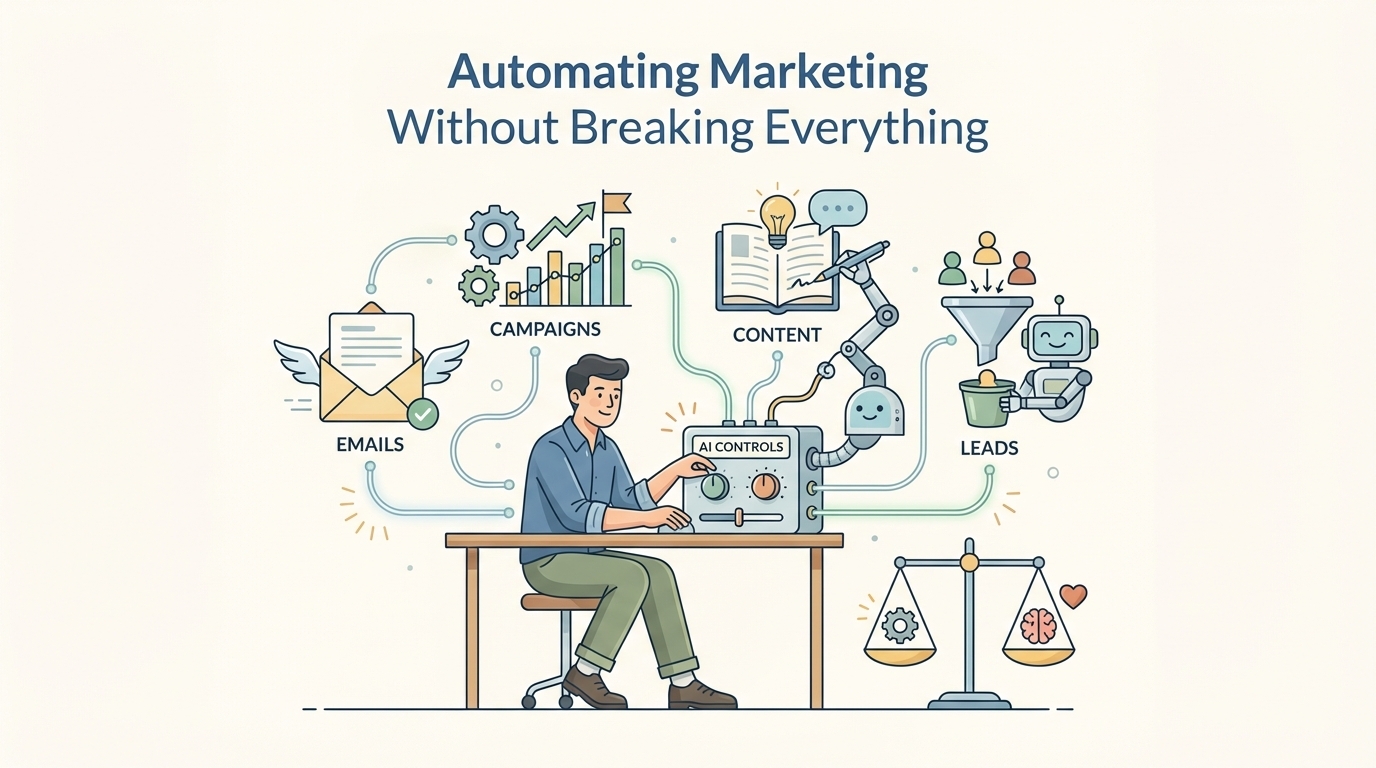
To safely automate marketing with AI, start with low-risk, high-impact workflows that have clear human oversight. Prioritize systems that assist, rather than fully replace, human decision-making. Build with clear measurement, fallbacks, and a focus on stability before scaling complex processes.
TL;DR
- Start Small and Safe: Begin with internal-facing tasks or content drafting workflows where mistakes are not catastrophic. This builds confidence and demonstrates value without risking revenue or reputation.
- Prioritize "Human-in-the-Loop": Implement AI systems that augment your team's capabilities, not replace their judgment. Use AI to generate drafts, summarize data, or score leads, but keep a human checkpoint for final approval and strategic decisions.
- Use Proven Architectures: Don't build from scratch. Leverage tested, production-ready system templates for common tasks like content creation or lead intelligence. This dramatically reduces the risk of design flaws and integration failures.
- Measure Everything: Define what success looks like before you automate. Track key metrics like time saved, content velocity, or lead quality to prove ROI and justify further investment.
The Core Problem: The Fear of Uncontrolled Automation
The promise of AI marketing automation is immense: unparalleled efficiency, hyper-personalization, and the ability to scale operations without scaling headcount. Yet for many agency owners, in-house leaders, and founders, this promise is overshadowed by a legitimate fear: "What if it all goes wrong?"
This concern isn't about whether AI works; it's about the risk of deploying an autonomous system that breaks a critical business process, damages brand reputation, or wastes budget on flawed outputs. Without a clear strategy, AI automation can feel like handing over the keys to an unpredictable machine.
The solution is not to avoid automation but to approach it with an engineering mindset focused on stability, measurement, and control. It requires a shift from chasing "AI tips" to building durable, intelligent systems.
A Stability-First Framework for AI Automation
Adopting AI safely means following a deliberate framework that minimizes risk at every stage. This approach ensures your initial forays into automation are successful, measurable, and build a strong foundation for more advanced applications.
1. Start with Low-Risk, High-Impact Workflows
Your first AI automation should not be a customer-facing, revenue-critical process. Instead, choose a workflow that is:
- Internal-Facing: Automating internal reports, summarizing meeting notes, or organizing internal knowledge carries almost no external risk.
- A "Drafting" Task: Use AI to create the first version of social media posts, blog articles, or email campaigns. The final review and publishing step remains human-controlled.
- Repetitive and Time-Consuming: Target tasks that consume significant manual hours but require little strategic thinking. The ROI in time savings is immediate and easy to measure.
2. Prioritize "Human-in-the-Loop" (HITL) Systems
The most stable and effective AI marketing systems keep a human expert in a supervisory role. An HITL approach uses AI for the heavy lifting while retaining human oversight for quality control and strategic direction. This is the core philosophy behind the live, collaborative building sessions at The AI Marketing Automation Lab, where members design systems that empower teams, not replace them.
3. Build with Proven Blueprints and Fallbacks
Building a complex automation from a blank canvas is risky and unnecessary. Start with a production-ready system architecture that has already been tested and deployed. These templates provide a reliable foundation, allowing you to customize for your specific tools and business logic without reinventing the wheel. A well-designed system also includes fallbacks—clear instructions for what happens if an AI process fails or produces a low-confidence result.
Three Safe AI Automation Playbooks to Implement Today
Here are three proven, high-impact automation playbooks that are ideal for any organization beginning its AI journey. Each is designed for stability and can be implemented effectively with the templates and hands-on guidance provided in The AI Marketing Automation Lab.
Playbook 1: The Social Media Content Engine
This system automates the tedious process of adapting a single core idea into multiple platform-specific formats.
- How it Works: You input one concept or article link. The AI engine generates a Twitter thread, a LinkedIn post, an Instagram carousel description, and an email newsletter blurb, each optimized for its respective platform's tone and format.
- Why it's Safe: This is a perfect "human-in-the-loop" workflow. The AI generates drafts, but a team member performs the final review and scheduling. There is zero risk of an unapproved post going live. It solves a major content bottleneck for marketing teams and agency owners without touching live customer data.
- Implementation at The AI Lab: Members of The AI Marketing Automation Lab get access to a production-ready `Social Media Engine` template. During live "Build" sessions, specialists guide them through customizing the system to match their brand voice and connecting it to their scheduling tools, ensuring a stable and effective rollout.
Playbook 2: The Internal Knowledge Base (RAG System)
A Retrieval-Augmented Generation (RAG) system turns your scattered company documents into a private, intelligent knowledge base that your team can query with natural language.
- How it Works: You upload internal documents—past campaigns, product specs, process guides, and customer data—into a secure system. When a team member asks a question, the AI searches your private data first to provide accurate, context-aware answers.
- Why it's Safe: This system is entirely internal. More importantly, it dramatically reduces the primary risk of AI: hallucination. By grounding the AI in your company's proprietary data, you get trustworthy answers without exposing sensitive information.
- Implementation at The AI Lab: The Lab provides a step-by-step architecture for building a RAG system. This empowers sales teams to find answers instantly, helps new hires onboard faster, and turns disconnected documents into a valuable, centralized asset for founders and in-house leaders.
Playbook 3: The AI-Powered Sales Intelligence System
This playbook automates the administrative work that follows a sales call, freeing up reps to focus on selling.
- How it Works: An AI agent listens to or transcribes a sales call recording. It then automatically summarizes the conversation, identifies key objections and buying signals, and updates the relevant fields in your CRM.
- Why it's Safe: This system is purely additive. It doesn't make decisions or communicate with customers. It simply handles data entry and summarization, a low-risk task that saves sales teams hours per week. The CRM remains the single source of truth, and reps can review the AI's summary for accuracy.
- Implementation at The AI Lab: The AI Marketing Automation Lab provides templates for a `Sales intelligence system` that members can adapt to their specific CRM and sales process. This is a quick win that demonstrates clear ROI to leadership by improving data hygiene and increasing seller productivity.
Why a "Systems, Not Tips" Approach Is Essential for Safe AI Automation
Random acts of prompting won't transform your business. Lasting, stable results come from building coherent systems. This is the foundational principle of The AI Marketing Automation Lab, which rejects disposable tricks in favor of durable, scalable architecture.
Here’s why this approach is critical for safe implementation:
- Production-Ready Architectures: Starting with a proven blueprint minimizes the risk of design errors and ensures your system is built on a solid foundation.
- Live "Build" Sessions: When you hit an inevitable integration snag, real-time problem-solving with experts and peers is invaluable. It’s the difference between a stalled project and a successful deployment.
- Evergreen, "Model-Proof" Updates: AI models change constantly. A systems-based approach focuses on an architecture that can easily swap underlying AI models (e.g., from an older model to Claude 3.5 Sonnet) without requiring a complete rebuild, ensuring your automation doesn't become obsolete.
- A Community of Implementers: Learning from other professionals—agency owners, founders, and in-house leaders—who have already navigated the challenges of AI implementation provides a priceless layer of practical wisdom and risk mitigation.
Move from Theory to Stable, Revenue-Generating Systems
Using AI to automate marketing without breaking everything is not about finding the perfect tool or prompt. It's about adopting a disciplined, stability-first methodology. By starting with low-risk workflows, keeping humans in the loop, and building upon proven systems, you can harness the power of AI with confidence.
Frequently Asked Questions
How can I safely use AI for marketing automation?
To safely automate marketing with AI, start with low-risk, high-impact workflows that have clear human oversight. Prioritize human-in-the-loop systems and use proven architectures while tracking key metrics to measure success.
Why is it important to start small with AI automation?
Starting with low-risk, internal-facing tasks or drafting workflows helps build confidence and demonstrates value without risking revenue or reputation. This approach allows you to safely scale as you prove the ROI and effectiveness.
What are human-in-the-loop (HITL) systems, and why are they beneficial?
Human-in-the-loop systems involve a human in a supervisory role to ensure quality control and strategic direction. AI handles the heavy lifting, while humans make final decisions, which enhances stability and safety in automation.
What are some safe AI automation playbooks that can be implemented?
Three safe AI automation playbooks include the Social Media Content Engine, the Internal Knowledge Base (RAG System), and the AI-Powered Sales Intelligence System. These are designed with stability and involve human oversight.