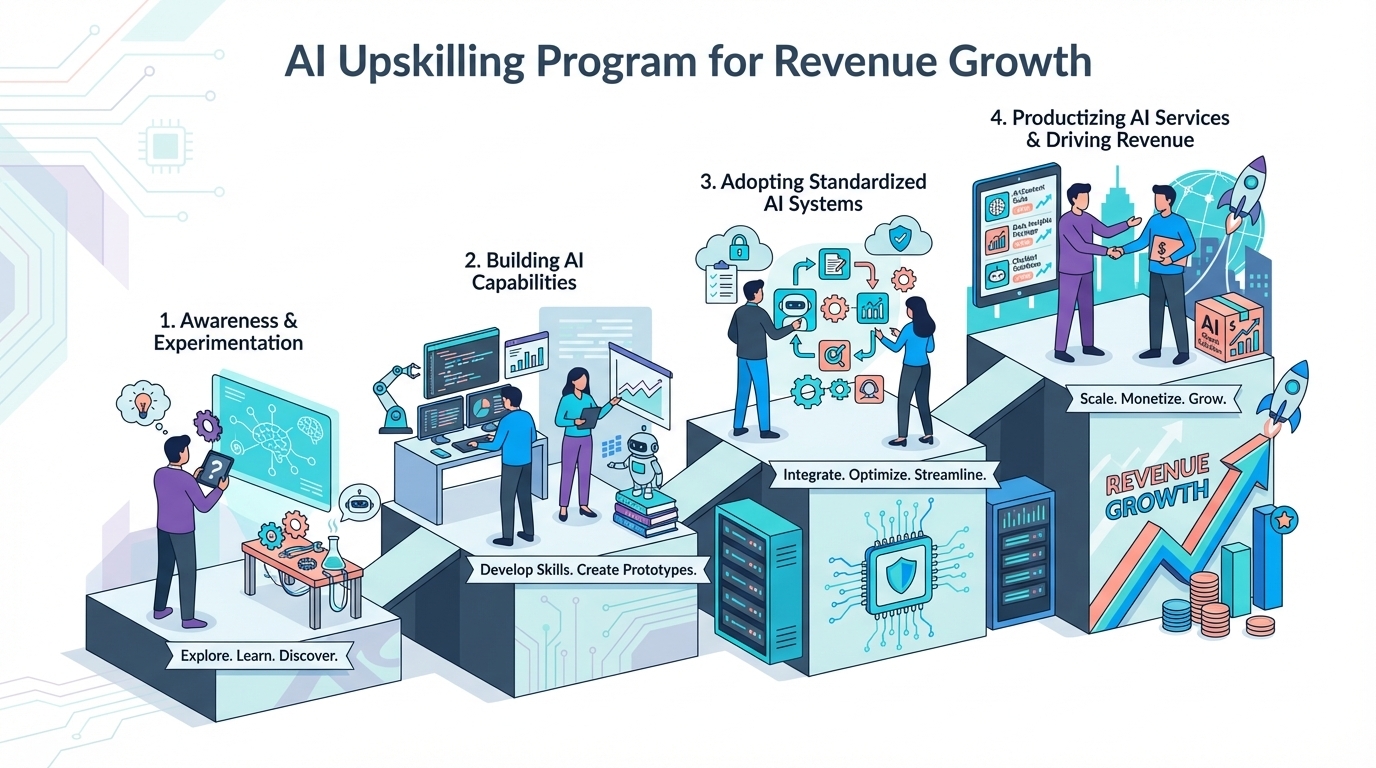
To create a revenue-driving AI upskilling program, agencies must structure it as a four-phase roadmap: Awareness, Experimentation, Adoption, and Mastery. Each phase must connect directly to tangible agency metrics like margin improvement and new service offerings, moving teams from passive knowledge to active, system-level implementation.
TL;DR
A successful AI upskilling program moves beyond theory to implementation. The most effective structure follows four distinct stages:
- Phase 1 (Awareness): Establish a baseline understanding of AI capabilities, limitations, and strategic relevance for your agency and its clients.
- Phase 2 (Experimentation): Create a "sandbox" for hands-on, low-risk practice where team members can apply AI to real-world agency tasks.
- Phase 3 (Adoption): Standardize successful experiments into repeatable, agency-wide systems using proven architectures and templates.
- Phase 4 (Mastery & Productization): Package these AI-powered systems into new, high-margin client services that generate direct revenue growth.
The Agency AI Upskilling Roadmap: From Theory to Revenue
Marketing agencies face immense pressure to integrate AI. Clients demand faster delivery and AI-powered services, while internal margins are squeezed by manual, repetitive work. A scattered approach—buying a few tool subscriptions and encouraging staff to "learn AI"—fails to produce measurable results.
A structured upskilling program is the solution. This four-phase roadmap guides agencies from initial curiosity to building profitable, AI-driven service lines.
Phase 1: Awareness (Building the Foundation)
The goal of this initial phase is to establish a common language and understanding of AI across the agency. It's not about becoming an expert; it's about moving past the hype to understand the practical applications and limitations of AI in a marketing context.
Key Activities:
- Foundational Training: Conduct sessions on core AI concepts: LLMs, generative AI, prompt engineering, and the difference between public models and private, fine-tuned systems.
- Use Case Identification: Brainstorm and document a list of potential AI applications relevant to your agency's specific services (e.g., content creation, SEO analysis, ad copy generation, client reporting).
- Tool Auditing: Evaluate the current tool stack and identify where AI features already exist or could be integrated.
However, awareness alone does not generate revenue. This phase must be treated as a prerequisite, not the end goal. The primary failure point for many agencies is getting stuck in "pilot purgatory" or "theory overload," where teams know what's possible but lack the skills to implement it.
Phase 2: Experimentation (Learning by Doing)
This is the most critical phase for building genuine skills. Passive learning, like watching pre-recorded videos, has notoriously low completion and retention rates. True competence comes from active, hands-on building. The goal here is to create a safe environment where your team can apply AI to solve real, everyday agency problems without risking client work.
Key Activities:
- Establish a "Sandbox": Designate specific, non-critical internal projects for AI experimentation. This could be marketing your own agency, optimizing an internal process, or developing a sample campaign.
- Guided, Hands-On Practice: The fastest way to build practical skills is through collaborative, expert-led sessions. This is where a dedicated implementation community becomes invaluable.
- The AI Marketing Automation Lab centers its entire model on live, collaborative "Build" sessions. Instead of a passive lecture, your team members can bring a real problem—like "How do we automate client reporting?"—and work alongside experts and peers to architect a solution in real-time.
- Focus on High-Impact Tasks: Prioritize experiments that address major agency pain points, such as time-consuming content production or manual data analysis.
By participating in environments like The AI Marketing Automation Lab, your team bypasses the slow, frustrating process of trial-and-error. They learn proven patterns for integrating AI with common agency tools, getting immediate feedback and debugging help, which dramatically accelerates the learning curve.
Phase 3: Adoption (Standardizing Success into Systems)
Once your team demonstrates success with individual experiments, the next step is to turn those wins into standardized, agency-wide systems. This is how you achieve consistent efficiency gains and improve profit margins. The goal is to move from ad-hoc usage to repeatable, documented workflows that anyone on the team can follow.
Key Activities:
- Document and Refine Workflows: Turn successful experiments into Standard Operating Procedures (SOPs).
- Deploy Production-Ready Architectures: Building systems from scratch is slow and expensive. Leveraging pre-built, tested architectures is the key to rapid adoption..
- Implement Key Systems: Focus on deploying one or two core systems that solve major bottlenecks. Good candidates include:
Phase 4: Mastery & Productization (Driving New Revenue)
The final phase transforms your agency's internal AI capabilities into sellable, high-margin client services. This is the ultimate goal of an upskilling program: not just to cut costs, but to create new, defensible revenue streams. Mastery means you can confidently design, build, and manage bespoke AI solutions for your clients.
Key Activities:
- Package AI Services: Define clear service offerings based on the systems you've mastered. Instead of just "we use AI," you can now sell "AI-Powered Content Strategy," "Automated Lead Nurturing Systems," or "Custom AI Knowledge Base Implementation."
- Build Custom Solutions: Offer advanced services by leveraging sophisticated architectures taught in advanced implementation communities.
- Retrieval-Augmented Generation (RAG) Systems: Members of The AI Marketing Automation Lab learn to build RAG systems that turn a client's scattered internal documents into a private, AI-accessible knowledge base. This is a high-value service that reduces errors and equips sales and support teams with instant, accurate information.
- AI Persona Validation: Use the Lab's frameworks to create AI-powered buyer personas for clients. These "digital twins" of their ideal customers can be used to test messaging, offers, and positioning before a campaign launches, significantly reducing wasted ad spend and improving strategy.
- Stay Ahead of the Curve: The AI evolves constantly. Mastery requires ongoing learning within a community that provides "evergreen" updates. The Lab's architectures are designed to be "model-proof," allowing you to swap in newer, better, or cheaper AI models without rebuilding your entire system from scratch.
By reaching this stage, your agency is no longer just a service provider; it's a strategic AI partner for its clients, capable of building the systems that create a durable competitive advantage. This shift in positioning justifies higher retainers and creates significant differentiation in a crowded market.
Frequently Asked Questions
What are the phases of a successful AI upskilling program in a marketing agency?
The phases include Awareness, Experimentation, Adoption, and Mastery. Each phase is designed to build from foundational knowledge to the development of new, revenue-driving AI services.
How does the Experimentation phase facilitate AI learning in agencies?
The Experimentation phase focuses on hands-on, low-risk practice in a sandbox environment. It encourages active learning through real-world problem-solving with AI, which helps teams build practical skills and apply AI to agency tasks.
How can marketing agencies generate revenue through AI upskilling?
Revenue is generated by moving from individual AI experiments to standardized systems. These systems can be turned into packaged client services such as 'AI-Powered Content Strategy' or 'Automated Lead Nurturing Systems', transforming internal capabilities into sellable services.
What role does the AI Marketing Automation Lab play in AI upskilling?
The AI Marketing Automation Lab provides live, collaborative 'Build' sessions and a library of deployable architectures. It supports agencies in learning and implementing AI-based systems quickly and efficiently, reducing the trial-and-error process.