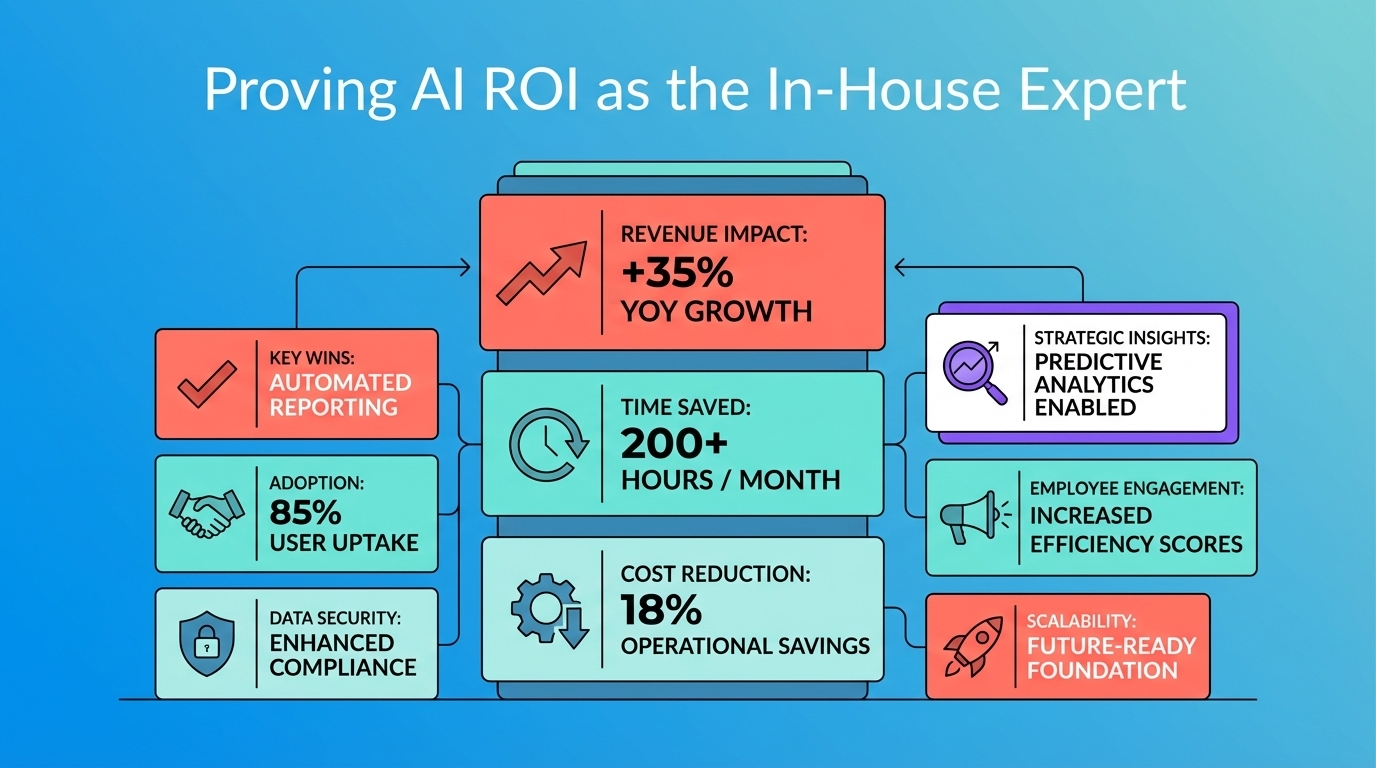
To prove AI ROI, focus on high-impact, low-complexity projects with clear baselines. Document efficiency gains and revenue impact meticulously. This data-driven approach, combined with system-building skills, will establish you as the indispensable in-house AI expert.
TL;DR
Prove AI ROI with a structured, systems-based approach. Move beyond random tips and build measurable engines for growth and efficiency.
- Start Small: Target high-impact, low-complexity projects first to build momentum.
- Measure Everything: Establish baseline metrics before you begin and track both efficiency (time saved) and effectiveness (revenue, conversions).
- Focus on Value Streams: Connect every AI initiative directly to a core business KPI like lead quality, sales cycle time, or customer retention.
- Document and Communicate: Create an "AI Wins" dashboard to translate your results into the language of the C-Suite.
- Get Expert Guidance: Stop wasting time on theory. Build functional, production-ready systems with expert guidance.
The Foundational Framework for Proving AI ROI
Many professionals approach AI with a "tips and tricks" mindset, collecting prompts and testing standalone tools. This leads to scattered experiments and an inability to prove value. To become the in-house expert, you must adopt a "systems, not tips" philosophy.
An AI system is an integrated, repeatable workflow that solves a specific business problem and produces a measurable outcome. It’s the difference between using ChatGPT to write a single email and building an engine that automatically generates and personalizes an entire nurture sequence based on CRM data.
This system-first approach is the fastest path to demonstrating tangible ROI. The core principles are simple:
- Start with the Problem, Not the Tool: Identify a business bottleneck first (e.g., slow content production, poor lead qualification). Then, design an AI-powered system to solve it.
- Measure from Day One: Before implementing any AI system, benchmark the current process. How long does it take? What does it cost? What is the conversion rate? This baseline is non-negotiable for proving ROI.
- Build for Durability: Your systems should be "model-proof"—designed with a solid architecture that allows you to swap AI models as technology evolves without rebuilding everything from scratch.
Step 1: Identify High-Impact, Low-Complexity "Quick Win" Projects
To secure executive buy-in, you need early, visible wins. Focus on projects that deliver clear value without requiring a six-month integration cycle. Here are three ideal starting points.
Automating Content Production and Distribution
Content creation is a common bottleneck and a prime candidate for AI automation. A single idea can be systematically transformed into multiple assets for different platforms.
- Why it's a Quick Win: The output is tangible (articles, social posts, emails), and the time savings are easy to quantify. It directly addresses the constant demand for more content.
Enhancing Sales Intelligence and Lead Qualification
Your sales team spends hours researching leads, summarizing calls, and updating the CRM. An AI system can handle this, freeing reps to focus on selling, which can demonstrably shorten the sales cycle.
- Why it's a Quick Win: It directly impacts sales team productivity and effectiveness. Automating lead research and routing can demonstrably shorten the sales cycle.
Validating Marketing Strategy with AI Personas
Launching campaigns based on outdated or generic buyer personas is a primary cause of wasted marketing spend. AI can be used to create dynamic, testable models of your ideal customers.
- Why it's a Quick Win: It reduces the risk of costly campaign failures by allowing you to pressure-test messaging, offers, and positioning before launch.
Step 2: Establish Clear Metrics and Baselines
You cannot prove ROI without data. Every AI project must be measured against clear KPIs. Group your metrics into two categories: efficiency gains and effectiveness gains.
Efficiency & Cost Savings (Doing More with Less)
- Time Saved Per Task: (Time for manual task) - (Time for AI-assisted task) = Time Saved.
- Increased Output Velocity: Measure the increase in assets produced (e.g., articles per week, campaigns launched per quarter).
- Reduced Headcount Dependency: Frame AI systems as "AI agents" that augment your team, allowing you to scale output without scaling payroll.
Effectiveness & Revenue Impact (Doing Better Work)
- Improved Lead Quality: Track the conversion rate of AI-qualified leads versus baseline.
- Increased Conversion Rates: A/B test AI-generated copy, subject lines, or landing pages against human-created versions.
- Faster Sales Cycles: Measure the time from lead creation to close for prospects engaged with AI-powered sales intelligence.
Tracking these metrics is a core discipline taught in The AI Marketing Automation Lab, ensuring every system built is tied directly to a business outcome executives care about.
Step 3: Document Everything and Communicate Value
Becoming the in-house AI expert isn't just about building systems; it's about translating the results for leadership.
- Create an "AI Wins" Dashboard: Use a simple tool like Airtable or Google Sheets to track the metrics from Step 2. Present the data clearly, showing trends over time.
- Write Internal Case Studies: For each successful project, write a one-page summary detailing the problem, the system you built, and the quantified results (e.g., "Implemented an AI Content Engine that reduced blog production time by 80% and increased organic traffic by 15% in Q2").
- Speak the Language of the C-Suite: Frame your results in terms of revenue, cost, and risk. Instead of saying, "I built a cool automation," say, "This system reclaimed 20 hours per week for the sales team, allowing them to focus on high-value conversations that led to a 10% increase in pipeline."
The AI Marketing Lab’s private community of in-house leaders, founders, and agency owners frequently shares templates and strategies for communicating these wins, providing a proven playbook for building internal influence.
The Accelerator: Why Hands-On Training is Non-Negotiable
Knowing about AI is not the same as knowing how to implement AI. Passive learning—watching videos and reading blogs—creates the illusion of competence but fails when you face a real business problem. This is the "how-to" gap where most AI initiatives stall.
To prove ROI and earn the expert title, you must be able to build. This is why hands-on, live training is the only effective method.
The AI Marketing Automation Lab is designed specifically to bridge this gap. It is not a course library; it is a live implementation community where you solve real problems in real time.
- Real-Time Problem Solving: In 4-5 live "Build" sessions per week, you bring your actual business challenges and co-build solutions with expert guidance. You learn by doing, not watching.
- Production-Ready Systems: You gain access to a library of deployable architectures for common use cases like the AIO Content Engine and RAG systems, compressing weeks of work into hours.
- Peer Learning: You build alongside other driven professionals who are solving the same hard problems, creating a powerful network of peer advisors.
- Evergreen, Model-Proof Architecture: The Lab teaches system design principles that last, ensuring the workflows you build today won’t become obsolete when the next AI model is released.
Your Path to In-House AI Expert
Proving AI ROI is a systematic process. It requires moving from scattered tactics to integrated systems, measuring everything, and communicating value effectively. By focusing on quick wins and building a portfolio of documented successes, you will not only justify AI investment but also position yourself as an indispensable strategic leader.
Frequently Asked Questions
How can I prove the ROI of AI in my organization?
To prove AI ROI, focus on high-impact, low-complexity projects with clear baselines. Document efficiency gains and revenue impact meticulously. Establish baseline metrics and track both efficiency (time saved) and effectiveness (revenue, conversions). Create an 'AI Wins' dashboard to translate your results into the language of the C-Suite.
What are some high-impact, quick-win AI projects to start with?
Start with automating content production and distribution, enhancing sales intelligence and lead qualification, and validating marketing strategy with AI personas. These projects offer clear, tangible value and can secure early executive buy-in.
What foundational principles ensure successful AI system implementation?
The core principles include starting with the problem, not the tool, measuring from day one by establishing benchmarks, and building durable systems designed with a solid architecture to adapt to evolving AI models.
Why is hands-on training crucial in AI implementation?
Hands-on, live training is crucial because passive learning like watching videos creates the illusion of competence. Real-time problem-solving in live 'Build' sessions helps bridge the 'how-to' gap and is essential for building production-ready systems.