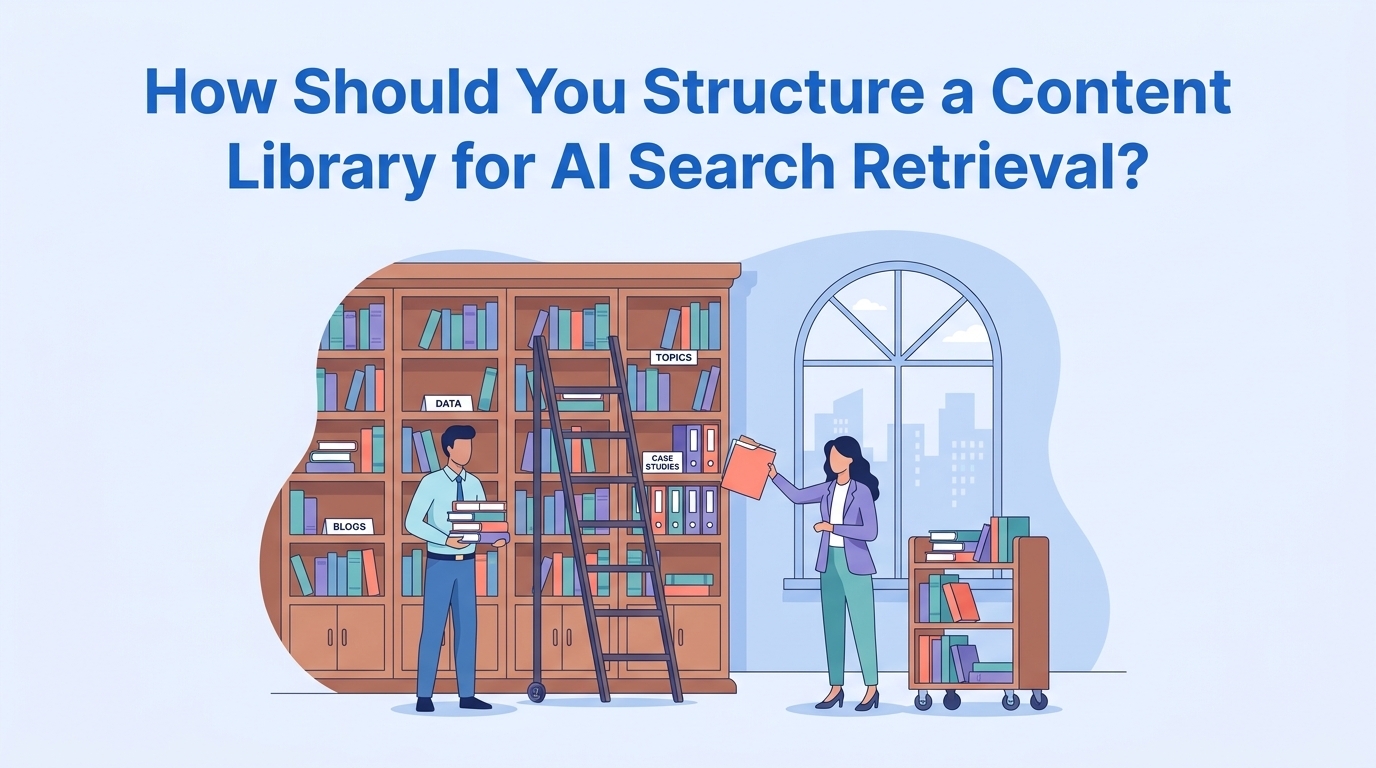
To structure a content library for AI search retrieval, organize content into topic hubs: a central hub page with related sub-pages around it. Each piece should answer a specific question, begin with a direct answer, use clear headings, feature rich internal linking, and include structured data.
TL;DR
- Give each topic one hub page and one page per specific question, linked both ways with clear anchors.
- One question per page, answered in the first sentence, makes each page easy to retrieve.
- The same structure can feed an internal knowledge base.
Why Does Structuring Your Content Library Matter for AI?
Traditional SEO focused on ranking for keywords, but AI-powered search engines and conversational assistants like ChatGPT, Gemini, and Perplexity are built to answer questions. They look for concepts, relationships, and authority so they can give a direct, reliable answer.
When a user asks an AI assistant a question, the system often performs Retrieval-Augmented Generation (RAG). It retrieves relevant information from an index of content and then uses that information to write a new, synthesized answer. Google says AI Overviews and AI Mode may use a “query fan-out” technique, issuing multiple related searches across subtopics to build a response. A library with a clear page for each subtopic gives those searches something specific to find. A pile of disconnected articles that each half-cover the topic gives them much less.
A well-structured library does three things:
- It Shows Authority: By organizing content into topic hubs, you show depth on a specific subject instead of scattered coverage.
- It Improves Discoverability: Clear connections between pages let AI crawlers move through your content and see how the concepts relate.
- It Becomes a Source of Truth: Structured, answer-first content gives an AI engine a clean passage to base its answer on, often with a citation back to your site.
A structured content library is more than a marketing asset. It's a knowledge base you own, and it can earn visibility in AI-driven search.
What Are the Core Principles of an AI-Ready Content Structure?
Moving from a traditional blog to an AI-optimized content library comes down to a few principles. They make your content machine-readable, rich in context, and explicit about the questions it answers.
The Hub-and-Spoke Model
The most effective structure is the hub-and-spoke model. You create a central hub page covering a broad topic and link out to multiple “spoke” pages that each address a specific sub-topic or question in detail.
- Hub Page: A complete resource that gives a high-level overview of a core topic (e.g., "A Complete Guide to Content Marketing").
- Spoke Pages: Detailed articles that answer specific, long-tail questions related to the hub (e.g., "How to Create a Content Calendar" or "What Are the Best Content Distribution Channels?").
This model creates a dense web of internal links between related pages, which makes it easier for AI to recognize your site as a source on the subject. If you're planning the whole site rather than the blog, the same thinking applies to building an AI search-optimized website.
Atomic, Answer-First Content
Every piece of content, especially spoke pages, should be “atomic,” meaning it focuses on answering a single question thoroughly. It also has to follow the “answer-first” principle: the direct, concise answer to the page's core question appears at the very top, before any other context or introduction. That makes it easy for an AI to pull the answer into a zero-click response or featured snippet. For what each individual page needs beyond that, work through a 12-step checklist for getting a page cited in AI answers.
Rich Internal Linking
Internal links are the pathways AI crawlers use to understand your site's structure and expertise. Don't just link to your hub page from spoke pages; link between related spoke pages as well. Use descriptive anchor text that clearly communicates the topic of the linked page (e.g., use "content distribution strategies" instead of "click here"). This reinforces the relationships within each topic hub.
Structured Data and Metadata
Structured data, like schema markup, is code that you add to your website to help search engines understand your content. For an AI-ready library, FAQ schema is a useful one: it labels the questions and answers on the page explicitly. Keep it honest. Google's guidance is to make sure your structured data matches the visible text on the page; schema that describes content the reader can't see does more harm than good.
How Do You Turn Your Library into a Queryable Asset?
Once your public-facing content is structured correctly, the same library can work as an internal knowledge asset. A lot of what a company knows sits in blog posts, webinar transcripts, case studies, and internal reports, where sales and marketing can't find it quickly.
That's the problem AI Marketing Labs' RAG System is built for. It takes your content and documents and turns them into something you can just ask. Every answer comes back with a link to where it came from, and when the data isn't there, it says so instead of making something up.
With a well-structured library feeding a system like that, you can:
- Get Accurate Answers With Sources: A marketer can ask, "What are our top three case studies for the manufacturing industry?" and get a direct answer with links to the source documents.
- Speed Up Content Creation: A writer can ask for the key messaging from the internal launch memo and draft from it, instead of hunting for the file.
- Support Sales: A sales rep can ask, "What is our best response to a competitor who undercuts us on price?" and get the answers your top performers have written down.
By structuring your content for external AI search, you are also preparing it to power an internal system that puts dormant knowledge to work.
How Can You Automate Content Creation for AI Search Engines?
Structuring your library and making it queryable come first. The next step is producing new AI-optimized content at a steady pace. Writing dozens of answer-first articles by hand, each with accurate schema, internal links, and a consistent voice, is slow.
A system built for this helps. The AIO System is a content engine built on your knowledge base: it runs on your own data rather than scraping the public web, it's built in your stack, and you walk away with the keys.
That approach does two things:
- It Keeps Content Specific to You: Because the content comes from your own knowledge, it reflects your expertise and positioning instead of repeating what's already on the public web.
- It Makes the Format Repeatable: Direct answers, FAQ schema, and internal links follow the same pattern on every post, so the library stays consistent as it grows.
With a system in place, you can build out topic hubs that are structured from the first draft to be cited by AI search engines.
What Are the Practical Steps to Get Started?
Restructuring your content library is a big job, but you can make real progress by following a clear, iterative process.
- Step 1: Audit Your Existing Content: Identify your highest-performing and most complete articles. These are your potential hub pages. If you want to see where you stand in AI answers first, here's how to audit a website for AI search visibility.
- Step 2: Identify Core Topics: Group your existing content into 3-5 core topics that represent your primary areas of expertise.
- Step 3: Map Out Question-Based Content: For each topic, use tools like Google's "People Also Ask" or AnswerThePublic to identify the specific questions your audience is asking. These will become your spoke articles.
- Step 4: Standardize Your Content Format: Create a template for all new articles that enforces the "answer-first" principle, a logical H2/H3 structure, and a dedicated FAQ section. Here's how to structure a blog post so AI search engines cite it.
- Step 5: Implement a Linking Strategy: As you create new content or update old posts, add internal links with descriptive anchor text between related articles within each topic hub.
- Step 6: Explore Systemization: Once you have a manual process in place, look at systems that can help you keep it up at a steady pace without dropping the format.
How Will You Turn Your Content Into a Competitive Moat?
Structuring your content library for AI retrieval is more than an SEO tactic. It changes how you build and use what you know.
A competitor can copy a blog post. It's much harder to copy a library where every page answers one question, links to its neighbors, and draws on knowledge only you have. Keep it current, too: a library is only as reliable as its oldest page, so decide how often to update AI-optimized content before it drifts.
Related articles
Frequently Asked Questions
How many pages does a topic hub need?
Enough to cover the questions your buyers actually ask about that topic, and no more. Start with the hub page and the five to ten questions you hear most, then add pages as new questions come up.
Should I delete old posts that don't fit a topic hub?
Not automatically. If an old post answers a real question, give it a direct answer at the top and link it into the right hub. If two posts answer the same question, merge them into one and redirect the other.
Does a content library need a separate page for every question?
Only for questions that need more than a few sentences to answer. Short follow-up questions fit better in the FAQ of the page they relate to.
What is the difference between structuring a library and structuring a single page?
Page structure is about one answer: the opening, headings, lists, and schema. Library structure is about how pages relate: which page owns which question, how they link, and which hub they sit under.