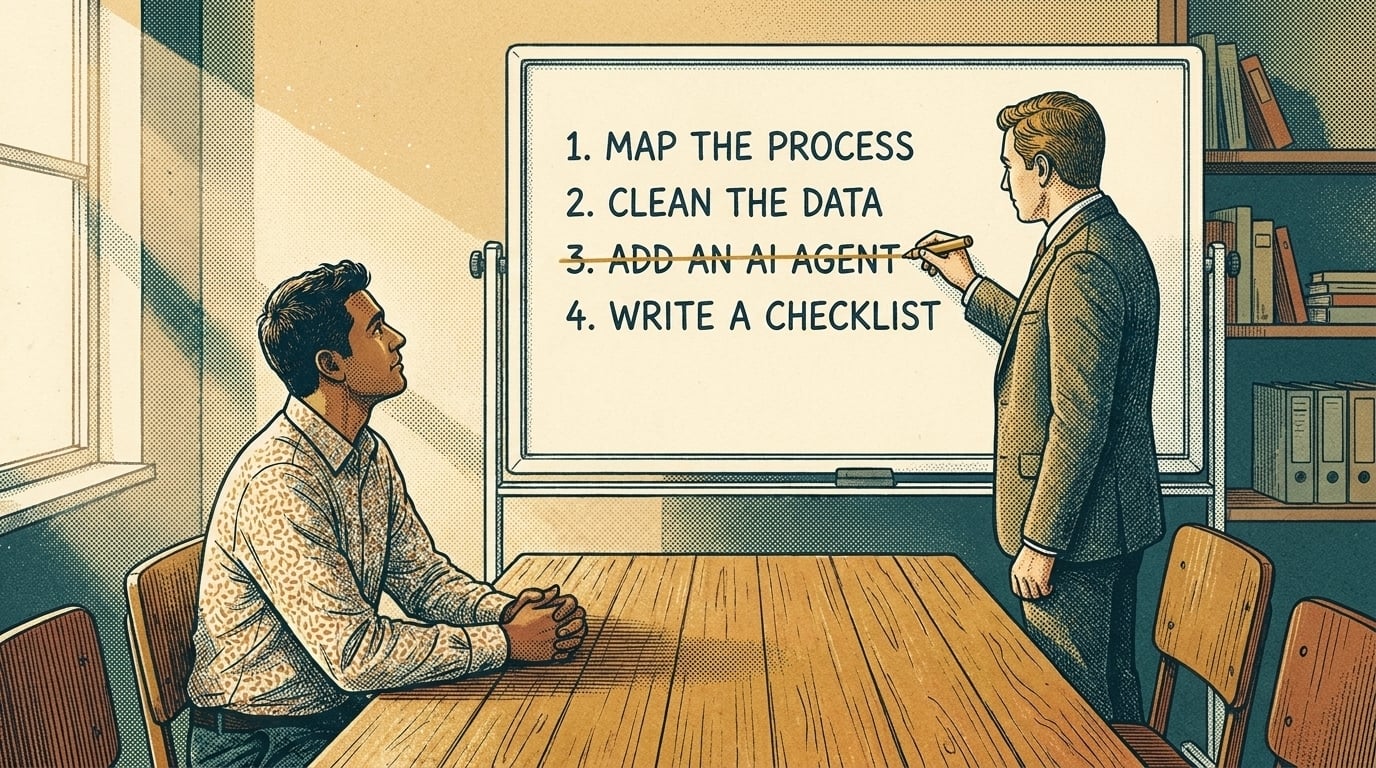
A good AI strategy consultant tells you to skip AI when the real problem is a broken process, missing or messy data, or a job that happens too rarely to be worth automating. Fix those first, or the AI does the mess faster. Hearing "not yet" on a first call is a good sign: it means the consultant looked at your work before selling you anything. A consultant who can't remember ever saying it is probably selling something.
TL;DR
- Broken process: fix the steps before adding AI.
- Messy data: clean the source, or the output inherits the mess.
- Rare task: a checklist beats an automation you'll have to maintain.
Why would a consultant talk you out of AI?
Because a project that fails is worse for everyone than one that never starts. Gartner predicted in June 2025 that over 40% of agentic AI projects will be canceled by the end of 2027, "due to escalating costs, unclear business value or inadequate risk controls." Two of those three reasons can show up on day one, if someone is willing to look.
Saying no early costs the consultant a sale. Saying yes to the wrong project costs you the build, the subscriptions, and the team's patience for the next attempt. The second is the bigger loss.
When is the process the real problem?
When the work is slow because of how it moves, not because typing is slow. Say quotes stall because three people approve them in a different order every time, and nobody knows who has the file. An AI that drafts quotes faster will drop them into the same pile.
The fix is boring and it comes first: decide who approves what, in which order, and write it down. McKinsey's November 2025 state of AI survey found that intentional redesigning of workflows has one of the strongest contributions to achieving meaningful business impact, and that its high performers were nearly three times as likely as others to say their organizations had fundamentally redesigned individual workflows. Redesign is the work. AI rides on top of it.
When is your data the real problem?
When the information the AI would need lives in three places, in three formats, and disagrees with itself. Customer details split between a CRM nobody updates, a spreadsheet, and someone's inbox. Prices in an old PDF and a newer email thread. An AI answering from that will sound confident and be wrong.
Gartner listed poor data quality first when it predicted that at least 30% of generative AI projects would be abandoned after proof of concept by the end of 2025. A good consultant will look at your real records before talking about tools, and may tell you the first project is getting one clean customer list.
When is the task too rare to automate?
Do the arithmetic. A report you build twice a month that takes an hour is 24 hours a year. Building an automation for it, testing it, and fixing it when a source changes can eat a good share of that in the first year, and the upkeep keeps going after that. A written checklist and a saved template may get you most of the time back for an afternoon's work.
Automation pays on work that's frequent, follows rules you can write down, and is cheap to undo when it gets one wrong. If a task misses two of those three, a good consultant will say so.
What does "not yet" look like in practice?
It should come with a to-do list and a signal to come back. Not "AI isn't for you," but "write down the approval order, run it that way for a month, and then the quoting draft is worth building." Or "merge the customer spreadsheets into the CRM, then call me." A good consultant tells you what has to be true first and how you'll know it is.
If you get a flat no with no next step, ask for one. The useful part of the answer is what to fix.
What might a good consultant suggest instead?
- A form. If requests arrive as rambling emails, a short intake form fixes the input before anything else touches it.
- A template. Many repeat documents need a good starting point, not a model writing from scratch.
- A rule in software you already have. Your email, CRM, or accounting tool may already sort, tag, or remind without any AI at all.
- A person. Some work needs judgment or a relationship. Hiring or outsourcing it can be the right call.
How do you find a consultant who will tell you no?
Ask on the first call: "What would make you tell me not to do this?" Then ask about a time they talked a client out of a project. Someone who answers both with specifics has done it. Someone who pivots back to a platform hasn't.
Listen for questions about your work before any mention of tools. And be wary of anyone whose answer is always an agent: Gartner estimates that only about 130 of the thousands of agentic AI vendors are real, and it calls the relabeling of older products as agents "agent washing." A consultant whose title changed last year may still be selling the old thing, which is why it pays to tell an AI specialist from a consultant who added AI.
AI Marketing Labs' consulting page says it plainly about Rick Kranz, who does the work: he'll say so when AI isn't the right fit. If you're getting ready for that first conversation, here's what to bring to an AI strategy session.
Frequently asked questions
Is it a bad sign if a consultant says I don't need AI?
No. It means they looked at your work before recommending anything. Ask what they'd fix instead and what would need to change before AI makes sense.
Should I still pay for a session that ends with skipping AI?
If it stopped you from paying for a build that wouldn't have worked, it was one of the cheaper hours you'll spend. Ask for the reasons in writing so you can act on them.
Can I come back to AI after fixing the process?
Yes. A clean, written process with good records is the easiest thing to automate later, and the build will be smaller because the rules are already decided.