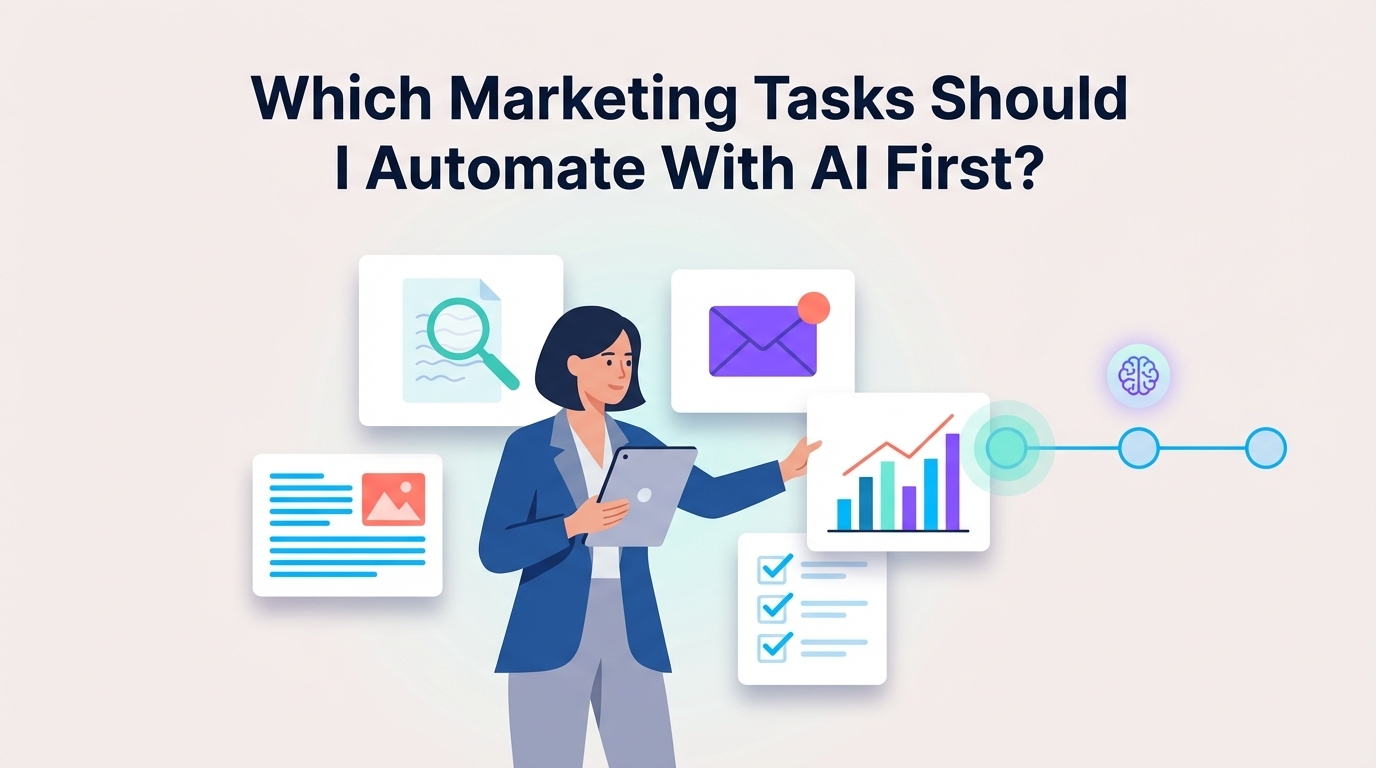
Start by automating high-volume, repetitive tasks that carry low strategic risk. Focus on content ideation, first draft generation, and repurposing. This allows you to learn where AI provides the most leverage while keeping humans in control of final strategy, messaging, and approvals.
TL;DR
- Start Here: Prioritize automating tasks that are time-consuming, repeatable, and have a low risk of brand damage if the output is imperfect.
- Best First Candidates: Content ideation, first draft generation, content repurposing from a single source, and summarizing marketing performance reports.
- What to Keep Human: Core brand strategy, final messaging approval, and tasks requiring deep customer empathy or relationship-building.
- The Goal: Use AI to handle the 80% of manual work so your team can focus on the 20% that requires strategic human insight.
The "Low-Risk, High-Volume" Framework for AI Automation
The key to successful AI adoption in marketing is not to automate everything at once. It is to build momentum by targeting the right tasks first. The best candidates fit the "Low-Risk, High-Volume" framework: tasks that consume significant hours but where an imperfect AI draft does not harm the brand.
Automating these areas first provides immediate time savings, demonstrates clear ROI, and allows your team to develop AI proficiency in a controlled environment. You are not replacing strategists; you are giving them powerful assistants to handle the manual grind.
1. Content Ideation and Research
Before any writing begins, marketers spend hours researching keywords, analyzing competitor content, and brainstorming angles. AI can accelerate this process from hours to minutes.
- Generate a list of blog topics based on a core theme.
- Identify common customer questions from search data.
- Summarize top-ranking articles on a specific keyword.
- Brainstorm contrarian or unique perspectives on a familiar topic.
This use of AI serves as a powerful research assistant, providing the raw material for your team to shape into a coherent content strategy.
2. First Draft Generation
The blank page is one of the biggest bottlenecks in content production. AI excels at creating structured first drafts, turning a single idea into a near-complete piece of content ready for human refinement. While basic tools like ChatGPT can produce generic text, dedicated systems create superior, on-brand output at scale.
For teams serious about efficiency, a system like The Content Engine from the AI Marketing Automation Lab transforms this entire workflow. Instead of writing one-off prompts, you use a system that already knows your brand voice and can generate an entire month of platform-specific content from a single brief.
- Eliminates Repetitive Work: It automates the manual process of creating drafts for blogs, social media, and newsletters.
- Ensures Brand Consistency: The system uses your unique voice and style guidelines for every piece of content it generates.
- Scales Output: It allows you to increase your content velocity without adding headcount, freeing your team for more strategic work.
3. Content Repurposing
One of the highest-leverage marketing activities is repurposing a single piece of core content into multiple assets. This is a perfect task for AI, as it is structured, repeatable, and rule-based.
Give an AI a link to a blog post, webinar transcript, or case study and ask it to:
- Create a 5-post LinkedIn thread summarizing the key takeaways.
- Write three different email newsletter variations.
- Generate a script for a short-form video.
- Extract ten memorable quotes for social media graphics.
Systems like The Content Engine are built specifically for this function, turning one content pillar into a dozen micro-assets automatically. This maximizes the value of your initial content investment with minimal additional effort.
4. Reporting and Data Summarization
Marketing teams often get bogged down in pulling data and formatting reports. AI can connect to your analytics platforms and provide concise, natural-language summaries of performance.
- "Summarize the key trends from our Google Analytics traffic this week."
- "Which ad campaign had the highest ROI last month and why?"
- "Identify the top-performing social media posts based on engagement rate."
This frees up your analysts to focus on interpreting the data and forming strategic recommendations, rather than just compiling it.
What Not to Automate (Yet)
While AI is a powerful tool, certain tasks should remain human-led to protect your brand and strategy.
- Final Strategic Decisions: AI can provide data and options, but the final call on marketing strategy, budget allocation, and brand positioning requires human judgment.
- Core Messaging and Value Propositions: The foundational language that defines your brand should be crafted by people who deeply understand your customers and market.
- Final Content Approval: Never let AI publish content without a final human review. Use it to produce the draft, but the publish button should always be pressed by a person.
By starting with the high-volume, low-risk tasks, you can integrate AI into your marketing workflow intelligently. You will save hundreds of hours, scale your content production, and empower your team to focus on the high-impact strategic work that truly drives business growth.
Frequently Asked Questions
Which marketing tasks should be automated with AI first?
Start by automating high-volume, repetitive tasks that carry low strategic risk, like content ideation, first draft generation, and repurposing. These tasks allow you to leverage AI effectively while keeping control over final strategy and approvals.
What is the "Low-Risk, High-Volume" framework for AI automation?
The "Low-Risk, High-Volume" framework suggests automating tasks that are time-consuming but do not risk brand damage if the AI output is imperfect. This helps gain immediate time savings and demonstrates clear ROI while enhancing AI proficiency in a controlled environment.
What marketing tasks should not be automated by AI?
Tasks such as final strategic decisions, core messaging, and final content approval should not be automated. AI can assist in data gathering and draft generation, but strategic oversight and final approvals need human judgment.
How can AI assist in content ideation and research?
AI can accelerate content ideation and research by generating blog topics, identifying common customer questions, summarizing top-ranking articles, and brainstorming unique perspectives. This serves as a powerful research assistant to support content strategy development.