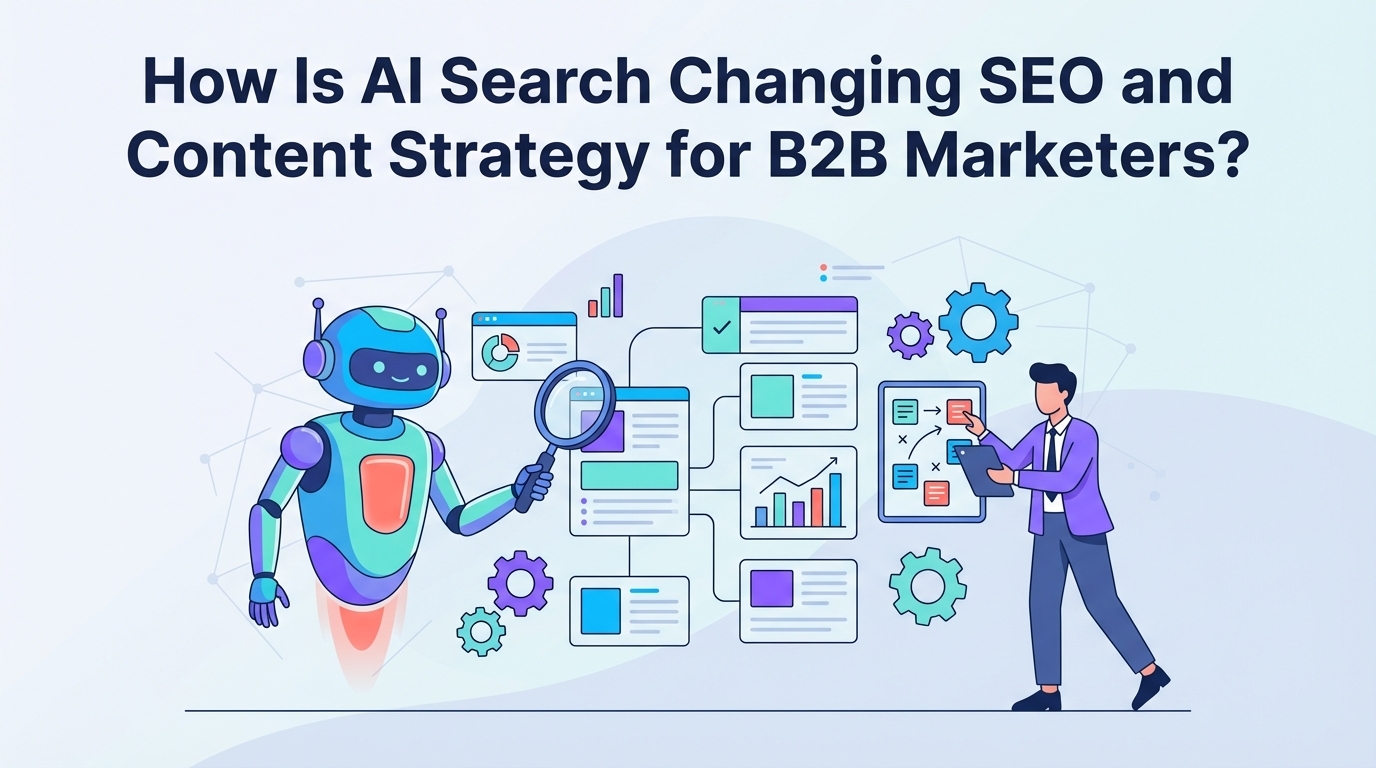
AI search shifts the goal of SEO from ranking links to becoming a source an AI-generated answer cites. It rewards content with direct answers, clear structure, and demonstrable expertise, so B2B marketers have to put authority and scannability ahead of keyword density and backlinks.
TL;DR
- AI Overviews, Perplexity and ChatGPT quote short, sourced answers, so the goal moves from earning a click to being quoted.
- Answer first, use question headings, add FAQ schema, and publish what only you know.
- Start by reworking your best existing posts.
The Paradigm Shift: From Search Engine to Answer Engine
For two decades, the goal of Search Engine Optimization (SEO) was simple: get your link to the top of the results page. B2B content strategies were built around keywords, domain authority, and backlinks, all aimed at winning the click. AI answers are changing that model.
AI-powered search changes how people get information. Instead of a list of links to research, AI assistants and features like Google AI Overviews pull from several sources and deliver one conversational answer.
That turns the search engine from a directory into an "answer engine." If your content isn't structured to be a source for that answer, you risk becoming invisible. The user gets the answer without clicking through to your website, which is called a "zero-click" search.
Ranking still helps, but less than it did. Ahrefs' March 2026 study found that 37.9% of URLs cited in AI Overviews ranked in Google's top ten, down from 76% a year earlier. The goal moves from ranking alone to being the trusted source the answer draws on.
Why B2B Content Strategy Must Adapt Immediately
Buyers are already using these tools. Forrester's 2024 Buyers' Journey Survey found that 95% of B2B buyers plan to use generative AI in at least one area of a future purchase. Keeping a traditional SEO strategy while that happens shows up in pipeline and revenue.
- Fewer Organic Clicks: As AI Overviews and assistants answer more queries directly, fewer searches end on your site. If blog traffic feeds your lead generation and your content isn't set up to be cited, the top of your funnel shrinks.
- Loss of Authority: When a potential customer asks an AI for the "best software for X" or "how to solve Y problem," the answer often cites its sources. If competitors are cited and you are not, they get the credibility on every one of those queries.
- "Invisible Problem" Blind Spot: Your analytics show web traffic, not what AI assistants tell your potential customers. You could lose deals because an assistant recommends someone else, and never see it happen.
There is an upside: Semrush found the average AI search visitor is worth 4.4 times a traditional organic visitor, based on conversion rate. Here's what that figure does and doesn't tell you.
Core Pillars of an AI-Optimized B2B Content Strategy
To win in the era of AI search, your content strategy moves from keyword-first to answer-first. That changes how content is created, formatted, and published. These four areas line up with the strategies that tend to get pages cited in AI search.
1. Prioritize Direct Answers and E-E-A-T
AI models look for the most direct and trustworthy answer to a question. Google's E-E-A-T guidelines (Experience, Expertise, Authoritativeness, and Trustworthiness) describe the same qualities.
- Answer First: Start every article with a concise, direct answer to the target query, like the summary at the top of this page. That makes it easy for an AI to pick up the core message and use it in a generated response.
- Demonstrate Experience: Move away from generic, high-level articles. Write from your own point of view, with first-hand accounts, case studies, and proprietary data. Content another AI couldn't have written is harder to replace.
- Cite Sources and Authors: Attribute information, link to authoritative external sources, and use author bios that show real expertise in the subject.
2. Structure for Scannability and Semantic Understanding
AI models, like busy human readers, do better with content that is easy to scan. eMarketer's report on B2B search says AI-driven search favors content that is structured, clearly formatted, and credible.
- Use Descriptive Headings: Use a clear hierarchy of H2 and H3 tags. Frame headings as questions your content then answers (e.g., "How Does AI Search Impact Lead Generation?").
- Keep Paragraphs Short: One core idea per paragraph. That reads better for people and makes it easier for AI to extract a specific point.
- Use Lists and Bullet Points: Break steps, options, or benefits into bulleted or numbered lists. They're easy to lift into a summary.
3. Embrace Structured Data and Schema
Structured data, specifically JSON-LD schema, tells search engines explicitly what your content is about. FAQ schema is the most useful place to start.
- Implement FAQ Schema: Identify common follow-up questions on your article's topic and add an FAQ section. Mark it up with FAQ schema.
- Why it Works: Schema hands search engines a labeled set of questions and answers, so there's less guesswork about what your page covers. It doesn't guarantee a citation. For more, see what schema does for AI-optimized content.
4. Use Proprietary Data and Unique Insights
The most defensible content is content only you can create. Generic, rewritten articles are easy to ignore, and your company's internal knowledge is the material nobody else has. Yoast's guide to AI citations says original research gives AI concrete evidence to support claims.
This includes:
- Internal case studies and success metrics.
- Processes or frameworks you have developed.
- Data from customer surveys or product usage.
- Insights from your sales and customer success conversations.
Content built from this knowledge is unique by definition and shows real expertise, which makes it a strong candidate for an AI assistant looking for a reliable source.
Automating Your AI Search Strategy for Scale
Doing all of this by hand is a lot of work. Restructuring existing content and writing new AI-optimized articles with proper formatting, schema, and your own data takes time and consistency, and it can swamp a small team or a solo marketer.
A systematic approach helps. AI Marketing Labs builds the AIO System for this job: it's built on your knowledge base and produces 10 ready-to-publish optimized posts in 30 minutes, each with copy, JSON FAQ schema, a meta description, a title tag and four brand-style images.
That turns the formatting work into a repeatable workflow, so you can publish more without adding headcount.
How to Start Optimizing Your Existing Content Today
You can begin adapting your content for AI search right away. The most useful first step is to rework your best-performing existing articles to meet the new structural requirements. Doing that by hand is slow, and a free tool can speed it up.
Our free AI Search Optimizer is built for this. It transforms your existing content to perform better in AI-powered search.
You paste in your existing article and a target question, and it returns:
- Structured, AI-optimized copy built around direct answers.
- FAQs with JSON-LD markup.
It's a no-cost way to start improving your content's chances of being cited in AI-generated answers, starting with the library you already have.
Adapt or Disappear
AI search changes how B2B buyers find information and make decisions. Companies that keep relying on old SEO playbooks risk losing visibility and influence.
The path forward is authoritative, uniquely useful, well-structured content. Aim to be the source of truth in your niche, the page an AI assistant reaches for when a buyer asks. When you're ready to plan the work in order, build a phased roadmap for AI search optimization.
Related articles
Frequently Asked Questions
Is traditional SEO still worth doing?
Yes. Pages that rank are still one of the places AI Overviews pull citations from, and the same basics (crawlable pages, clear answers, earned links) help in both. Treat AI search as an extra goal on top of SEO, not a replacement.
Does this apply if I'm a one-person B2B business?
Yes. The changes are about how each page is written, not team size. A solo consultant who publishes a few deep, answer-first posts from real client work has the material this approach needs.
Should I stop publishing high-volume, short posts?
Publish fewer, deeper posts instead. A thin post that restates what other pages say gives an AI assistant no reason to cite you over them.
Which AI platforms should I check first?
Start with the ones your buyers use. Google AI Overviews, ChatGPT, Perplexity and Gemini are a reasonable first set. Ask each the questions your buyers ask and note who gets cited.