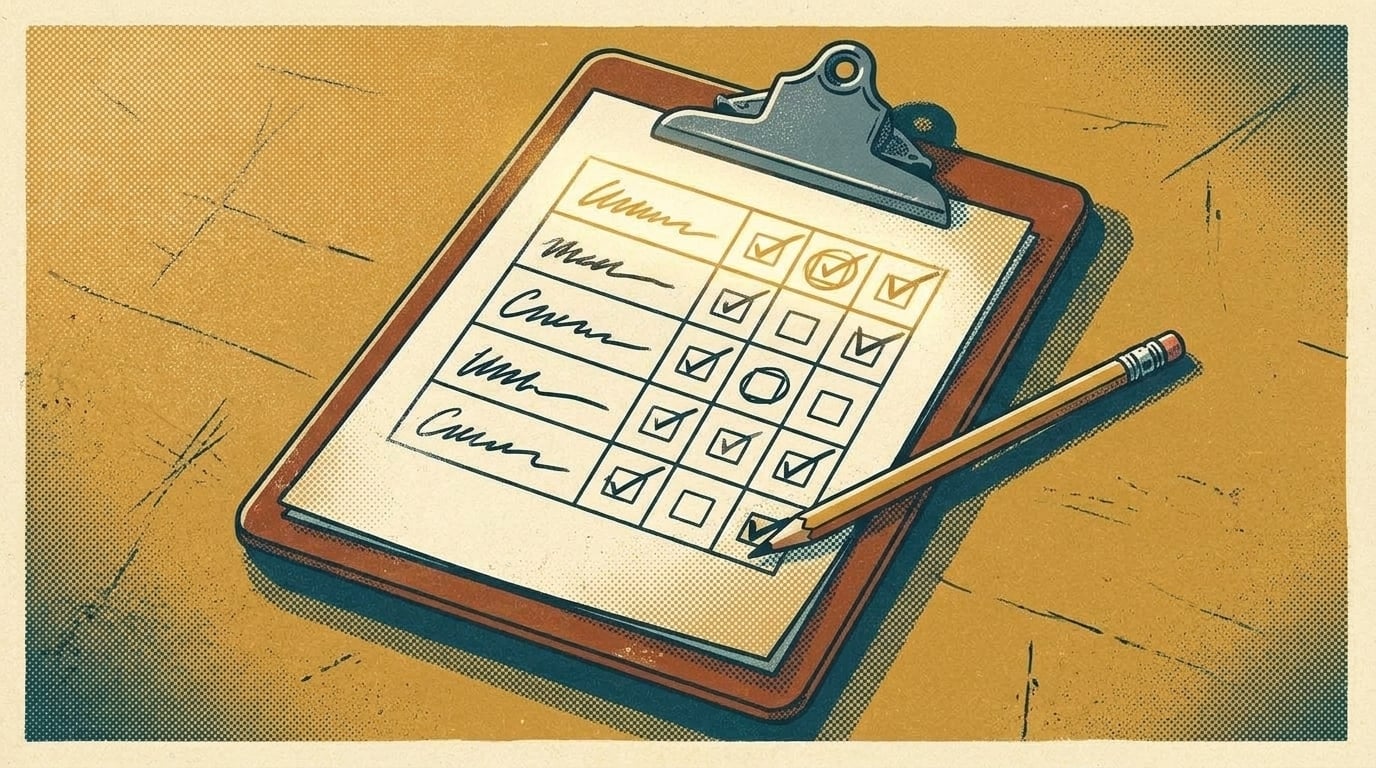
A useful AI readiness assessment for a small business scores tasks, not the whole company. Pick your three most repetitive tasks and rate each one on five checks: how often it runs, whether its inputs live in one place, whether one person owns it, whether you can tell a good result from a bad one quickly, and how cheap a mistake is to catch. The highest score is where AI starts. All you need is a spreadsheet and an afternoon.
TL;DR
- Enterprise frameworks score departments you may not have. Score tasks instead.
- A task that fails on inputs needs a cleanup before it needs AI.
- The result is one task to start with and a short list of fixes.
Why don't the big readiness frameworks fit a small business?
They were built to compare large organizations. Cisco's readiness tool, for example, scores six dimensions: strategy, infrastructure, data, governance, talent and culture. The index behind it surveyed leaders at organizations with over 500 employees across 26 industries.
Those are fair questions for a company with an IT department and a data team. For a ten-person business or a solo practice, most of them collapse into one: is there a specific task that AI can take on, using information you already have, with someone to check it? That question you can answer yourself.
Which tasks should you assess?
Start with where the hours go. Write down every task that you or your people do at least weekly and that follows roughly the same steps each time: answering quote requests, writing up call notes, chasing invoices, building the weekly report, sorting intake forms. Put a rough hours-per-week number beside each one. A guess is fine for now.
Then keep the three with the most hours. Don't add the task you find most interesting or the one a vendor demoed well. The point is to find where AI would pay off, and that's where the time is.
What goes on the AI readiness checklist?
Score each of your three tasks from 0 to 2 on these five checks. A 2 means the task clearly passes.
| Check | The question | 0 | 2 |
|---|
| Frequency | How often does it run? | A few times a year | Daily or several times a week |
| Inputs | Does the information it starts from live in one place? | Scattered across email, paper and memory | One inbox, form, folder or system |
| Ownership | Is one named person responsible for it? | Whoever gets to it | One person, who'd check the output |
| Clear result | Can you tell a good result from a bad one quickly? | Only by waiting weeks to see | At a glance, or against a known answer |
| Cost of a mistake | What happens if it's wrong once? | Money or a client lost | A person catches it before it goes out |
Give 1 for anything in between. Add the scores. Ten is the top, and anything that scores 0 on inputs or ownership goes to the bottom no matter its total.
How does the scoring play out?
Take an illustration, not a client example. Answering common customer questions by email scores 2 on frequency, 2 on inputs (one inbox), 2 on ownership, 2 on clear result and 2 on mistake cost, because someone reads each reply before it's sent. That's a 10. The monthly report pulled from three systems scores 0 on frequency, 0 on inputs and 1 on ownership. It might save more hours on paper, but it's a poor first task.
That gap is the useful part of the exercise. The task with the most hours isn't always the one that's ready.
What if a task scores low on inputs?
Fix the inputs before you buy anything. Gartner has predicted that through 2026, organizations will abandon 60% of AI projects unsupported by AI-ready data. In the same release, 63% of the data management leaders it surveyed said they either don't have, or aren't sure they have, the right data practices. That research is about large organizations, but the lesson travels.
For a small business, the cleanup can be modest and specific: one customer list instead of three, one shared folder for quotes, a form that replaces free-text emails. It's still worth doing first, and it can save time before any AI is involved.
What else should you check before you start?
- Access. Are the accounts for the software involved in the business's name, with an admin you can reach? A tool tied to a former employee's login will stall a project fast.
- What you already pay for. Your email, CRM or accounting tool may already include AI features. Check before adding a subscription.
- Time from the owner of the task. Whoever does the work today needs an hour or two to show how it runs and to test the first version.
If you'd like a dollar figure next to the score, run the numbers on what the top task is worth before you automate it.
What should the finished assessment look like?
One page. Your three tasks with their hours and scores, the one you'll start with, and a short fix list for anything that scored 0 or 1 on inputs, ownership or access. Add the date you'll run it again. If someone outside the business is going to help, that page is the brief: it shows them where the time goes and what's ready, which saves the first hour of any conversation.
Keep the version you scored today. When you run it again after the first task is live, the change in scores is a quick read on whether the cleanup worked.
What do you do with the result?
Start with the top task, and only that one. You can try it yourself, starting with the first workflows worth building with AI automation. If the scores were hard to call, or the top task needs your systems connected, that's where outside help earns its fee. AI Marketing Labs runs consulting as one-on-one work with Rick Kranz, starting by looking at how your business actually runs and picking the place where AI is worth doing first. For what that kind of help should leave you with, see what a good AI consultant should hand over.
Related articles
Frequently asked questions
How often should I run an AI readiness assessment?
Run it again after the first task is live, or when the business changes in a way that shifts where the hours go. Scores move once you've cleaned up inputs or named owners.
Can I run this assessment alone, without my team?
You can draft it alone, but check the scores with whoever does each task. They know where the inputs really live and what goes wrong, and their scores beat a guess from above.
What total score is high enough to start?
Treat the scores as a ranking, not a pass mark. Start with your highest-scoring task, as long as it doesn't score 0 on inputs or ownership.