What a Good AI Consultant Should Leave You With

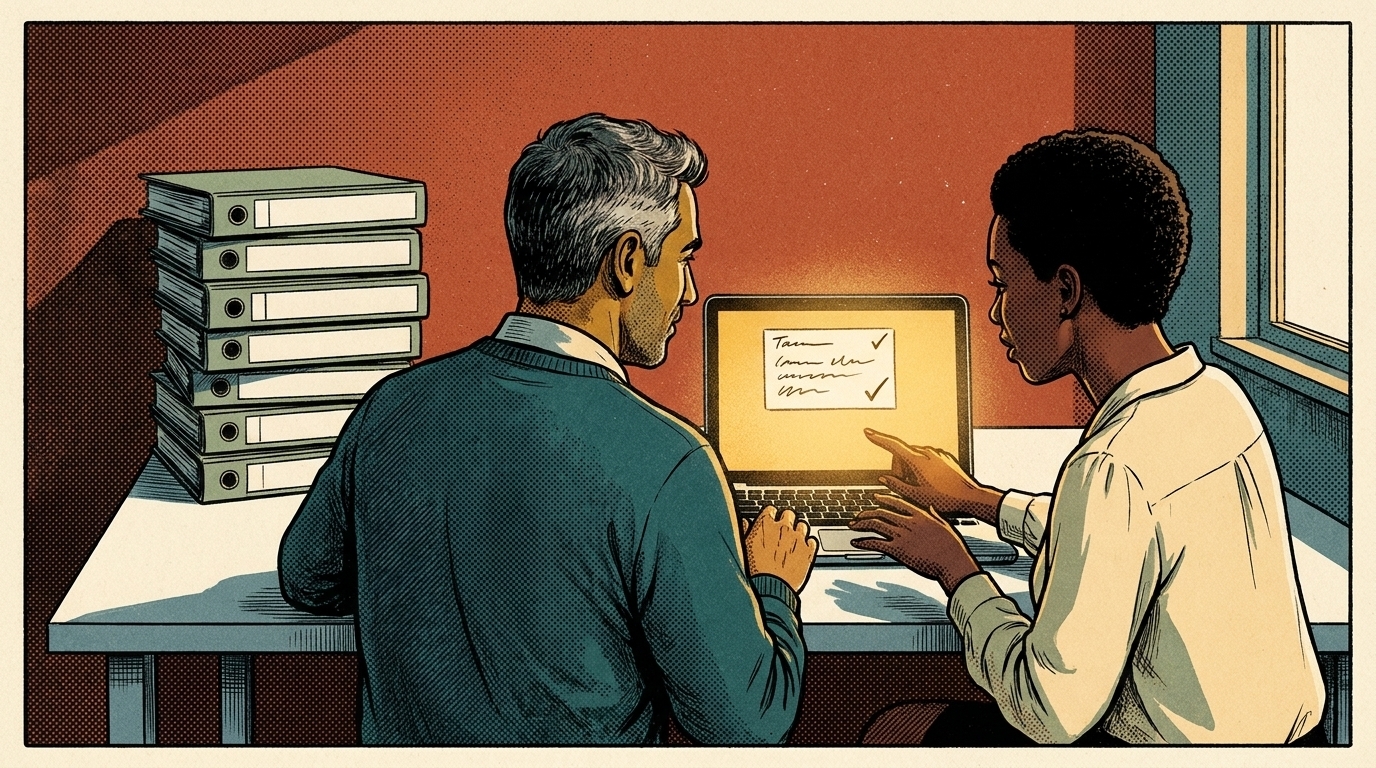
What a good AI consultant leaves you with depends on what you hired them to do. A clear decision on where to start, an approach you can act on, a stuck project moving again, people who use AI in their real work, or a working system you own: each is a fair result when it's the one you agreed to. Settle which one before any work starts, and get it in writing.
TL;DR
- Agree on the end point first: a decision, an approach, an unstuck project, trained people, or a working system.
- If the scope includes a build, get ownership, logins, and a maintenance document in writing, and hold the final payment until handoff.
What is AI consulting, and what should it produce?
AI consulting is paid outside help to work out where AI fits in your business and, depending on the scope, to help you build it. Some engagements are advice: where to start, which approach to take, a second opinion before you spend. Some are troubleshooting a build that stalled. Others end with a system built and handed over. Any of these can be worth buying, as long as you know which one you're paying for and what you'll have when it ends. That end point is what this post is about. For the fuller answer, including how it differs from paying for AI software, see what AI consulting is and how it differs from buying software. If you want a picture of the job itself, here's what an AI consultant actually does in a normal week.
AI Marketing Labs offers AI consulting as dedicated work with Rick Kranz, scoped around what you need. That can mean advice on where to start, a review of an approach, help getting a stuck project moving, building alongside you, or training the people who'll use it.
What should you own when the engagement ends?
If the scope includes a build, ask for this list in writing before any work starts. If a consultant won't commit to it, you find out before you've paid for anything.
- A system that runs on real work. Not a demo on sample data. It should be handling the actual quotes, emails, or intake forms it was built for, and the people doing that work should be using it without the consultant on the call.
- Your accounts and your logins. The automations, the AI accounts, and the data should sit under your business, with admin access in your name. If the consultant's agency owns the account, you're renting.
- A maintenance document. Plain language: what each step does, where it tends to break, and what to check when it does. The test is whether a different freelancer could pick it up next year.
- Trained people. Whoever runs the process every day, you or someone you work with, should be able to adjust it. One recorded training call that nobody rewatches doesn't count. If your team is wary of AI to begin with, start with training built for people who don't trust it yet.
- A before and after number. Hours a week on the task, turnaround time, errors caught. Measure it before the build starts, so the result isn't a feeling.
- Support terms in writing. What happens when something breaks in month three, who fixes it, and what that costs.
Turn that list into the scope of work, with a date on each line. Then ask to see a maintenance document from another project. A consultant who has handed off real systems should have one. The work itself should move through four stages from first call to handoff, and each line of the scope should map to one of them.
An advice engagement needs the same discipline with a shorter list: the decision or recommendation you'll walk away with, the reasoning behind it, and the next step you can take on your own or with someone else. For strategy work, here's what you should have on paper when it ends.
Why do so many AI projects end with nothing running?
Because the plan is the easy part, and a tool that sits beside the work is easy to ignore. MIT's Project NANDA reviewed more than 300 publicly disclosed AI initiatives from the first half of 2025 and found that only 5% of integrated AI pilots were extracting millions in value, while the vast majority showed no measurable impact on the P&L. The report names a core reason: most of these systems "do not retain feedback, adapt to context, or improve over time."
That research looked at enterprise AI. A ten-person shop or a solo practice has less room for a pilot that doesn't ship, which is the reason to agree on the end point up front instead of hoping for it at the end.
What does an AI consultant cost?
Price follows the scope. A May 2026 career guide on the University of Miami's career site lists typical ranges: strategy assessments at $5,000 to $25,000, workflow implementation projects at $5,000 to $75,000, team training at $2,000 to $15,000, and fractional AI officer retainers at $3,000 to $15,000 a month (How to Become an AI Consultant). Treat those as one guide's read on the market, not quotes. For published hourly rates and what moves a quote up, see what AI consulting companies charge.
Inside those ranges, a build's price moves with how many of your systems the workflow has to touch, how messy the data going into it is, and how many people need training to run it. A build that reads one inbox and writes to one spreadsheet costs less than one that pulls from your CRM, your accounting software, and a shared drive.
The number to push on is what you pay after the engagement. A system stitched together from subscriptions the consultant picked can cost more each year than the build did. Ask for the monthly cost of every tool in the proposal, and ask what happens to the system if you stop paying the consultant.
What should the proposal say before you sign?
A proposal tells you what the consultant thinks they're selling. Read it for four things.
- Deliverables you can point at. "AI strategy" and "implementation support" aren't deliverables. "A recommendation on which of our three intake processes to automate first, with the reasoning" is. So is "intake form answers sorted and routed to the right person, running on our inbox by week six."
- An acceptance test. For a build, agree on what the system has to handle before the final payment: a set number of real quotes, emails, or tickets processed correctly while you watch. If it can't pass on your work, it isn't done.
- Ownership language. The contract should say the workflows, prompts, code, and accounts belong to you once you've paid. If it's silent, ask. If the answer is a license, you'll be paying for access to your own process.
- Payments tied to milestones. A deposit to start, a payment when the first version runs on real work, and the last payment at handoff. Paying most of the fee up front weakens the reason to finish.
What should make you walk away on the first call?
You can learn a lot in thirty minutes if you listen for what the consultant asks about. A good one spends the call on your problem: who touches the work, where it waits, what it costs you when it's late. Be wary when the call goes the other way.
- They name a platform before they've asked how the work gets done. That can mean they resell it.
- They can't describe a system they built that a client still runs today.
- They want a monthly retainer before anything is scoped.
- Every answer to "who owns it afterward" gets vague.
None of these prove bad intent. They do tell you the engagement is set up to keep you coming back rather than to leave you running on your own. Before you sign with anyone, vet the firm on what it has already built: call a reference who uses the system every day, and read the contract for who owns your data. And if someone wants to add governance work to the scope, check whether a business your size needs an AI governance consultant first.
How do you get the right help and a good first month?
Match the kind of help to where you're stuck before you compare firms. A single working session, a plan, a build alongside you, and team training each end in something different, and which AI consulting services fit which problem lays them side by side. Before you shortlist anyone, work out which of the four types of AI consulting firms fits your business. If you've already tried ChatGPT and stalled, the gap is usually the setup around the tool, not the tool itself; here's what consulting adds after you've tried ChatGPT.
Not sure you're ready to hire anyone yet? Score your own tasks first with an AI readiness assessment you can run in an afternoon. If you'd rather have someone else look, here's what an AI audit should tell you before you buy anything. If you'd like an outside opinion before committing to more, start small: here's what one consulting session can get you.
Once you've hired someone, the first month should go to one task, not ten. What a consultant should do in the first month walks through it week by week, and a 90-day AI roadmap stretches the same one-project approach across a quarter. If there are several candidate projects, ask how the consultant ranks your first three projects, and ask to see the scoring. And if the approach is already settled and what you need is build hours, compare an implementation consultant with an AI developer before you sign. If what you want built is an AI agent, see when paying an agent consultant makes sense.
When is paying for advice alone the right call?
When advice is what moves you forward. That covers more situations than people expect: you don't know which problem to solve first, you want a second opinion on an approach before you spend on it, you're building it yourself and hit a wall, or you plan to run the build in-house and want an experienced person to check the plan. Keep that work scoped and fixed, and make its output something you can act on: one named problem to start with, a recommended approach, or a clear next step past the roadblock. A roadmap of twelve initiatives is a sign the work went too wide.
A quick way to tell whether you need an AI strategy consultant or someone who builds: if you can name the process, who does it, and how many hours it eats, you're ready to build, with help or on your own. And if you're choosing between an AI specialist and a general consultant who has added AI, pick by the problem, not the title.
If you're still deciding whether you need outside help at all, start with when to hire an AI consultant for a small business. And if you already have a plan that never got built, bring it to whoever helps next and ask which single item they'd start with.
Related articles
- Whether to hire an AI consulting firm or one consultant
- What to bring to your first AI strategy session
- When a good consultant tells you to skip AI
- Getting your team using AI every day
- How long an AI consulting project should take
- An AI implementation strategy with no IT team
- What an AI consultant does in the first month
- Which AI consulting services fit which problem
Frequently asked questions
Should I pay an AI consultant hourly or a fixed price?
Pay a fixed price for a scoped build, because you know what you're getting and the consultant carries the risk of going over. Hourly makes sense for open-ended advice, like a few working sessions to decide what to build first.
What's the difference between an AI consultant and an AI agency?
An AI consultant can be one person who advises and sometimes builds. An agency is a team that builds and may also maintain systems for you. Either can work. What matters is whether you get the result you agreed to and, for a build, whether you can run it without them.
What happens if the consultant disappears after launch?
If the accounts are in your name and the maintenance document is any good, another builder can pick it up. If the accounts are in the consultant's name, you may have to rebuild. That's why ownership belongs in the contract, not in a handshake.
Can an AI consultant work with the software we already use?
A good one should build on it. Ask which of your current tools they plan to connect, which new subscriptions they'd add, and why each one is needed.
Talk it through with Rick
One-on-one AI consulting with Rick Kranz. It starts with your problem, covers anything from finding where AI fits to building the fix, and the scope and fee are agreed before any work begins.

With over 15 years of marketing experience, Kelly is an AI Marketing Strategist and Fractional CMO focused on results. She is renowned for building data-driven marketing systems that simplify workloads and drive growth. Her award-winning expertise in marketing automation once generated $2.1 million in additional revenue for a client in under a year. Kelly writes to help businesses work smarter and build for a sustainable future.